


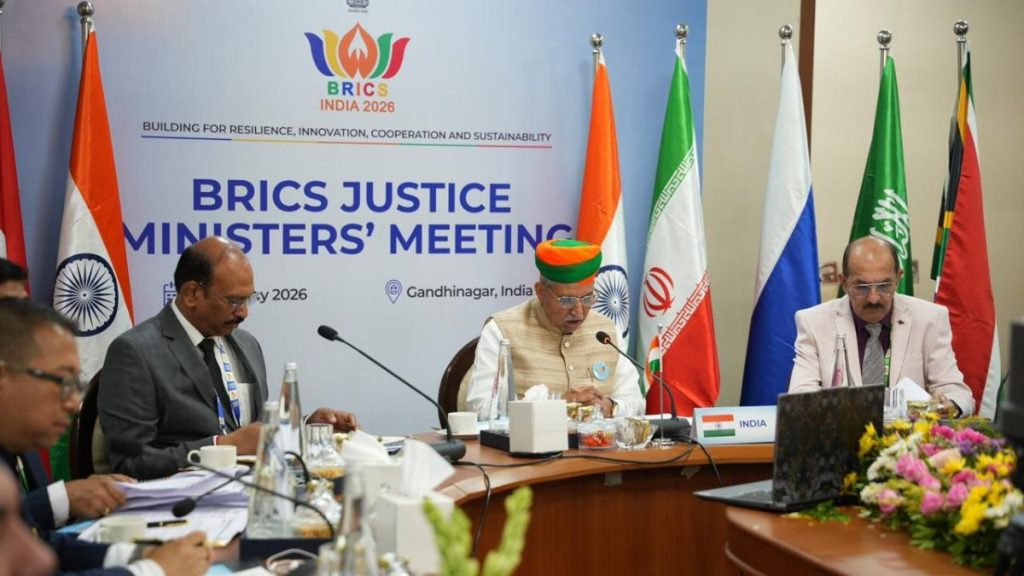
BRICS Justice Ministers, who met in Gandhinagar under India’s presidency on Thursday (May 21, 2026), agreed unanimously on the importance of strengthening the Alternative Dispute Resolution (ADR) mechanisms, particularly through enhanced cooperation and capacity building in mediation and arbitration.
India, which chaired the meeting, called for a united effort to combat terrorism in all its forms and manifestations, expressing concern over cross-border terrorism.
The meeting, with representatives from BRICS nations arriving for the ministerial meeting, followed the senior officials meeting held on Wednesday (May 20), when they finalised the joint declaration text titled ‘Declaration of Ministers of Justice of BRICS countries on Strengthening Alternative Dispute Resolution through Capacity Building in Mediation and Arbitration’.
The senior officials met in the hybrid mode, and the meeting had participation from Brazil, China, Egypt, Ethiopia, Iran, Indonesia, Russia, South Africa, the United Arab Emirates, and, apart from the chair, India.
Following extensive and constructive consultations among member nations, the Declaration was placed before the Ministers of Justice for formal adoption.
Earlier, in a statement, the Ministry of Law and Justice said the meetings underscored India’s leadership in promoting ADR as a core component of modern legal-system reform and as a vital tool for delivering accessible, speedy, and affordable justice to citizens.
It further noted that the BRICS Justice Ministers would promote dialogue and cooperation on ADR, particularly mediation and arbitration, by facilitating the exchange of best practices, policy approaches, and institutional experiences.
They would also strengthen professional capacity and institutional ecosystems through training, professional exchanges, joint workshops, and knowledge-sharing platforms for mediators, arbitrators, judges, government legal officers, and legal professionals.
The ministers would enhance court-referred and pre-litigation mediation, fostering institutional cooperation among arbitration centres, mediation institutions, and legal training bodies.
They would leverage digital technologies to improve accessibility and efficiency, support cooperation on cross-border commercial disputes, advance legal research and comparative study of BRICS jurisprudence to harmonise laws on trade and environment, and promote training for government legal officers.
Meanwhile, in New Delhi, Ministry of External Affairs Secretary (West) Sibi George expressed India’s concern over cross-border terrorism and called for concerted and united efforts to combat terrorism in all its forms and manifestations.
Delivering his keynote address at the 11th Annual BRICS Counter Terrorism Working Group (CTWG) Meeting, George emphasised the need for a robust collaborative approach to tackle the challenges to counter terrorism, like evolving terror funding mechanisms, radicalisation, and the use of new and emerging technologies for terrorism.
He called for adopting a zero-tolerance approach to terrorism, he appealed for strengthening the existing global counterterrorism architecture through active, comprehensive, and sustained global efforts and international cooperation, the MEA said in a statement posted on X.
George stressed the need to make BRICS CTWG more resilient, future-ready, innovative, inclusive, and outcome-oriented. He also reaffirmed India’s commitment to further deepen cooperation with BRICS member countries for a secure and terror-free world.