


New Delhi: Four passenger flights were caught up in bomb alerts across Europe on Tuesday, which prompted aircraft searches and a temporary airport closure as authorities investigated whether the threats were connected. Separately, the president of Ukraine, Volodymyr Zelenskyy, arrived in Berlin to seek stronger air defences and energy support before renewed negotiations involving Kyiv, Moscow and Washington.
The aviation incidents affected two Warsaw-bound services, a flight to Murcia in Spain and another arriving in the Bulgarian capital, Sofia. All four aircraft landed safely, with subsequent reporting indicating that searches had found no explosives on the affected planes.
The alerts unfolded during a separate round of European diplomacy over Russia’s war in Ukraine, with Berlin hosting Zelenskyy and Brussels preparing consultations involving Ukraine’s principal partners. The available reporting established no connection between those diplomatic engagements and the aircraft threats.
Two Warsaw-bound flights searched
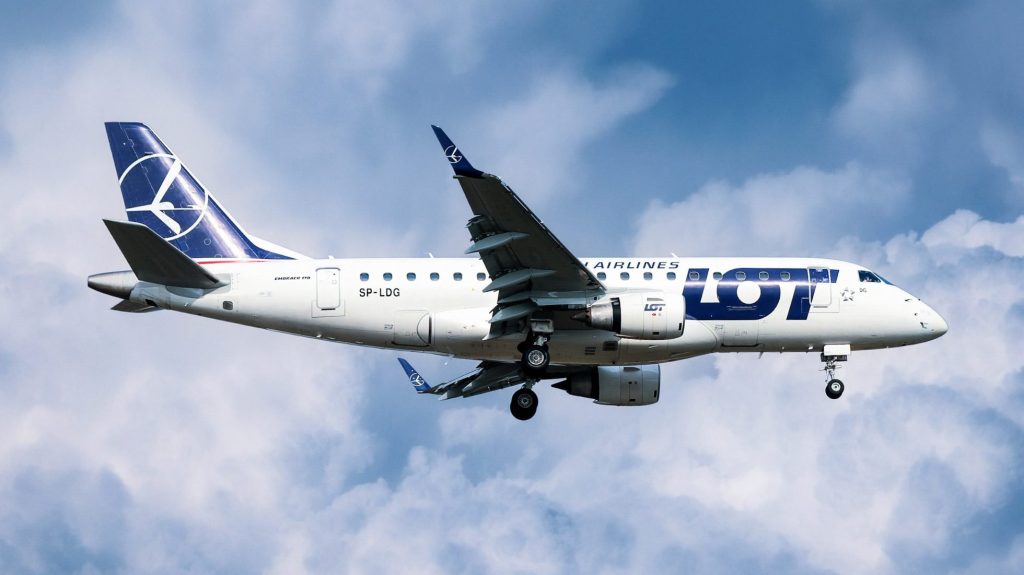
A LOT Polish Airlines Boeing 737 MAX carrying 181 people from London Heathrow to Warsaw Chopin airport diverted to Warsaw-Modlin after a bomb warning. According to the airport’s account, reproduced by Reuters, the alert was raised at 9.54am local time and the aircraft landed at 10.01am.
Modlin temporarily suspended operations while emergency services assessed the threat and passengers disembarked for security checks. Flights subsequently resumed, although the area containing the aircraft initially remained restricted while passengers and crew waited in the arrivals hall.
Authorities later cancelled the London flight’s bomb alert, restoring normal operations at Modlin. Separately, an SAS service from Copenhagen landed safely at Warsaw Chopin, where passengers disembarked and security personnel examined the aircraft.
Polish authorities said the threat involving the SAS aircraft had not been substantiated, while Chopin continued operating during the checks. Investigators had not established whether the two Warsaw incidents were linked, Reuters reported.
Spain gives all-clear, Bulgarian reports revise flight’s origin
In Spain, a Ryanair service from Manchester landed at Murcia’s international airport, where 114 passengers and seven crew members disembarked following a bomb threat. The Spanish government’s representative in Murcia, Francisco Lucas, said emergency procedures had been activated and security personnel were inspecting the aircraft.
The Guardia Civil subsequently ruled out the presence of explosives, and Lucas said the airport would operate normally. Passengers and crew had been taken to an isolated area for screening while emergency services and a crisis committee coordinated the response.
Reporting on the Sofia incident changed during the day: initial accounts identified the aircraft as arriving from Israel, but updated Bulgarian reports described a flight from Bergamo in Italy. Bulgarian National Television revised its headline accordingly, while later local coverage, citing information from the interior ministry, said the aircraft search had found no explosive device.
The interior ministry’s acting secretary-general, Lyubomir Nikolov, said emailed bomb warnings had targeted several institutions as well as an aircraft associated with Sofia airport. He said officers were responding under established procedures and that there was, at that stage, no information indicating specific terrorist intentions or actions.
The incidents followed a similar disruption on November 2, when a Wizz Air flight from London Luton to Sofia diverted to Budapest after receiving a threat during the journey. Security checks found nothing, and the aircraft subsequently continued to Sofia.
Zelenskyy seeks air defence and winter support
In Berlin, the German chancellor, Friedrich Merz, welcomed Zelenskyy with military honours before talks at the federal chancellery. The programme included discussions between the two delegations, with Zelenskyy also scheduled to meet the German president, Frank-Walter Steinmeier, and the Bundestag president, Julia Klöckner.
Zelenskyy identified diplomatic coordination, stronger air defences and assistance for Ukraine’s energy sector as the priorities of his visit. He was also due to participate in the Berlin Security Conference, bringing his appeal for support before European officials and defence specialists.
The immediate military requirement includes additional interceptors to counter Russian ballistic missiles, while energy assistance is intended to help Ukraine sustain electricity supplies through winter. Germany has said it has already supplied as many Patriot systems as it can spare without compromising its own air defences, illustrating the constraints facing further transfers.
Merz presented the visit as a demonstration of support, referring to Zelenskyy’s confrontation with the US president, Donald Trump, at the White House in February 2025. Speaking to business leaders before the meeting, he indicated that the Ukrainian leader would receive a different reception in Berlin.
The talks followed an earlier German commitment to expand assistance: during a visit to Kyiv on October 4, Merz announced a package worth more than €1.3 billion. According to the Ukrainian presidency’s account, that meeting also addressed defence requirements and energy infrastructure ahead of winter.
Russian strikes sharpen Kyiv’s appeal
Zelenskyy’s visit came after another large Russian aerial assault, which he said involved 289 attack drones, 59 cruise missiles and 17 ballistic missiles. Power-generation facilities and substations across nine regions were among the principal targets, causing emergency electricity cuts in several cities and communities.
Ukrainian authorities said a hospital in Kharkiv was hit, injuring at least 73 people and damaging its cardiology department. Regional prosecutors said 226 patients had to be transferred to other hospitals, underlining the pressure that attacks on medical facilities were placing on the city’s health services.
Separately, the reported death toll from the Monday attack on Komyshuvakha, in the Zaporizhzhia region, rose to 31, superseding the earlier figure of 29. Regional authorities said nearly 50 people remained missing after strikes hit a school used for humanitarian aid distribution and a shelter, with search-and-rescue work continuing.
Zelenskyy drew attention to the timing of the latest barrage on the day of US congressional elections and urged Washington to help Ukraine defend its skies. His remarks linked the immediate demand for protection against further attacks with the diplomatic effort to secure a durable peace.
Brussels consultations before Abu Dhabi negotiations
The Kremlin confirmed that Russian, Ukrainian and US representatives would hold trilateral talks in Abu Dhabi on November 10–11. The Kremlin spokesman, Dmitry Peskov, said the Russian delegation would be led by Vladimir Medinsky, an aide to the Russian president, Vladimir Putin.
Before those negotiations, the European Commission will host a meeting on November 4 involving representatives of Ukraine, the United States, France, Germany, the United Kingdom, Nato and the World Bank. The commission’s chief spokeswoman, Paula Pinho, said the discussions would address Ukraine’s post-war reconstruction and prosperity, building on earlier consultations in Miami.
Pinho did not confirm which US officials would attend and said she had no information about a possible visit to Brussels by Zelenskyy. Separately, European reporting said consultations that week would also cover security guarantees for Ukraine, a central issue in preparations for a possible settlement.
Elsewhere in Europe, Sweden’s parliament rejected the Centre Party leader, Elisabeth Thand Ringqvist, as prime minister by 324 votes to 25, marking a second failed government-formation attempt since the September election. The caretaker prime minister, Ulf Kristersson, will now have a week to explore a government; two further failed parliamentary nominations would trigger an extraordinary election.