


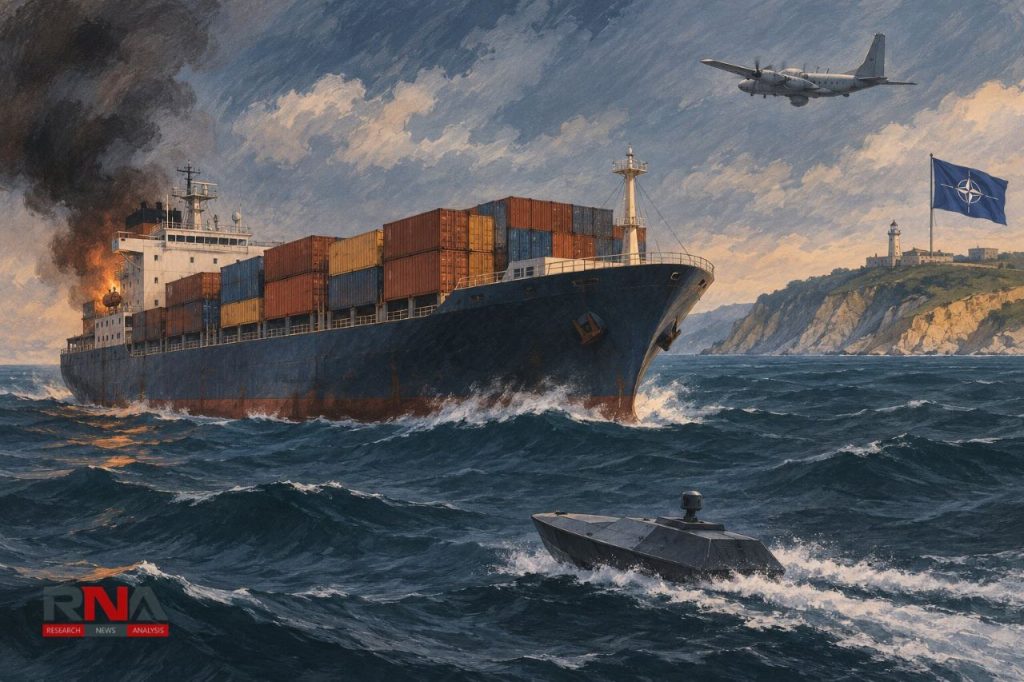
New Delhi: A succession of attacks on merchant ships off Romania and Bulgaria is bringing the Russia-Ukraine war closer to Nato’s shores, prompting additional surveillance deployments along a vital commercial waterway. The sinking of a container ship in Bulgaria’s exclusive economic zone has sharpened concerns about the alliance’s ability to protect shipping without becoming directly involved in the conflict.
The Liberian-flagged, Greek-managed Contship Jet sank after being struck by three maritime drones on October 28 while travelling from Haifa, Israel, to the Romanian port of Constanța. All 18 crew members – 14 Filipinos and four Ukrainians – were rescued and taken to Varna, according to Euronews on Monday.
The attack occurred as defence ministers from Bulgaria, Romania and Turkey met in Sofia to discuss regional security. They condemned attacks on commercial vessels and agreed to strengthen intelligence sharing, early warnings and coordination, while Bulgarian naval teams reported no signs of pollution despite hazardous materials aboard the ship.
A widening pattern of attacks
The sinking followed several serious incidents along the western Black Sea’s shipping routes during October. A Reuters chronology records two crew deaths aboard the Royad Mammadov on October 5 and 12 people missing after the Alfa Watan sank the following day.
On October 13, the Chelsea 3 was damaged and the HS Dignity sank, with 11 crew members from the latter reported missing. The next day, the tanker Yara J was hit inside Romanian territorial waters, while the Wine Trader was struck on October 15 just outside them.
Responsibility remains a crucial unresolved issue in individual cases: Nato’s October 20 announcement did not formally attribute the attacks to a country. Analysts cited by Reuters suspect Russia, but Moscow denies targeting Ukraine’s neighbours, and Romania has emphasized the need for forensic evidence before assigning responsibility for specific incidents.
Nato reinforces surveillance
Nato announced on October 20 that it would send additional maritime patrol aircraft, radar systems and drones to the Black Sea after its North Atlantic Council discussed the deteriorating security situation. The response also included intelligence personnel and specialists able to examine explosive remnants, reflecting the need both to detect threats and establish who was behind them.
France has already temporarily deployed an Atlantique 2 maritime patrol aircraft to Romania’s Mihail Kogălniceanu air base. According to a Romanian defence ministry, the aircraft arrived on October 18 and is scheduled to conduct surveillance over the western Black Sea until November 6.
Its mission includes identifying navigational dangers and improving protection for critical infrastructure in Romania’s exclusive economic zone. Romania has also increased patrols involving ships, helicopters and drones, while issuing updated advice to mariners on hazards and recommended routes.
Why the location of an attack matters
The distinction between territorial waters and an exclusive economic zone is central to understanding the security implications. Under the United Nations Convention on the Law of the Sea, a coastal state has sovereign rights over resources and specified activities in its exclusive economic zone, but other states retain navigation and overflight freedoms; this differs from sovereignty over territorial waters.
An attack on a foreign merchant vessel in such a zone therefore cannot automatically be treated as an attack on the coastal state’s territory. Assessing its implications for Nato requires consideration of the circumstances, attribution and the alliance’s treaty obligations, rather than proximity to a member’s coastline alone.
Nato’s Article 5 collective-defence commitment treats an armed attack against one member as an attack against all. However, it does not prescribe an identical military response from every ally: each takes the action it considers necessary, which may include armed force.
The navigational danger also extends beyond deliberately targeted strikes. The US Maritime Administration’s current regional advisory warns of drifting mines, misidentification and accidental impacts caused by electronic warfare interfering with missile or drone guidance systems.
Grain trade and energy infrastructure exposed
The economic damage reaches both belligerents: Reuters reported that 317 merchant and other vessels were hit across the Black Sea and Sea of Azov between May and October, citing maritime intelligence firm Ambrey. Russian grain exports through those waters fell to 300,000 tonnes in September from 4.74 million tonnes a year earlier, while Ukrainian port grain exports declined to 810,000 tonnes from 2.1 million tonnes.
Ukraine’s suspension of Black Sea port operations in late July redirected cargo towards Danube ports and Romania’s Sulina Canal. That diversion has increased the importance of shipping routes close to Nato territory, linking the protection of commercial traffic more closely to the alliance’s regional security concerns.
Romania also has substantial offshore energy investments to protect, including the Neptun Deep gas development operated by OMV Petrom in partnership with Romgaz. In its September project update, OMV Petrom said first gas was expected in the first half of 2027, with annual production at plateau estimated at about eight billion cubic metres.
Maritime ceasefire efforts
Turkey, Egypt and India have pushed for maritime ceasefires, according to Reuters, as shipping disruption threatens food and fuel supplies. Russia has rejected a limited maritime truce, arguing that it would give Ukraine respite, leaving the diplomatic initiative without an agreement.
Turkey’s role is particularly significant because passage through the Bosphorus and Dardanelles is governed by the Montreux Convention. Its restrictions include limits on the tonnage and length of stay of warships belonging to countries without a Black Sea coastline, shaping the options for an outside naval presence.
For commercial operators, the immediate challenge remains keeping crews and cargo safe while the military and diplomatic responses develop. The US Maritime Administration advises vessels operating in the region to reassess risks, review protective measures and follow current navigational warnings – precautions that underline how widely the conflict now affects civilian shipping.