


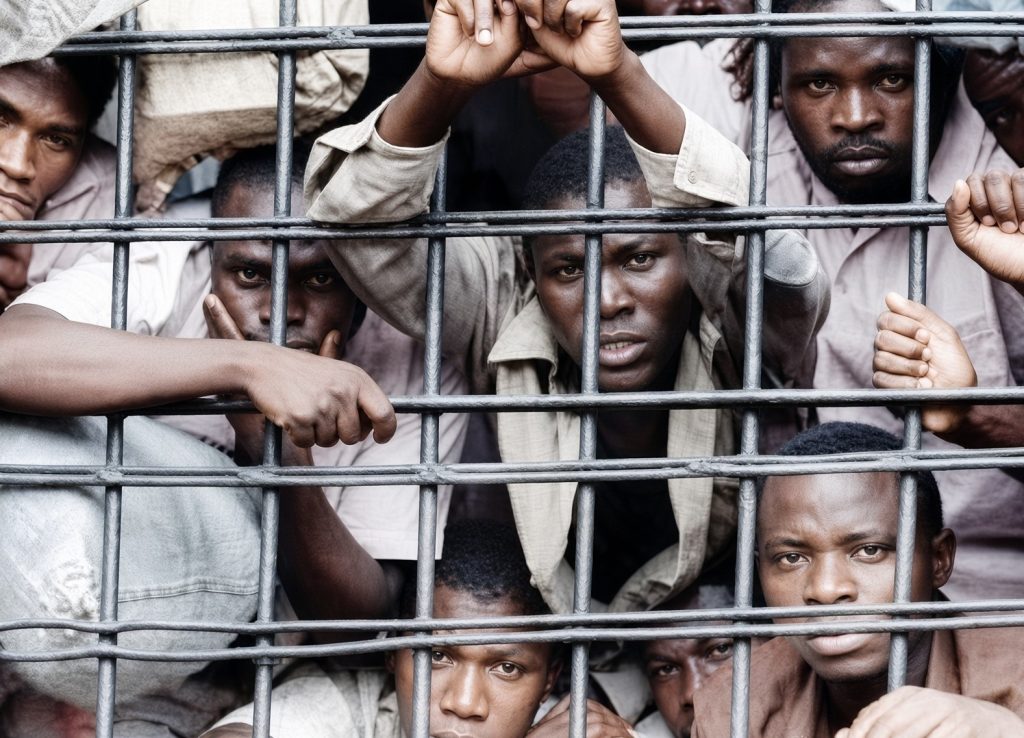
New Delhi: At least 37 suspected illegal gold miners have suffocated inside an overcrowded, poorly ventilated detention cell in the Nigerian city of Minna, according to survivors, plunging Niger State into mourning and triggering violent protests in which security forces opened fire on demonstrators. The deaths, discovered in the early hours of Thursday have prompted a formal inquiry into how so many detainees perished within a single cell run by a state paramilitary agency.
The victims were among scores of suspects rounded up by the Nigeria Security and Civil Defence Corps, a paramilitary body that works alongside the police, during raids on illegal gold-mining sites in the Wushishi-Lukoto area west of Minna on Tuesday and Wednesday. Officers detained the men at the Mohammed Inuwa Wushishi Housing Estate and in Lukoto village, with some of those held reportedly internally displaced persons from communities in the Shiroro local government area, according to Daily Trust.
Niger State’s governor, Mohammed Umaru Bago, confirmed the toll to reporters in the state capital, calling the episode “sad” and “tragic”. He announced a committee of inquiry, declared three days of mourning and postponed the start of campaigning for elections due in January.
The scale of the deaths, and the manner in which they emerged, shocked residents of Minna. A Reuters witness filmed 33 bodies laid out in a hospital ward on the day the deaths came to light, before the state authorities revised the toll upward to 37 the following day.
Anger spilled onto the streets on Thursday evening and continued into Friday, when hundreds of people, including relatives of the dead and other miners, gathered near the NSCDC’s office demanding accountability. Police cordoned off the area and fired teargas to disperse the crowd, while a Reuters witness saw security forces discharge live rounds as some protesters, carrying sticks, machetes and traditional hunting rifles, pushed back.
At least one body was seen lying in the street during the unrest, and soldiers and police officers were deployed across the city to restore order. Demonstrators also attempted to set fire to government buildings in the Tunga neighbourhood.
“We are not thieves – we are simply seeking a way to make a living by mining,” Yusuf Auwal, a miner who joined the protests, told Reuters.
Relatives have accused the NSCDC of mistreating detainees even before the deaths occurred. Shafa’atu Suleiman, whose son Abdullahi was among those held, said officials had refused to allow families to deliver food to the cramped cell and had demanded 100,000 naira, or roughly $75, to secure the detainees’ release. “This is injustice,” she said. “We will not forgive them.”
Nigeria’s interior minister, Olubunmi Tunji-Ojo, ordered the immediate suspension of the Niger State NSCDC commandant, Suberu Siyaka Aniviye, pending the outcome of the investigation. Police in the state have separately opened their own inquiry and appealed to the public for information.
Niger State is Nigeria’s largest by land area, more than twice the size of Belgium, and its mineral wealth, particularly gold, draws thousands of artisanal miners each year. The federal government has for years tried, with limited success, to curb unlicensed mining at thousands of informal sites across the country, arguing that the practice damages the environment and deprives the state of revenue.
Cause of death
Officials initially attributed the deaths to a suspected disease outbreak among the detainees, a claim Aniviye repeated in a statement describing the operation as a “burst operation” that had yielded “significant results”. He said the bodies had been taken to the General Hospital in Minna for post-mortem examination to establish the actual cause of death.
That explanation has since unravelled under scrutiny from survivors, relatives and journalists. Family members who had visited detainees shortly before the deaths said they had seen no signs of serious illness among them, and the NSCDC itself later conceded that the cause of death had not been established and would depend on the outcome of medical examinations.
Survivors have instead pointed to severe overcrowding, extreme heat and poor ventilation inside the cell. Dauda Shehu, one of the survivors, told journalists at the hospital that detainees had begged guards for help as people around them began to collapse. Another survivor, who did not wish to be named, said he had escaped death only because he was positioned near the cell’s entrance, where the air was less stifling. “We were screaming for help,” he said, adding that detainees had told guards “people are dying one after the other” but had not been believed.
An intelligence assessment seen by AFP likewise concluded that overcrowding and inadequate ventilation, rather than infectious disease, were the more probable explanation. Investigators are expected to draw on toxicology and post-mortem findings before issuing a definitive verdict, and campaigners are likely to press for the inquiry to examine whether custodial neglect, rather than misfortune, lay behind the deaths.