


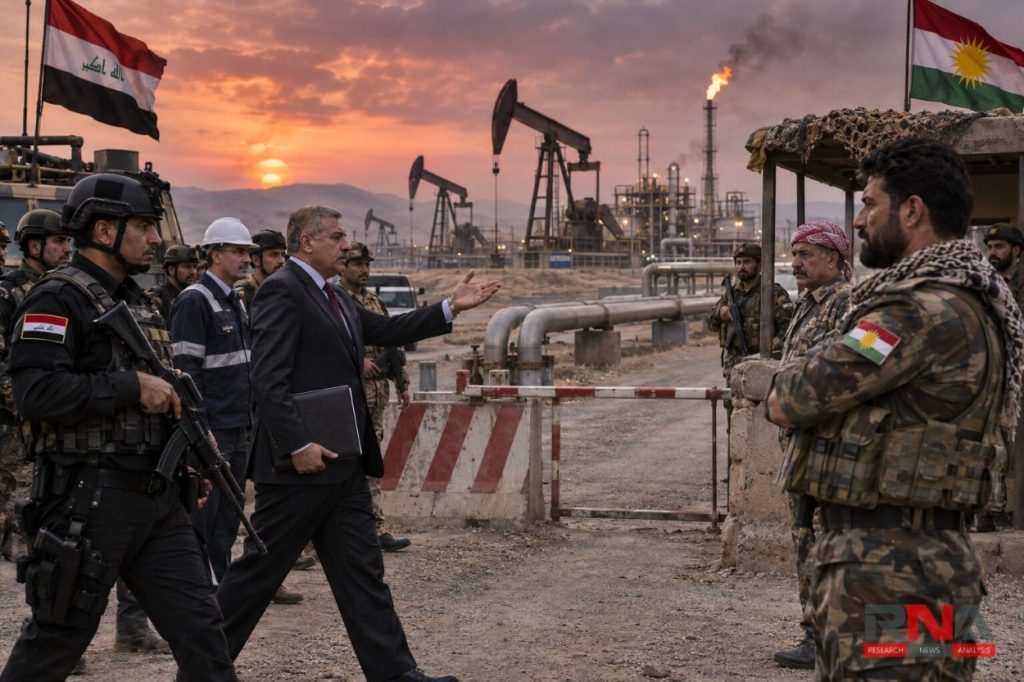
New Delhi: Iraq has ordered the federal takeover of oilfields under Kurdish security control and moved to bring the autonomous Kurdistan region’s border crossings and petroleum exports under Baghdad’s authority. The sweeping directives, announced on Tuesday, following an investigation into oil smuggling, threaten to reopen a longstanding political and economic confrontation between the federal government and the Kurdish leadership.
The Iraqi prime minister, Ali al-Zaidi, instructed the federal oil ministry to assume management of oilfields in the provinces of Diyala, Kirkuk, Salahuddin and Nineveh that remain under Kurdish security jurisdiction. The decision marks a significant expansion of Baghdad’s efforts to consolidate control over the country’s strategic resources, following its recent confrontation with a powerful Iran-backed armed group accused of operating an oil-smuggling network.
According to a report by Reuters, the directives followed an investigation into alleged irregularities at the state-owned North Oil Company, which oversees oil and gas operations across northern Iraq. The government has ordered enhanced surveillance of oil installations, including the deployment of cameras at facilities currently under the protection of Kurdish security forces.
The federal Border Ports Authority has been directed to take charge of all official crossings in the Kurdistan region, while security forces have been instructed to shut unauthorized border passages and informal roads connecting Kurdish-administered territories with the four provinces. Baghdad has also prohibited the Kurdistan Regional Government (KRG) from independently authorizing exports of crude oil and refined petroleum products.
The government has dismissed several senior officials, including the federal border authority chief, the Kirkuk police chief and the commander of the Kirkuk Operations Command. According to the National, the director general of the North Oil Company and his deputies have been suspended pending further investigation.
Baghdad has also ordered the installation of electronic meters at operational oil wells and the establishment of a nationwide digital monitoring network to detect theft from pipelines. Investigators will scrutinize petroleum supply contracts, refinery deliveries and payments made to purported pipeline protection personnel.
The battle over Kurdistan’s oil wealth
The latest confrontation has its roots in the unresolved division of powers between Baghdad and Irbil, the capital of Iraqi Kurdistan, following the overthrow of Saddam Hussein in 2003. Iraq’s 2005 constitution formally recognized Kurdistan’s autonomous status but left considerable room for competing interpretations of the authority exercised by federal and regional institutions over natural resources.
Article 112 of the constitution provides for joint management of oil and gas extracted from existing fields by the federal government and producing regions and provinces. Kurdish authorities have maintained that fields subsequently discovered could be developed under regional jurisdiction, while Baghdad has consistently challenged independent Kurdish petroleum contracts and exports.
In February 2022, Iraq’s Federal Supreme Court declared Kurdistan’s regional oil and gas legislation unconstitutional and directed the KRG to surrender its petroleum production to federal authorities. Irbil rejected the ruling, which it regarded as an infringement of its constitutional powers.
The dispute acquired an international dimension in March 2023 when an arbitration ruling against Turkey over unauthorized Kurdish oil exports resulted in the suspension of shipments through the Kirkuk-Ceyhan pipeline. Exports eventually resumed on September 27, 2025, under an arrangement involving Baghdad, Irbil and international oil companies, with Iraq’s State Organization for Marketing of Oil (SOMO) overseeing sales.
Tuesday’s directives go considerably beyond that arrangement by seeking federal operational and security control over disputed oil installations, although Baghdad has yet to identify the individual fields affected.
Baghdad’s broader offensive against oil smuggling
Zaidi’s latest move follows a similar campaign against Kataib Hezbollah, an influential Iran-backed militia operating within Iraq’s Popular Mobilization Forces (PMF). Iraqi authorities have accused the organization of involvement in a sophisticated petroleum-smuggling operation centred on its longstanding stronghold of Jurf al-Sakhar, south of Baghdad.
Last week, Iraqi security forces entered the area following a negotiated settlement that averted a potentially violent confrontation with the militia. Kataib Hezbollah has denied the allegations, which involve the suspected diversion of state-owned petroleum worth hundreds of millions of dollars.
The two developments indicate that Zaidi’s administration is attempting to assert federal authority over economic and security structures that have operated with varying degrees of independence from Baghdad. However, extending such a campaign to Kurdistan presents a different constitutional and political challenge because of the region’s formally recognized autonomous status.
The timing is particularly significant as Kurdistan is grappling with a widening political rift between its two dominant political formations – the Kurdistan Democratic Party (KDP) and the Patriotic Union of Kurdistan (PUK). Their disagreements over power-sharing and financial resources have weakened political cohesion within the autonomous region.
Implications for global oil supplies and India
Iraq was the second-largest crude oil producer in the Organization of the Petroleum Exporting Countries (Opec) in 2024, according to the US Energy Information Administration. Petroleum revenues underpin the Iraqi economy, financing government expenditure, public-sector salaries and much of the country’s infrastructure development.
Northern Iraq’s export infrastructure also holds considerable strategic importance as it provides access to Mediterranean markets through Turkey without passing through the Strait of Hormuz. Renewed friction between Baghdad and Irbil could undermine the reliability of this alternative export corridor at a time of persistent geopolitical instability in West Asia.
For India, which counts Iraq among its principal crude oil suppliers, the immediate concern is the possibility of wider disruptions to Iraqi production and exports. Although most Iraqi crude destined for Asian markets is shipped from southern terminals, any prolonged domestic confrontation could compound existing regional supply risks and exert upward pressure on international oil prices.
Much will now depend on whether Baghdad can implement its directives through negotiations with Irbil or resorts to unilateral enforcement. A campaign launched ostensibly to combat petroleum theft could otherwise develop into a wider confrontation over the constitutional, economic and territorial foundations of Iraqi federalism.