


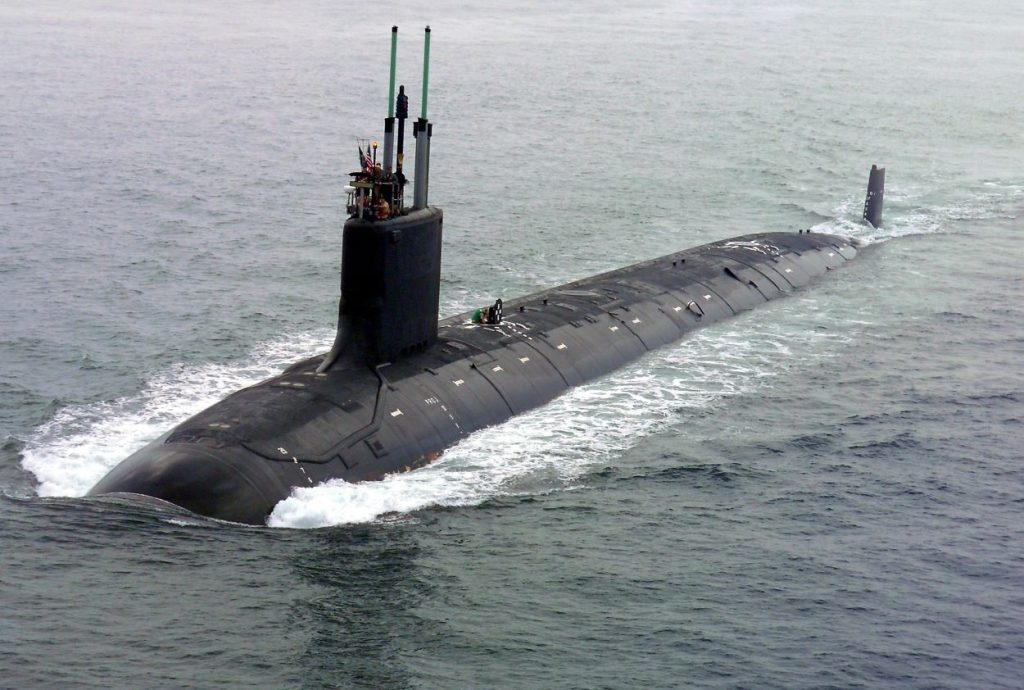
New Delhi: The United States could face a prolonged reduction in its nuclear-powered attack submarine fleet if it proceeds with plans to supply Australia with Virginia-class submarines under the Aukus security partnership, according to a new congressional assessment that raises serious questions about the agreement’s military feasibility. The findings expose a fundamental dilemma for Washington – whether strengthening an Indo-Pacific ally against China is worth temporarily weakening its own undersea combat capabilities at a time when American shipyards are struggling to meet domestic naval requirements.
The warning comes from the nonpartisan US Congressional Budget Office (CBO), whose latest assessment of US naval shipbuilding, released on Thursday submarine industrial base. The analysis suggests that transferring attack submarines to Australia could leave the US Navy with fewer operational vessels for many years, potentially complicating American military planning in the western Pacific.
Under the Aukus arrangement, announced in September 2021, Washington has committed to selling Canberra at least three Virginia-class nuclear-powered attack submarines, with the possibility of transferring two additional vessels, beginning in 2032. Australia will eventually operate a fleet of eight conventionally armed, nuclear-powered submarines, including the future SSN-Aukus class developed jointly with Britain.
America’s submarine production crisis
The principal obstacle is the inability of American shipyards to manufacture nuclear-powered submarines at the pace required to sustain the US Navy’s existing fleet and fulfil its Australian commitments.
According to the CBO assessment, American manufacturers are currently producing approximately 1.13 Virginia-class submarines annually, substantially below the two vessels needed each year to satisfy American requirements. Meeting both domestic demand and Aukus obligations would require production to increase to approximately 2.33 submarines annually – more than double the present output.
The industrial difficulties extend beyond production figures, reflecting shortages of skilled workers, stretched supplier networks, rising costs and increasingly complicated construction requirements. Submarines that previously took five to six years to manufacture now require approximately 10 to 11 years, with several Virginia-class vessels experiencing substantial delivery delays.
The CBO’s earlier projections also demonstrated how difficult it would be to compensate for transfers to Australia. Even under a scenario involving the construction of five additional replacement submarines, American attack submarine numbers could remain below their planned levels for approximately two decades, from 2032 until 2052.
The pressure is compounded by the simultaneous construction of Columbia-class ballistic missile submarines, which form a central component of America’s nuclear deterrent. These strategically important vessels compete with the Virginia-class programme for industrial capacity, specialist equipment and experienced personnel.
Strategic dilemma over China
Beyond manufacturing constraints, the assessment raises an equally consequential question concerning military command and operational availability during a confrontation with China.
Although transferring submarines to Australia would increase allied undersea capabilities in the Indo-Pacific, the vessels would operate under Australian sovereign command rather than American authority. Consequently, Washington could not automatically deploy Australian submarines during a conflict involving Taiwan or the South China Sea, even if their presence would strengthen collective deterrence.
The distinction has considerable operational implications because nuclear-powered attack submarines are among the most effective platforms for surveillance, intelligence collection, hunting enemy submarines and conducting long-range conventional strikes. Their ability to remain submerged for extended periods makes them particularly valuable in contested maritime environments where surface warships could face substantial missile threats.
The assessment nevertheless recognizes that Australian-operated submarines could strengthen regional deterrence by providing additional allied capabilities closer to potential conflict zones. The uncertainty concerns whether those capabilities would necessarily be available to American commanders during a crisis.
American legislation also establishes an important safeguard: submarine transfers can proceed only if the US president certifies that they will not degrade American undersea capabilities. This provision gives Washington considerable discretion to delay or withhold deliveries if domestic naval requirements cannot be adequately protected.
Australia insists Aukus remains on course
Despite growing questions surrounding the programme, Australia’s government continues to defend Aukus as essential to its long-term national security.
The deputy prime minister and defence minister, Richard Marles, has maintained that the partnership is proceeding, rejecting suggestions that industrial difficulties in the United States have made the agreement unworkable. Canberra has also invested billions of dollars in strengthening American submarine manufacturing capacity, recognizing that its acquisition timetable depends directly on improvements in US production.
In the latest Australian statement to the International Atomic Energy Agency, delivered on Wednesday, Canberra confirmed continued progress in personnel training, infrastructure development and submarine maintenance cooperation.
The statement revealed that USS Colorado, a Virginia-class submarine, arrived at HMAS Stirling in Western Australia on October 27 for maintenance activities. The submarine is also scheduled to become the first vessel assigned to Submarine Rotational Force-West from late 2027, when rotational deployments involving up to four American submarines and one British submarine are planned.
China maintains opposition to Aukus
China has consistently opposed Aukus, arguing that the partnership intensifies military confrontation in the Indo-Pacific and creates risks for the international nuclear non-proliferation framework.
In its September intervention at the IAEA, Beijing warned that transferring naval nuclear-propulsion technology and highly enriched uranium to a non-nuclear-weapon state could establish a dangerous precedent. China also called for broader international scrutiny of the arrangement, maintaining that existing safeguards mechanisms had not adequately addressed its concerns.
Australia, Britain and the United States reject those allegations, emphasizing that the submarines will carry conventional weapons and remain subject to appropriate international safeguards. Canberra has additionally committed not to enrich uranium or manufacture nuclear fuel for its submarine programme.
No separate Chinese government response specifically addressing the November 19 CBO assessment could be verified as of November 20.
Implications for Indo-Pacific security
For India, the difficulties confronting Aukus underline the importance of industrial capacity in sustaining modern maritime deterrence, particularly as the Indian Navy pursues its own nuclear-powered attack submarine programme.
Although India is not an Aukus participant, the eventual deployment of additional allied nuclear-powered submarines could influence the regional maritime balance, particularly across the eastern Indian Ocean and western Pacific. However, the emerging American production shortfall also illustrates how major strategic commitments can become vulnerable when defence manufacturing capacity fails to keep pace with geopolitical ambitions.
The central question is therefore no longer simply whether Australia requires nuclear-powered submarines, but whether the United States can deliver them without compromising its own readiness against China.
For Washington and Canberra, resolving that contradiction will ultimately determine whether Aukus fulfils its promise as a cornerstone of Indo-Pacific deterrence or becomes another ambitious defence agreement constrained by industrial realities.