


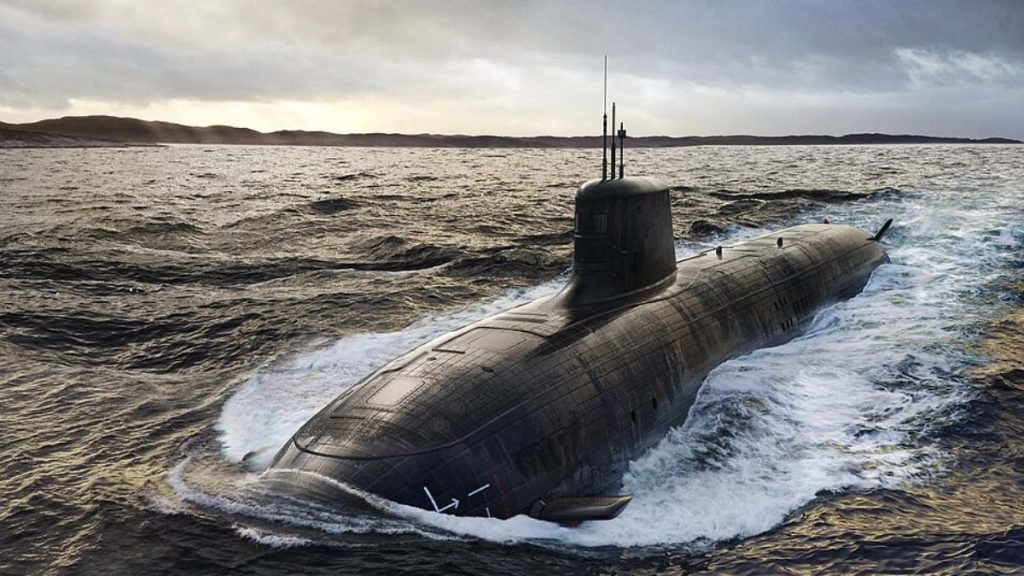
New Delhi: Expanding their Indo-Pacific strategy since 2021, the United States, the United Kingdom, and Australia have announced an undersea drone network and a rotational nuclear submarine force to counter the growing Chinese aggression in the Indo-Pacific region.
The three nations, as part of a military grouping called AUKUS, announced last week that the new trilateral “signature projects” would focus on developing new capabilities for unmanned underwater vehicle (UUV) operations.
In a statement, AUKUS announced that the undersea drone network would develop “cutting-edge payloads and enabling systems” to grow the UUV arsenals, with deliveries planned in 2027.
AUKUS, which went unnoticed for a few years now, got a fresh fillip after the US war secretary, Pete Hegseth; the UK secretary of state for defence, John Healey; and the Australian deputy prime minister and defence minister, Richard Marles, met at the American embassy in Singapore on May 30. They were there for the Shangri-La Dialogue.
“This project is intended to significantly enhance AUKUS partners’ ability to protect critical national seabed infrastructure; deploy cutting-edge surveillance, reconnaissance, and strike capabilities; conduct logistics operations; and bolster superiority in anti-submarine and anti-surface warfare, mine countermeasures, electronic warfare, and contested littoral manoeuvre,” the statement said.
AUKUS focuses on emerging technologies
A factsheet on the new AUKUS initiatives said the jointly developed payloads are expected to be interchangeable. The technologies produced could include sensors, navigation tools, offensive strike capabilities, and other assets that enable information-sharing and teaming with other uncrewed and crewed platforms, such as common control systems.
The partner nations also expect to have shared standards and operational concepts, it said. Uncrewed and undersea warfare capabilities are force multipliers for crewed platforms. They enhance the agility, asymmetry, and survivability of the defence units.
The US chief of naval operations, Admiral Daryl Caudle, and other Pentagon leaders are keen on using unmanned platforms to enhance the capacity of the US Navy’s fleet and keep sailors out of harm’s way, according to several media reports. Adm. Caudle had unveiled his “hedge strategy” earlier this year, which included fielding a network of robotic and autonomous systems and associated enablers.
Licence-free industrial production plans
The new projects would be covered under Pillar 2 of AUKUS, while the previously announced nuclear submarines project would be under Pillar 1. The Pillar 2 would focus on expediting the delivery of advanced and emerging technology capabilities for the three AUKUS partners.
The Pillar 2 technologies would include artificial intelligence, undersea assets, cyber, quantum, hypersonics, counterhypersonics, electronic warfare, and information sharing tools.
The three nations supported deepening industrial base collaboration among them by “expanding the breadth of the AUKUS licence-free environment by taking expeditious and practical steps to narrow the list of excluded technologies.”
Meanwhile, Australia would acquire in-service US Virginia-class nuclear submarines, a move that would alter the current asymmetry growing in the Indo-Pacific. “For too long in AUKUS, we talked too much and delivered too little. That has changed now,” Healey, speaking on the new initiatives, said.
AUKUS for deterring China
AUKUS member-states are concerned over China’s growing military influence, buildup, and aggressive behaviour in the Indo-Pacific region, particularly the South China Sea, where several American allies are facing maritime territorial conflict with Beijing.
“The US won’t let China impose hegemony in Asia,” Hegseth told the Shangri-La Dialogue. Last month, the US authorized the establishment of its navy’s support elements for the Submarine Rotational Force – West (SRF-W) at Perth in Australia. The first rotational deployment of American naval personnel to HMAS Stirling is planned for next year.
The SRF-W would directly support submarine deployments in the Indo-Pacific region and accelerate Australia’s readiness to own, operate, maintain, and regulate a nuclear submarine fleet.