


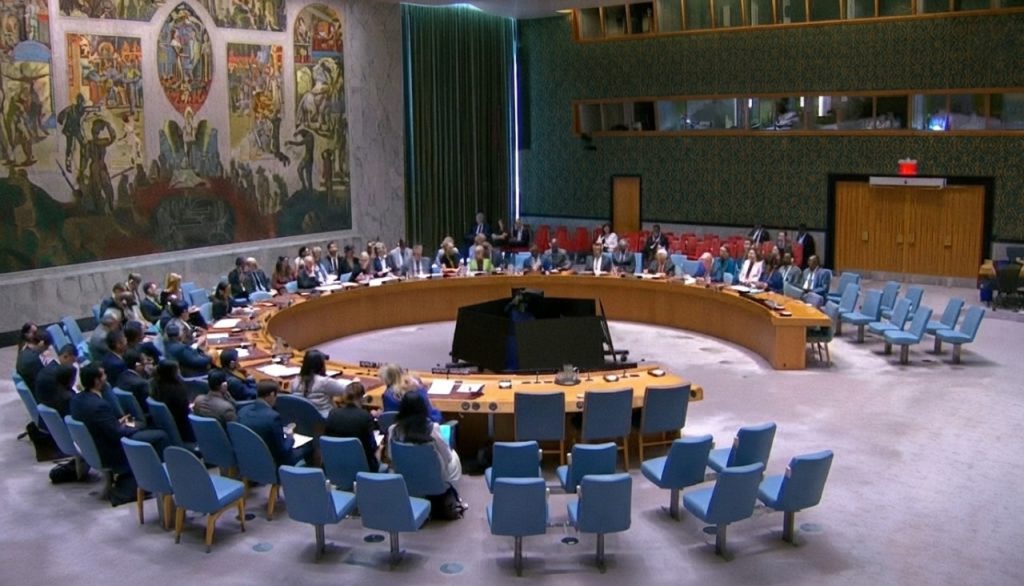
New Delhi: Russia and China on Thursday, vetoed a US-backed United Nations security council resolution that sought to extend the mandate of an independent panel monitoring sanctions on Iran, bringing the council’s latest attempt to preserve the mechanism to an end. The vote exposed once again the sharp divide among the permanent members over the legal status of the sanctions regime, Iran’s nuclear commitments and the wider Western pressure campaign against Tehran.
The draft received 11 votes in favour, while Russia and China voted against it and Pakistan and Somalia abstained. The proposed renewal would have kept the panel in place for another year, although the expert body had effectively been unable to operate because the council had failed to agree on its composition.
The dispute is rooted in the continuing disagreement over the so-called snapback mechanism in the 2015 Iran nuclear agreement, formally known as the Joint Comprehensive Plan of Action. Britain, France and Germany activated the mechanism in 2025, arguing that Iran had failed to meet its nuclear commitments, resulting in the reimposition of UN sanctions that had previously been suspended.
Russia and China reject that interpretation, maintaining that the relevant UN sanctions provisions expired when Security Council Resolution 2231 reached its scheduled end date in October 2025. Moscow’s UN ambassador, Vasily Nebenzia, argued that the US-sponsored text lacked a valid legal basis, while Washington said the disappearance of independent monitoring would make it harder to establish whether sanctions were being violated.
The US representative, Jennifer Locetta, said the end of the panel would remove an important source of independent reporting on sanctions violations, including alleged prohibited defence cooperation involving Iran and other countries. Western governments have also argued that the absence of an expert mechanism could make sanctions enforcement more difficult, although the veto itself does not formally remove the sanctions that those governments consider to be in force.
The vote comes at a particularly sensitive moment in West Asia, with the conflict involving Iran continuing to affect the security of major maritime routes. The immediate consequence at the UN is therefore not the introduction or removal of a new sanctions regime, but the loss of a mechanism intended to provide independent scrutiny of compliance and alleged violations.
A separate Reuters report on September 17 highlighted the wider maritime dimension of the crisis, saying China had privately urged Iran to use its influence over Yemen’s Houthis to help prevent further escalation around the Red Sea and Bab el-Mandeb after Saudi Arabia sought Beijing’s assistance. Three Iranian sources familiar with the matter said the appeal followed recent Houthi advances that had increased risks to Saudi oil exports and shipping, although it remained unclear whether Tehran would act on Beijing’s request.
China told Reuters that it did not want regional tensions to spill further into Yemen and the Red Sea, and called for dialogue while stressing that facilities vital to people’s livelihoods should not be targeted. The development underlines the extent to which the security of the Strait of Hormuz, the Red Sea and Bab el-Mandeb has become interconnected with the broader Iran crisis, with disruptions at either end of the maritime network carrying implications for energy supplies and international trade.
India says commercial ships must not be targeted
Against this wider backdrop, India’s permanent representative to the United Nations, Harish Parvathaneni, called for stronger international safeguards for maritime commerce, warning that civilian shipping should not be drawn into geopolitical confrontation. Addressing a UNSC Arria-formula meeting on maritime security, on Thursday, he said commercial vessels must not become targets of geopolitical tensions and that freedom of navigation and overflight must be respected in accordance with international law, including the UN Convention on the Law of the Sea.
Parvathaneni said recent disruptions to major maritime routes had demonstrated that the security of sea lanes was directly linked to international peace, energy security and food security. For India, as a major maritime nation with extensive commercial and energy interests, he stressed the importance of a free, open, secure and rules-based maritime domain in which navigation rights are not subjected to coercion, threats, unlawful restrictions or arbitrary interference.
He also drew attention to the economic consequences that can follow when a maritime chokepoint becomes insecure. Disruption at one route can shift pressure on to alternative corridors, increase freight and insurance costs and interfere with energy and food supplies, with developing economies particularly exposed to such cascading effects.
India used the intervention to highlight its own maritime-security operations, saying that operations in the Gulf of Aden and Red Sea had, as of September 14, helped ensure the safe transit of more than 449 merchant vessels carrying nearly 20.3 million metric tonnes of cargo and oil with a combined value of more than $8.4 billion. New Delhi also pointed to Operation Urja Suraksha, under which Indian Navy units have been deployed in the western Arabian Sea following the deterioration of the security environment in West Asia.
The Indian statement further emphasized the need for better coordination between existing maritime-security mechanisms, including the Information Fusion Centre – Indian Ocean Region, while calling for greater attention to the safety, evacuation, medical assistance, crew changes and repatriation of seafarers caught in conflict zones. It also identified attacks involving unmanned systems, cyber threats and interference with navigation and communications as emerging risks requiring greater international cooperation.
India’s position places the protection of commercial shipping within a broader principle: maritime routes should remain functional even when states are in confrontation elsewhere. With the Gulf, Red Sea and surrounding waterways facing overlapping security pressures, New Delhi’s emphasis is that civilian trade and seafarers should not become collateral elements of strategic disputes between states and armed groups.