


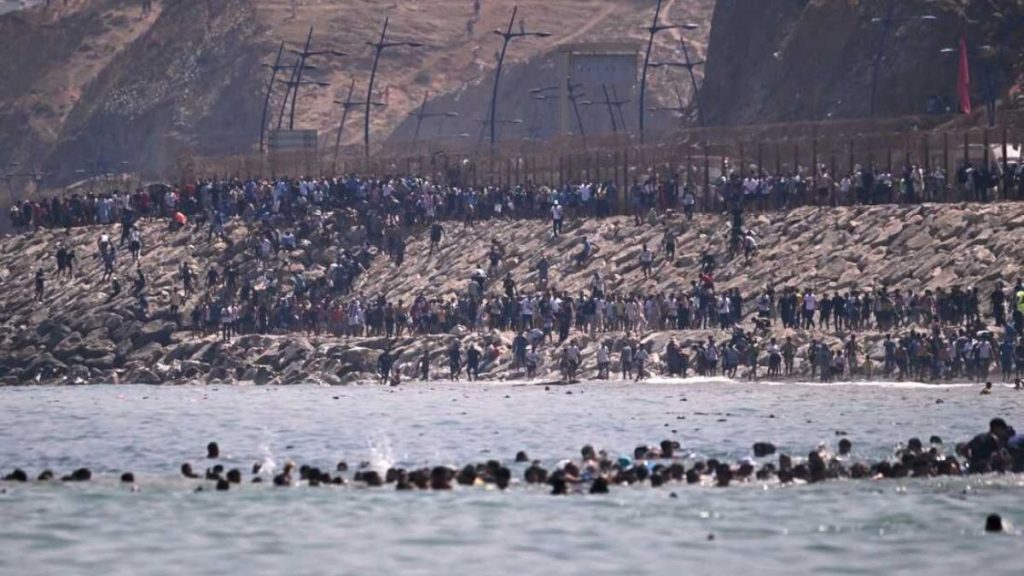
New Delhi: At least 57 people died as nearly 60,000 migrants, mostly young Moroccans, crossed from Morocco into Ceuta between Thursday and Friday, prompting Spain to deploy the military after the sudden influx overwhelmed local authorities. Ceuta is a small Spanish territory on the North African coast that shares a land border with Morocco.
By Friday evening, however, more than 48,300 migrants had returned to Morocco, according to Spain’s Interior Ministry.
Many migrants swam around the border fence or crossed via breakwaters and border checkpoints, while Moroccan police used tear gas, water cannon and warning shots to stop them, as reported by RNA Media earlier. Many of the deaths came from drowning or from stampedes near the Tarajal breakwater.
Ceuta’s president, Juan Jesús Vivas, called it a situation of absolute humanitarian and social emergency. Thousands, including children, slept outdoors as Ceuta’s reception centres quickly ran out of space. The city, home to about 85,000 people, struggled to cope with the sudden influx.
Spanish authorities have pointed to a ruling by Spain’s Supreme Court from June 2026 as one trigger. The court held that migrants arriving by sea cannot be automatically returned to Morocco without due legal process.
The ruling did not legalise unauthorised migration. However, Spanish officials say human smuggling networks used the decision to spread false claims on Moroccan social media that Spain had effectively opened its borders.
Many migrants said economic hardship at home, including high unemployment and low wages, pushed them to attempt the crossing regardless.
Spain sends in the military
The prime minister of Spain, Pedro Sánchez, travelled to Ceuta and described the mass crossing as “an attack on Spain’s territorial integrity”, saying it deserved the country’s strongest condemnation.
Spain deployed additional troops, police and emergency services to the enclave, and said it would try to expel those who had entered illegally as quickly as possible.
Despite that, most migrants left of their own accord rather than being formally deported. Many told reporters they could not find food or shelter in the enclave, and returned to Morocco through border posts and gaps in the fence.
Morocco’s role remains unclear
Morocco has not said whether it deliberately eased border controls, and its Interior Ministry did not respond to requests for comment. Rabat also does not recognise Spanish sovereignty over Ceuta and Melilla, describing them as “occupied” territory. The episode has also raised questions over Morocco’s role in the sudden migrant surge, although no evidence has emerged so far to support claims that Rabat deliberately allowed the crossings.
There are also reports of separate clashes near Melilla, Spain’s other North African territory, where migrants and police clashed and cars were set on fire. Unlike a similar 2021 incident, when Morocco was seen to have deliberately loosened border controls during a spat with Spain, no such evidence has come up this time.
Wider implications for the EU
The European Commission president, Ursula von der Leyen, called the images from Ceuta unacceptable. Italy briefly restored border checks on arrivals from Spain, and France tightened its own controls, amid concerns that migrants could eventually move to other parts of Europe through the Schengen area.
However, Ceuta operates under special border rules, meaning migrants cannot freely travel to mainland Spain without identity and document checks.