


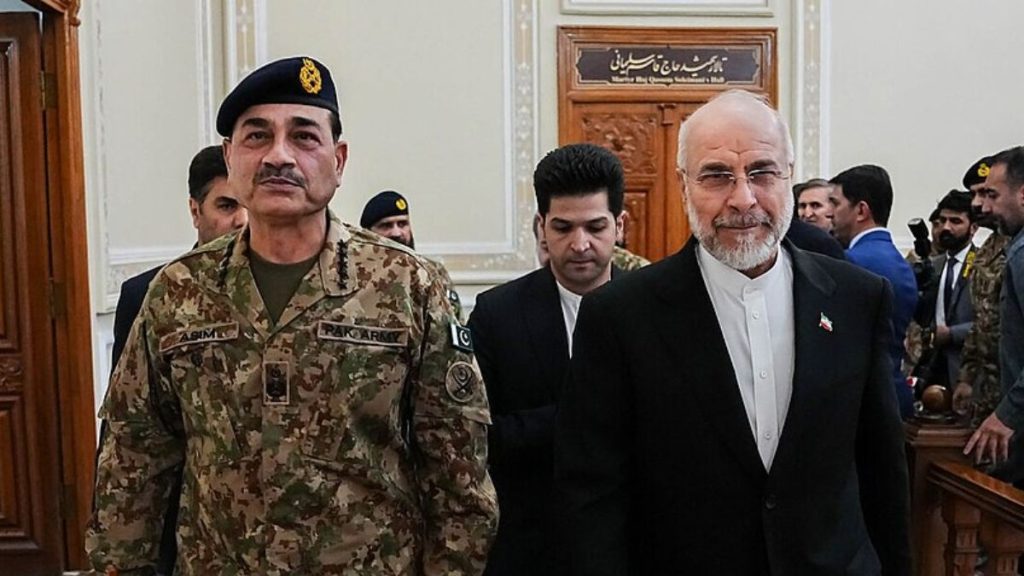
New Delhi: The Pakistan Army chief, Field Marshal Asim Munir, arrived in Tehran on Monday for talks with senior Iranian officials as Islamabad makes another attempt to keep diplomacy alive between Iran and the United States, whose negotiations have stalled amid renewed tensions over sanctions and the Strait of Hormuz.
Iran’s official IRNA news agency said Munir, accompanied by Pakistan’s interior minister Mohsin Naqvi, was received by Iranian interior minister Eskandar Momeni. Iran’s foreign ministry said the visit was intended to strengthen bilateral ties and continue Pakistan’s efforts to promote regional peace and security. It is Munir’s third visit to Iran this year.
The timing is important. A Reuters report said the US president, Donald Trump, spoke to Munir last week before the Tehran trip. According to one of those reports, Washington wanted Pakistan to use its influence to encourage Iran to return to negotiations. The White House had not publicly confirmed the call and details of the conversation, if it took place, remained unclear.
There is currently no formal negotiating process to return to. Trump said on August 18 that no talks with Iran were taking place or scheduled. Iran, meanwhile, has insisted that conditions attached to an earlier understanding must first be honoured.
That earlier opening had been built partly through Pakistani mediation. Islamabad hosted US-Iran engagement during the conflict and an interim memorandum of understanding was signed in June. Pakistan’s government publicly credited Munir, the prime minister, Shehbaz Sharif and other officials with helping facilitate the process.
The arrangement subsequently unravelled as Washington and Tehran disagreed over its implementation, including sanctions, military activity and the terms for restoring normal traffic through the Strait of Hormuz.
What can Munir actually achieve in Tehran?
Munir arrives with something many intermediaries lack: access at senior levels in both capitals. His contacts with Tehran are well established. During an earlier visit in May, he met the Iranian president, Masoud Pezeshkian; parliament speaker, Mohammad Bagher Ghalibaf; foreign minister, Abbas Araghchi; and the interior minister, Momeni. Pakistan said those discussions formed part of its mediation effort. Iranian officials have also publicly acknowledged Islamabad’s role in earlier negotiations.
His Washington channel is equally relevant. The report that said Trump personally called Munir before the latest mission suggests the Pakistani military chief is being used as more than a bilateral defence interlocutor. He is carrying political weight in a process in which Pakistan’s civilian government, foreign ministry and military leadership have all been involved. But access is not the same as leverage.
Pakistan can carry messages, clarify positions and perhaps reduce the risk of miscalculation. It cannot, by itself, resolve the disputes that caused the previous arrangement to unravel.
The Iranian chief negotiator, Mohammad Bagher Ghalibaf, has said Tehran wants the US blockade of Iranian ports lifted, oil sanctions removed, frozen assets released and military threats ended before movement through Hormuz returns to normal. Trump, by contrast, has said the June arrangement is over and has pursued further economic pressure on Iran.
Those are substantive differences, not simply a communications problem. A realistic objective for Munir may therefore be smaller than a new agreement. Re-establishing a negotiating channel, securing another round of talks or identifying terms under which both sides could resume discussions would itself represent progress.
Hormuz is central to deadlock
The Strait of Hormuz is one of the hardest issues Munir will have to navigate. Before the conflict, roughly a fifth of global oil and liquefied natural gas flows passed through the narrow waterway. Tehran has tied normalisation of traffic to US compliance with its interpretation of the June deal, while Washington insists that the strait is open.
Actual shipping activity shows that conditions are far from normal. Kpler data cited by Reuters showed fewer than 20 commodity vessels transited Hormuz over the weekend, with traffic roughly 90 per cent below pre-conflict levels during the week ending August 21.
For Pakistan, a prolonged disruption is economically and strategically damaging. Islamabad borders Iran, maintains trade ties with Tehran and also has close political, economic and security relationships with Saudi Arabia and other Gulf states.
Munir is therefore not mediating without interests of his own. Pakistan needs to prevent an Iran confrontation from destabilizing its western neighbourhood while protecting ties with Washington and its Gulf partners.
Why is Pakistan’s army chief at the centre?
Munir’s role also reflects the unusual nature of Pakistan’s diplomatic channel. He is not simply the army chief. Pakistani official sources identify him as both chief of army staff and chief of defence forces, placing him at the apex of the country’s military establishment. He was directly involved in earlier Iran mediation and accompanied Pakistan’s Prime Minister to talks on implementing the June understanding.
His repeated involvement gives Islamabad a channel that combines diplomacy with security communication. That matters when the issues under discussion include military escalation, maritime security and the risk of renewed conflict.
It also has limits. Pakistan may be useful precisely because it talks to both sides, but neither Washington nor Tehran has surrendered control of the negotiating terms to Islamabad. Reuters quoted a Pakistani source describing a deep trust deficit between the US and Iran and saying Munir would try to reduce that mistrust. Reducing mistrust is very different from resolving the dispute.
Why India has a stake in the outcome
For India, the significance lies less in Pakistan’s diplomatic profile than in what happens around Iran and Hormuz. Disruption in the Gulf is already affecting Indian energy planning. Petronet LNG said this month that it lacked clarity over September LNG supplies from Qatar after force majeure affected dozens of cargoes. India has turned to alternative suppliers, including Oman, the US, Nigeria and Angola. Indian Oil is also seeking more LPG from Algeria as part of diversification away from disrupted Middle Eastern routes.
India also has substantial bilateral interests in Iran, including its long-running involvement in Chabahar port and connectivity towards Afghanistan and Central Asia.
A prolonged US-Iran confrontation therefore affects Indian interests through energy costs, shipping, Gulf stability and connectivity, regardless of who succeeds in mediating.
Munir’s latest mission should consequently be measured against a modest test. Pakistan has already demonstrated that it can get messages to Washington and Tehran and, at earlier stages, help bring them into a negotiating process. What it has not demonstrated is an ability to make either side abandon core demands.
If Munir can reopen a functioning diplomatic channel, ease immediate tensions around Hormuz or persuade both sides to resume direct negotiations, Islamabad will have achieved something tangible. A broader settlement will still depend on decisions made in Washington and Tehran. Pakistan has access. This visit will show whether it has enough leverage to make that access matter.