


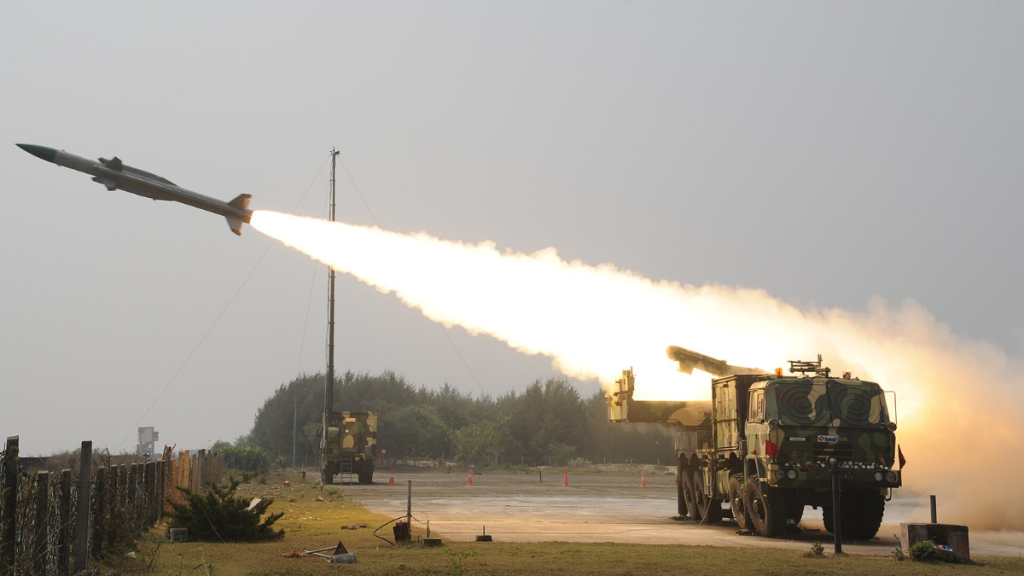
Eastern European nation Armenia is increasingly turning to India for defence systems, buying nearly $2 billion worth of arms since 2020, against the backdrop of its military conflict with Azerbaijan, which gets similar support from Pakistan and Turkiye.
Yerevan has deepened its military engagement with New Delhi, not only in arms purchases but also in military training, high-level exchanges, and visits by senior officers.
As part of that diplomatic military exchange, a high-ranking three-member Armenian defence delegation visited the School of Artillery in Maharashtra’s Nashik district recently.
During the visit, the delegation received a briefing on the artillery training facilities and operational methodologies of the Indian Army. They also got to witness a live-fire demonstration of Indian artillery guns.
This delegation visit came just a month after Armenia’s First Deputy Minister of Defence and Chief of General Staff Lieutenant General Edvard Asryan came to Delhi for meetings with the top defence leaders of India.
Lt Gen Asryan met with India’s Chief of Defence Staff General Anil Chauhan, Chief of Army Staff General Upendra Dwivedi, Chief of Air Staff Air Chief Marshal A. P. Singh, and Defence Secretary Rajesh Kumar Singh.
In February 2026, General Anil Chauhan visited Yerevan to strengthen the bilateral defence cooperation between India and Armenia, when he inaugurated defence research facilities, and highlighted the importance of joint training in modern warfare.
The two senior-level visits showcased the growing India-Armenia defence partnership, even as Russia has reduced its military supplies to Eastern European partners in recent years due to the Ukraine war.
Armenia has fought two major wars with its neighbour, Azerbaijan, in 2020 and 2023, when Turkish drones deployed by Azerbaijan wiped out the Armenian armoured columns.
Azerbaijan has received Islamabad’s support, signing a deal for buying 40 JF-17 Block III fighter aircraft developed jointly by Pakistan and China.
Against this backdrop, Armenia identified India as a reliable partner for military systems, including advanced air defence missiles, battlefield awareness radars, and precision-strike rockets.
In 2022, Armenia became the first international buyer of India’s Akash surface-to-air missile system in a $720 million deal. The Akash air defence system is designed to intercept and destroy aerial threats such as fighter aircraft, helicopters, and drones.
It provides medium-range protection and is equipped with radar-guided tracking and multi-target engagement capability. The system enhances Armenia’s ability to counter missile and unmanned aerial threats.
India began deliveries of the Akash to Armenia in 2024, significantly improving Armenia’s capability to counter aerial and missile threats.
Yerevan also bought the Pinaka, a long-range rocket artillery platform capable of delivering rapid, high-volume fire over a wide area. It is designed for precision strikes against enemy positions, infrastructure, and concentrated troop formations, offering mobility and quick deployment in battlefield conditions.
The Eastern European nation also purchased the Swathi radar, used to detect and track incoming artillery and mortar rounds. Swathi identifies the point of origin of hostile fire, enabling rapid counter-battery response. The system significantly improves battlefield situational awareness and reaction time.
India also supplied advanced anti-drone technologies designed to detect, track, and neutralise unmanned aerial threats. These systems are intended to protect critical infrastructure and military assets from surveillance and attack drones.
Armenia continues to expand cooperation with India in defence training, equipment procurement, and potential joint production, strengthening New Delhi’s role in the strategic balance of the South Caucasus