


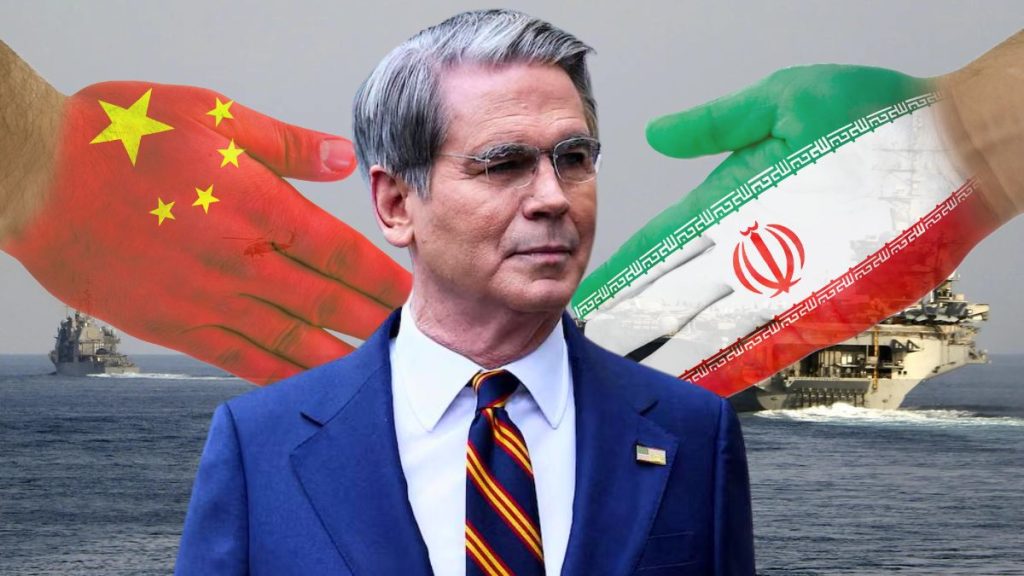
Days before a closely watched meeting between US President Donald Trump and Chinese President Xi Jinping, Washington has sharpened its rhetoric on Beijing’s role in the ongoing West Asia conflict. US Treasury Secretary Scott Bessent has accused China of indirectly financing Iran’s war efforts.
In a recent interview, Bessent linked the claim to China’s continued purchase of Iranian oil even as tensions disrupt one of the world’s most critical shipping routes. Notably, the comments add a new layer of complexity to US-China ties at a time when both countries are navigating not just bilateral issues, but also the broader fallout of the Strait of Hormuz crisis.
Why did Bessent accuse China of funding Iran?
Bessent’s central argument rests on energy flows. Speaking to Fox News, the US Treasury Secretary said China buys roughly 90% of Iran’s oil exports, effectively providing Tehran with a crucial revenue stream during the conflict. The argument is almost identical to the one made several times by US President Donald Trump on countries purchasing oil from Russia.
By framing Iran as “the largest state sponsor of terrorism,” Bessent suggested that these purchases amount to indirect financial support for Iran’s activities in the region. China has continued importing Iranian crude despite longstanding US sanctions, a position that has frequently put it at odds with Washington’s efforts to isolate Tehran economically.
Moreover, Bessent’s accusation comes against the backdrop of severe disruptions in the Strait of Hormuz, where maritime traffic has been affected by escalating hostilities involving Iran. The waterway, a vital corridor for global oil and gas shipments, has seen blockades, threats, and military operations that have unsettled markets worldwide.
Bessent linked China’s role directly to efforts to resolve the crisis, urging Beijing to use its influence over Tehran to help reopen the strait. He also called on China to support the US-led initiative to restore safe passage for ships, including “Project Freedom,” which aims to guide stranded vessels through the region.
Sharp remarks ahead of the Trump-Xi meeting
The timing of the US Treasury Secretary’s remarks is anything but ignorable. Trump is expected to visit Beijing next week, and the summit is being seen as an opportunity to stabilise relations between the two global powers. While US-China ties have shown signs of improvement following a preliminary trade agreement last year, differences over Iran, sanctions, and global security remain unresolved.
At the same time, Bessent struck a measured note, highlighting “stability” in the relationship and pointing to mutual respect between the two leaders.
How has China responded to US pressure on Iran oil trade?
Beijing has consistently defended its position, opposing what it calls unilateral sanctions imposed by the United States. After Washington targeted Chinese entities linked to Iranian oil trade last week, China described the measures as unlawful and pledged to protect the interests of its companies.
China has also taken a firm stance at the United Nations. Along with Russia, it vetoed a proposed Security Council resolution condemning Iran’s blockade of the Strait of Hormuz, arguing that the draft failed to present a balanced view of the conflict.
Chinese officials have maintained that any resolution must account for the broader context, including US and Israeli military actions in the region.
The US is now urging China to translate that economic influence into diplomatic action, particularly in helping to stabilise the situation in Hormuz.