


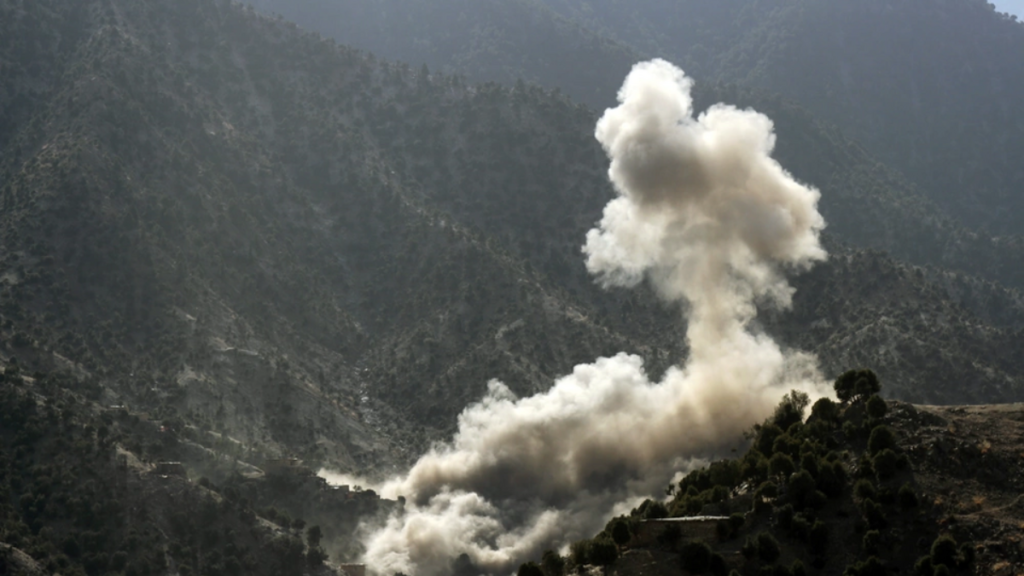
New Delhi: The Afghanistan-Pakistan conflict intensified dramatically with the Afghan Taliban government announcing that its Air Force had conducted precision airstrikes inside Pakistani territory targeting alleged Islamic State – Khorasan Province (ISKP) positions on Tuesday. The strikes were reportedly carried out in Pishin (Balochistan), Shah Salim valley (Chitral), and Kambar Khel (Khyber Pakhtunkhwa) inside Pakistani territory.
In late February, the Afghanistan-Pakistan military confrontation officially entered its second phase when Pakistan conducted large-scale aerial bombardments within Afghanistan and was met with direct military opposition by the Taliban. Since then, the conflict has continued to evolve through airstrikes, drone attacks, artillery exchanges, ground clashes, cross-border raids, temporary ceasefires and renewed retaliations.
Unlike earlier instances of limited artillery and border skirmishes, both Pakistan and Afghanistan are now using air power along their respective international borders, with both sides claiming their respective actions are counterterrorism operations.
The strikes, which Kabul described as a counterterrorism operation, were carried out in direct retaliation for Pakistan’s air operations inside eastern Afghanistan conducted days earlier. In response, the Kabul Authorities also declared that any threat to its national security regardless of location, could be targeted.
Trigger for latest escalation
The immediate trigger for the latest escalation occurred when a Tehrik-e Taliban Pakistan (TTP) -associated group called Jamaat-ul-Ahrar carried out a suicide attack on 27 June at headquarters for the Pakistan Rangers in Karachi.
The attack killed three Rangers personnel and prompted Pakistan to launch cross-border air and ground operations on 28–29 June against alleged TTP, Jamaat-ul-Ahrar and ISKP positions in Paktia, Paktika and Kunar – all inside Pakistan. Islamabad claimed 29 militants were killed and justified the strikes as acts of self-defence. Islamabad alleged that 29 militants had been killed in the operations and had a right of self-defence against the attacks.
However, Afghanistan’s Taliban regime has denied Pakistan’s assertion and declared that the majority of the attacks had been conducted against civilian areas. In this context, the UN Assistance Mission to Afghanistan reported 28 civilian deaths and 49 injuries, while the Afghan government reported the number of civilian deaths to be 38 and accused Pakistan of breaching international law. The strikes attracted regional attention, with India condemning the strikes by Pakistan as a “blatant act of aggression” and reaffirming its wish that Pakistan respect the sovereignty of Afghanistan.
As a result, Afghanistan conducted retaliatory airstrikes against what it said were ISKP operational sites located inside Pakistan. The announcement by Kabul that it would attack threats “no matter where they are” indicates a change in its approach to cross-border counterterrorism operations from primarily defensive to more aggressively pursuing terrorists outside Afghanistan’s borders.
Pakistan rejected this rationale and reiterated its position that armed forces personnel of the TTP receive protection/sanctuary in Afghanistan, and that it had intercepted drone attacks launched from within Afghanistan.
The new exchange signals change in the conflict as what began as intermittent border skirmishes have now become mutual air operations across the borders, with each government claiming the other supports terrorist groups. This continuous cycle of response raises the risk of generating additional military conflict, civilian deaths and errors in strategic decision making, while also making it more difficult for both countries to cooperate and maintain stability along the Durand Line.