


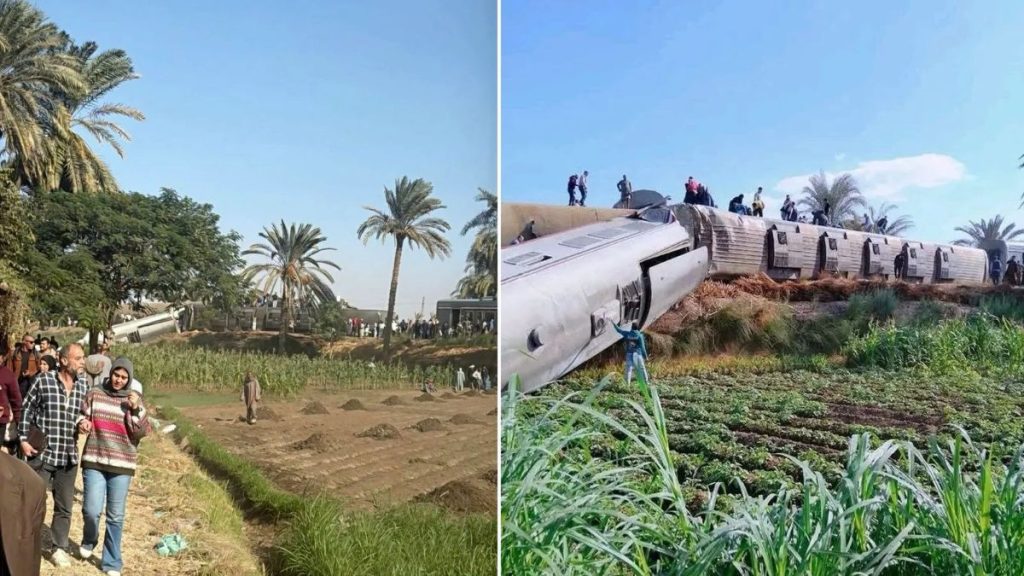
New Delhi: Seven people were killed and 125 injured when two passenger trains collided in Egypt’s Giza province on Sunday, derailing several carriages and triggering a major rescue operation. The president, Abdel Fattah el-Sisi, ordered an investigation into the Sunday crash near Al-Ayyat, an area marked by previous deadly railway disasters.
Train No. 134, travelling from Giza to Fayoum, struck the rear of stationary train No. 2010, which was heading from Cairo to Aswan, between Kafr Ammar and Al-Raqqa stations. The Egyptian national railways confirmed the collision, while preliminary findings from the public prosecution established that both trains were on the same track.
Several carriages derailed, with some tumbling down an embankment. Local residents joined emergency personnel in searching damaged coaches for survivors as railway crews deployed cranes to clear the wreckage.
Egypt’s health ministry confirmed seven deaths and 125 injuries in its latest Sunday update. The driver of the Giza-Fayoum train was among those killed, the public prosecution said.
Seventy-two ambulances participated in evacuation operations as hospitals were placed on heightened alert. The health minister, Khaled Abdel Ghaffar, said passengers were being treated for fractures and head injuries, while the Egyptian Red Crescent provided emergency assistance and psychological support to victims and their families.
Of the 125 injured, 71 were discharged, 43 remained hospitalized and 11 were transferred to other hospitals, Ahram Online reported.
President orders investigation
El-Sisi directed authorities to establish the circumstances surrounding the collision and hold anyone found responsible for negligence accountable.
The public prosecution opened an inquiry and ordered a specialized technical committee to examine the damaged trains, railway tracks and operating procedures. No final determination of the accident’s cause has been announced. Prosecutors warned that the death toll could rise as investigations and medical treatment continued.
Rail services between Cairo and Upper Egypt were initially disrupted, with replacement buses arranged and ticket refunds offered. Egyptian national railways announced on Monday that damaged carriages had been removed and operations restored on the Cairo-High Dam line.
Egypt’s financial regulatory authority also increased compensation for deaths and permanent total disability from 30,000 to 50,000 Egyptian pounds through the Railway and Metro accident insurance pool, subject to applicable procedures.
A district marked by railway disasters
The collision occurred near the site of Egypt’s deadliest railway disaster. In February 2002, a fire engulfed an overcrowded Cairo to Luxor train near Al-Ayyat, killing more than 370 people, according to widely cited official figures.
The district witnessed another collision in September 2026, when two freight trains crashed, injuring a driver and his assistant.
Egypt recorded 170 train accidents in 2025, down from 220 in 2024, according to the central agency for public mobilization and statistics. These incidents caused 39 deaths and 139 injuries.
Railway officials have cited investments of approximately 366 billion Egyptian pounds in infrastructure modernization, signalling upgrades and operational improvements.
The latest collision has renewed questions about whether these investments are delivering sustained improvements in railway safety, with investigators yet to establish what caused the crash.