


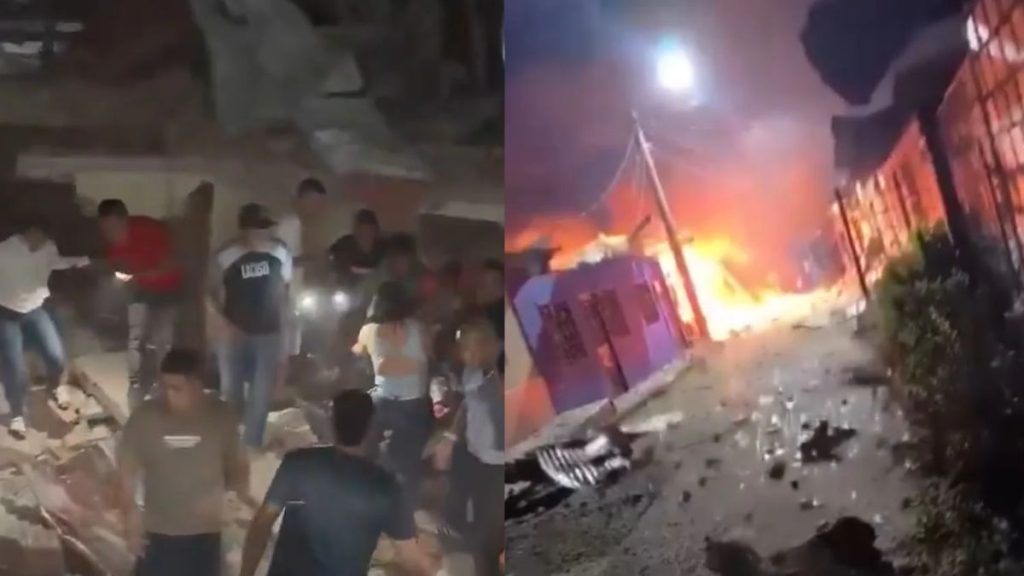
New Delhi: Four civilians, including a two-month-old baby, were killed when attackers fired explosives towards a military installation in Planadas, Colombia, on Sunday night. The assault injured 18 people and damaged a hospital and 177 homes in Tolima department, amid further attacks across the country’s southwest.
Tolima governor, Adriana Magali Matiz, confirmed the preliminary toll following an emergency security meeting on Monday. In a post on X, she expressed solidarity with bereaved families and demanded justice. The departmental government said three of the injured needed specialist treatment elsewhere; the baby’s father was also among those killed.
Planadas mayor, Juan Camilo Hueje, said explosive filled cylinders were launched from a modified dump truck towards the military compound around 9.45pm. Some struck nearby houses and the hospital’s pharmacy, causing a fire that forced patients to be evacuated. A school was used to treat casualties while authorities arranged temporary medical services.
Colombia’s defence ministry said the explosives were fired from ramps fitted to the truck rather than confirming earlier reports that the vehicle itself exploded. The ministry provisionally blamed the Geronimo Galeano faction of dissident revolutionary armed forces of colombia (FARC) members, but investigators have not conclusively established responsibility.
Hueje also reported drones above the town; their involvement in the blasts remains unconfirmed. The government deployed additional troops to help secure the area and identify the attackers.
Violence spreads beyond Tolima
Separate attacks were reported in neighbouring departments. A motorcycle bombing in Algeciras, Huila, killed police officer Julian Esmith Castano Lopez and injured two officers and four civilians, according to Colombian reporting. Explosions and armed harassment were also reported in Balboa, La Sierra and Totoro in Cauca, with no evidence that every attack had the same perpetrators.
The government has also reinforced security in Cucuta, near the Venezuelan border, following a series of attacks. The president, Abelardo de la Espriella, ordered the city’s temporary militarization on October 29 and announced that a new military police campaign, Esparta, would begin operations on November 3.
Abelardo de la Espriella, condemned the violence and ordered stronger security deployments. He pledged to intensify military operations, including airstrikes against armed groups, and move towards restarting aerial spraying of coca crops. Those commitments were policy statements, not confirmation of a newly launched nationwide offensive.
Colombia’s human rights Ombudswoman, Iris Marin, said armed groups had competed for control around Planadas since 2022, with tensions sharpened by operations against illegal gold mining. She described the attack on civilians and medical facilities as a violation of international humanitarian law.
The 2016 peace agreement between the government and FARC reduced fighting in several regions but did not end competition among dissident factions, drug-trafficking networks and other armed groups. De la Espriella suspended talks with remaining insurgent organizations after taking office in August.
Conflict monitor ACLED recorded 34 bomb or explosives related attacks by illegal armed groups and state forces over the four weeks ending October 16, nine per cent above the comparable previous year average, Associated Press reported. The total includes military airstrikes, not just insurgent attacks.