


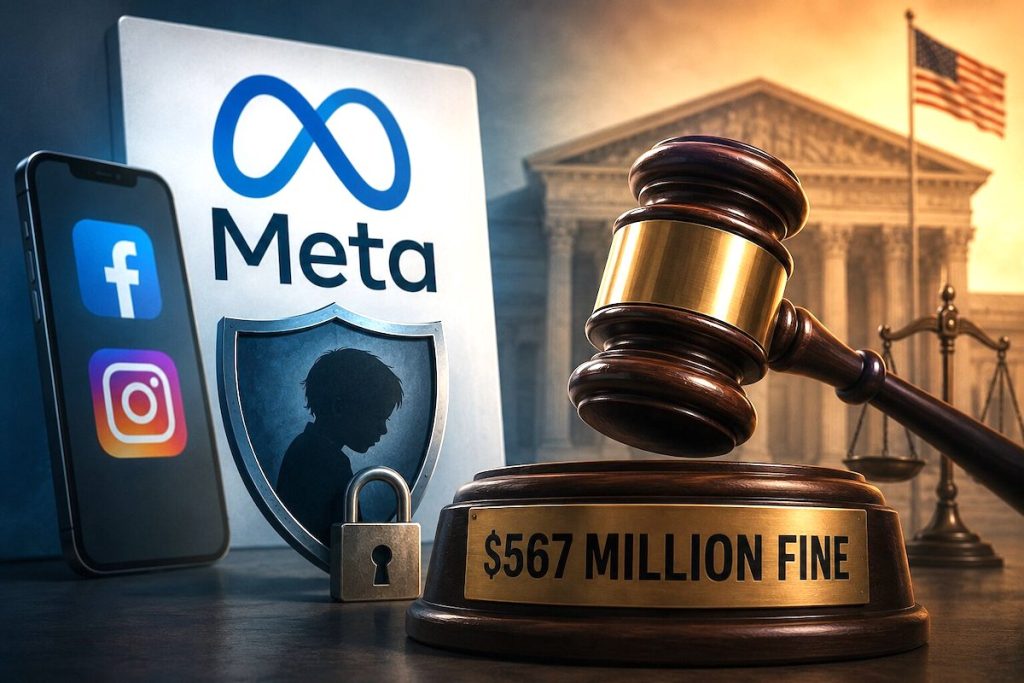
New Delhi: A United States judge has ordered Meta to pay $567 million and overhaul how its platforms treat young users in the state, after ruling that the company’s conduct amounted to a public nuisance. The penalty, handed down on Thursday by a New Mexico court, is the largest ever imposed on the social media giant over child safety and takes its total liability in the case to $942 million.
The judge, Bryan Biedscheid, sitting in Santa Fe, delivered the ruling without a jury after three weeks of testimony in the second phase of the trial. He compared Meta to a factory whose product is advertising and content, with the psychological harm and sexual exploitation of children forming the pollution that needed to be abated.
The case originated from a 2023 lawsuit filed by New Mexico’s attorney general, Raúl Torrez, who accused Meta of designing its products to addict young users and failing to protect children from sexual exploitation on Facebook and Instagram. In March, a jury had already found the company liable for thousands of violations of the state’s Unfair Practices Act, ordering $375 million in damages after concluding that Meta misrepresented the safety of its platforms to the public.
The court order
The latest decree runs for five years and directs the $567 million into a fund intended to reduce future harm to young users. Meta must also impose monthly limits on teenagers’ use of Facebook and Instagram, restrict notifications to minors, tighten controls on adult contact with children, and build in safeguards for its AI chatbots.
The company has further been told to strengthen its review of child sexual abuse reports and to seek proof of age from users it estimates may be under 13. Any user it cannot confidently age-verify must be treated as a minor until they establish otherwise, and Meta must partner with schools or a child safety organization to set up a portal through which staff can flag suspected underage accounts.
Judge Biedscheid also ordered Meta to delete personal data it holds on users under 13 and to report on its compliance twice a year. Notably, the court stopped short of requiring Meta to collect additional personal data or track children passively for age-verification purposes, citing constraints under America’s federal children’s privacy law, COPPA.
Meta’s response
A Meta spokesperson said on Thursday that the company disagreed with the ruling and would appeal. The spokesperson added that Meta had worked hard to keep people safe on its platforms and had been transparent about the difficulty of identifying and removing bad actors.
Even so, $942 million is a modest sum against Meta’s scale – the company reported roughly $60 billion in annual profit last year, underlining why critics argue that fines alone are unlikely to force a change in behaviour.
India dimension
The New Mexico verdict arrives days after Meta’s chief executive, Mark Zuckerberg, apologized to the Indian government over child sexual abuse material, deepfake content and what officials described as operational lapses on the company’s platforms. As RNA Media had reported, the apology was conveyed when a Meta delegation led by the company’s chief global affairs officer, Joel Kaplan, met the secretary of the Ministry of Electronics and Information Technology (MeitY), S Krishnan, in New Delhi.
Indian officials reportedly told the delegation in plain terms that Meta cannot claim intermediary status – and, with it, safe harbour protection under section 79 of the Information Technology Act – because its algorithms actively select who receives content. Meta is said to have conceded that it had accepted payments to boost certain categories of content, a practice that sits uneasily alongside the child-safety concerns raised in the meeting.
The friction traces back to the temporary removal of a Facebook video posted by the prime minister, Narendra Modi, on July 23, his first direct address to the country’s Gen Z during protests over the NEET-UG 2026 examination-paper leak. Meta blamed a technical glitch, an explanation the ministry rejected as inadequate, prompting the parliamentary standing committee on communications and information technology – chaired by the Bharatiya Janata Party MP, Nishikant Dubey – to summon Meta executives and warn that its safe harbour protection could be withdrawn if Zuckerberg did not apologize personally within three days.
Separately, the ministry had already issued Meta a notice over child sexual abuse material appearing in paid advertisements on Instagram, an issue raised again at the New Delhi meeting alongside concerns over synthetic content and the security of verified accounts belonging to public figures. It is not the first time Meta has had to backtrack in India – in January 2025, a senior Meta India executive apologized after Zuckerberg wrongly claimed on a podcast that India’s government, among others, had lost power because of the pandemic.
Seen alongside the New Mexico judgment, the Oakland trials due later this month and the European Commission’s ongoing probe into under-age access to Instagram and Facebook, the Indian episode fits a wider pattern. Regulators from Santa Fe to New Delhi appear increasingly unwilling to accept Meta’s assurances at face value, preferring instead to threaten – and in America’s case, impose – consequences with real financial and legal weight.