


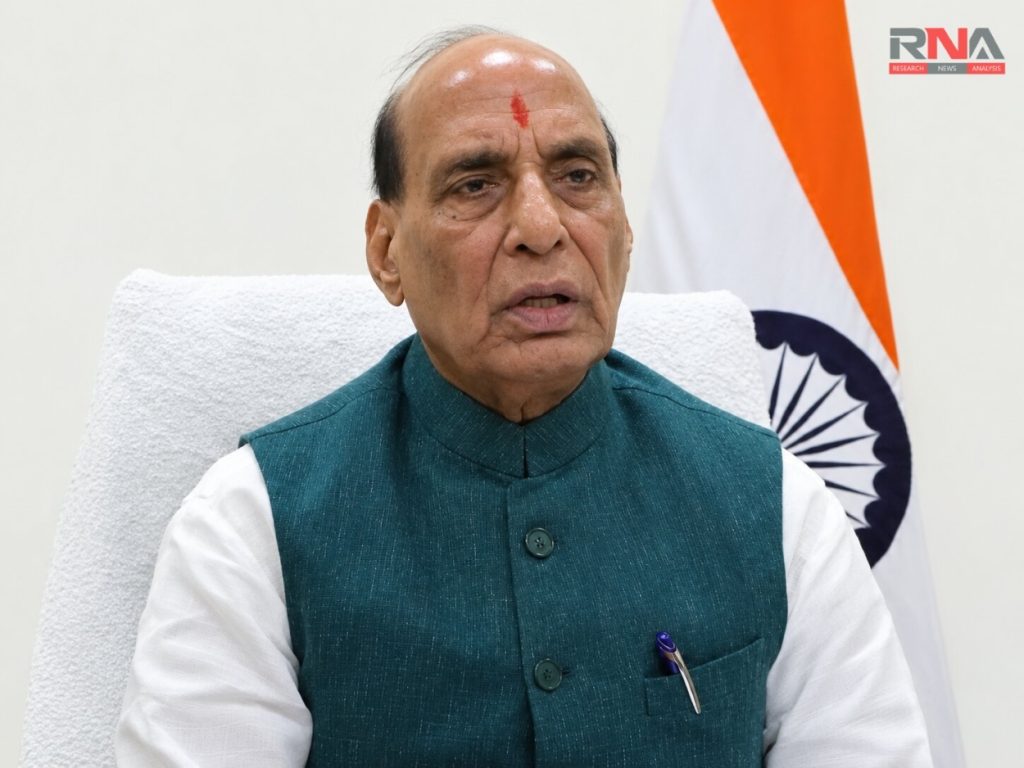
New Delhi: The defence minister, Rajnath Singh, on Sunday called for greater indigenous capabilities in advanced inspection and testing technologies, arguing that India’s growing defence manufacturing ambitions must be supported by equally strong systems for ensuring the quality and reliability of military equipment. He warned that deficiencies in testing and quality assurance could compromise operational readiness and urged the country to reduce its dependence on foreign technologies used to assess critical defence components.
Addressing an international conference in Hyderabad through videoconferencing on Sunday, Singh said India must progress from being primarily a consumer of sophisticated technologies to becoming a developer and innovator in strategically important fields. His remarks focused on non-destructive testing (NDT) – a range of inspection techniques used to identify structural weaknesses and hidden defects in materials, equipment and machinery without damaging or dismantling them.
The defence minister said strengthening domestic capabilities in specialized sensors, inspection equipment, evaluation systems and associated software was essential to securing defence supply chains and reducing technological vulnerabilities. He also called for uniform quality-assurance procedures across public-sector defence enterprises, private manufacturers, start-ups and micro, small and medium enterprises involved in military production.
According to Singh, the increasing complexity of modern weapons and military platforms has made precision testing indispensable throughout their development, manufacturing and maintenance cycles. Even minor defects concealed within components could shorten equipment life, increase maintenance requirements or cause failures during critical operations, potentially affecting the outcome of military missions.
The implications extend across aircraft, missile systems, warships, submarines and space-based platforms, where structural integrity and component reliability are fundamental to operational safety. As India expands domestic production of increasingly sophisticated military equipment, ensuring that locally manufactured components meet demanding performance standards is becoming an important part of its broader defence industrial strategy.
Why non-destructive testing matters
Unlike conventional testing methods that may require components to be cut, dismantled or subjected to destructive loads, NDT allows engineers to assess the internal condition of materials while preserving their usability. Techniques such as ultrasonic inspection, industrial radiography, magnetic particle testing and eddy-current examination can reveal cracks, corrosion, internal discontinuities and manufacturing defects that may otherwise escape detection.
Such examinations are particularly important in aerospace and naval engineering, where components are frequently exposed to extreme temperatures, mechanical stress, vibration and corrosive environments. Inspection techniques can help determine whether a component remains safe for service, identify problems before they become serious and support decisions about maintenance or replacement.
Singh compared the principles of NDT with medical examinations that use ultrasound and x-rays to assess the human body without surgery. He argued that India must move beyond simply identifying faults after manufacture and adopt production practices designed to prevent defects from developing in the first place.
The minister also emphasized the importance of ensuring that inspection results are accurate, reproducible and traceable to established testing procedures. He said examinations involving strategically important equipment must follow appropriate technical standards and be evaluated by qualified professionals, leaving no room for compromised test integrity.
His observations highlight an important distinction between manufacturing military equipment domestically and achieving comprehensive technological self-reliance. Indigenous production can still depend on imported inspection instruments, specialized software or testing expertise, making the development of domestic evaluation capabilities relevant to both industrial resilience and national security.
AI and robotics could transform military inspections
Singh identified artificial intelligence, machine learning, robotics, advanced sensors, digital twins and predictive analytics as technologies capable of transforming non-destructive evaluation. Their integration with established inspection methods, he said, could improve the speed and consistency of examinations while enabling engineers to recognize patterns in complex inspection data that conventional techniques might overlook.
Digital twins – virtual representations of physical equipment or systems – can help engineers assess how components respond to operational stresses and changing conditions. When combined with sensor information and predictive analytics, such systems can also support condition-based maintenance, allowing potential problems to be investigated before they result in equipment failure.
The defence minister urged Indian researchers and manufacturers to develop solutions suited to the country’s strategic and industrial requirements rather than relying exclusively on imported systems. Investment in research, advanced instruments, software development and specialized manpower could also create opportunities for Indian inspection technologies in international markets, he said.
Singh linked these requirements to India’s wider efforts to build an indigenous defence industrial base, citing advances in missile development, naval construction, aerospace engineering and radar technologies. He referred to the commissioning of INS Vikrant, the country’s first indigenously built aircraft carrier, as an example of the industrial and technological capabilities developed through domestic defence programmes.
He also highlighted the Innovations for Defence Excellence (iDEX) initiative and the Technology Development Fund (TDF) as mechanisms supporting innovation and indigenous technology development. Both programmes are intended to encourage participation by industry, research institutions and smaller technology enterprises in addressing defence requirements.
However, the minister’s remarks did not include a new funding commitment, a procurement proposal or a timetable for developing additional indigenous NDT capabilities. His address instead outlined the need for sustained cooperation among government agencies, defence manufacturers, academic institutions and research laboratories to strengthen India’s inspection and quality-assurance ecosystem.
Conference brings together global experts
Singh was addressing the inaugural session of the 36th Annual Conference on Non-Destructive Evaluation and Enabling Technologies (NDE 2026) and the 15th International Symposium on Non-Destructive Testing in Aerospace (AeroNDT 2026). Organized by the Indian Society for Non-Destructive Testing, the two events are being held at the HITEX Exhibition Centre in Hyderabad from November 15 to 17, bringing together more than 2,000 scientists, engineers, researchers, industry representatives and students.
The conferences are examining advances in inspection technologies, aerospace certification, industrial safety and the growing application of artificial intelligence in materials evaluation. More than 100 exhibitors are expected to showcase inspection equipment and related technologies, with technical discussions covering defence and aerospace alongside energy, manufacturing and other industrial sectors.
Among the subjects featured in the programme are advances in non-destructive testing in the age of artificial intelligence, aerospace inspection standards and the development of skilled personnel for specialized evaluation work. The conference also provides a forum for Indian manufacturers and researchers to examine international developments and explore potential technological collaborations.
For India’s defence sector, the importance of such capabilities extends beyond production efficiency to the availability, safety and service life of military platforms. As domestic manufacturing expands into more technologically demanding systems, the ability to verify the integrity of components throughout their operational lives will remain central to ensuring that indigenous equipment performs reliably under combat conditions.