


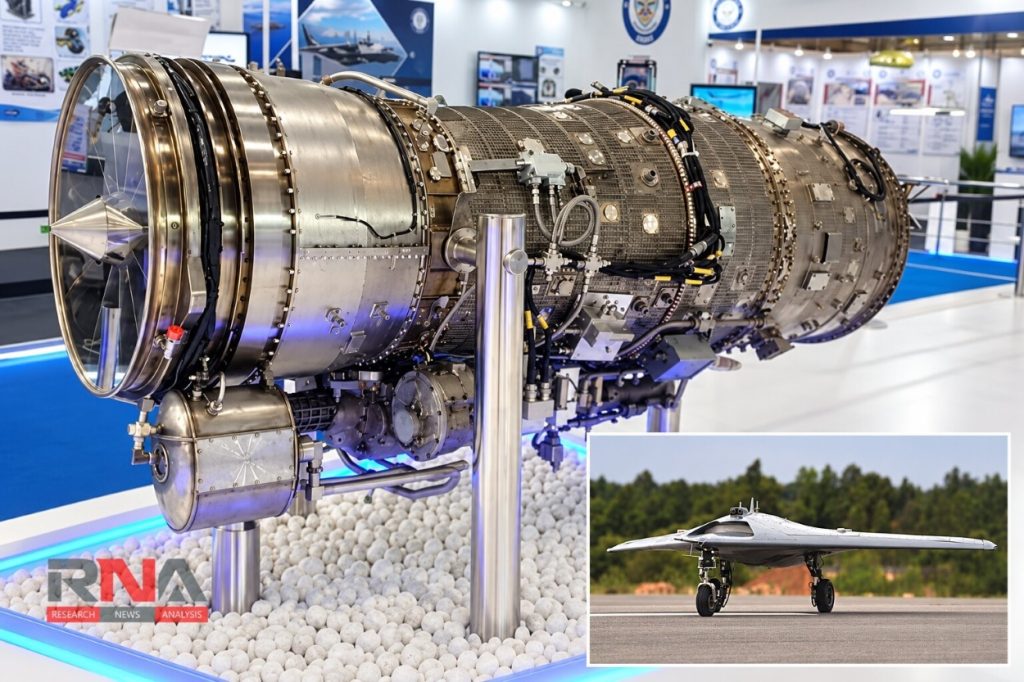
New Delhi: India’s indigenous Kaveri dry engine has reportedly completed high-altitude and flight trials in Russia, advancing efforts to power the planned Ghatak stealth unmanned combat aerial vehicle (UCAV). Developed by the Defence Research and Development Organisation’s (DRDO) Gas Turbine Research Establishment (GTRE), the engine offers a potential domestic propulsion option for a programme intended to strengthen India’s unmanned strike capabilities.
According to the report, the engine produced a peak dry thrust of 48.5 kilonewtons (kN), exceeding its approximately 46kN target. The reported result supports further work towards integration with Ghatak, although successful engine trials alone do not establish that the aircraft or its propulsion system is ready for operational service.
The immediate significance lies in finding a practical application for technology originally developed for the Tejas fighter programme. A non-afterburning Kaveri derivative could give India greater control over propulsion for an unmanned combat aircraft, while drawing on decades of investment in engine design, materials and testing.
The “dry” designation means the engine operates without an afterburner, which injects additional fuel into the exhaust stream to increase thrust. As NASA’s explanation of afterburning engines shows, that extra thrust comes with substantially higher fuel consumption, making the distinction important when comparing this derivative with engines designed for supersonic fighters.
The chronology nevertheless requires care because Russian testing of the Kaveri derivative predates the latest reports. At Aero India 2023, a senior GTRE official told Janes that the engine had completed high-altitude chamber tests at Russia’s Central Institute of Aviation Motors, under conditions simulating an altitude of 13,000 metres.
Those chamber tests should be distinguished from flight trials and subsequent clearance for installation in an aircraft. The latest reporting describes progress towards Ghatak integration, but the material available does not establish the precise completion date of the reported trials or provide a detailed certification and integration schedule.
Kaveri’s origins go back to 1989, when the government sanctioned the indigenous engine project for India’s light combat aircraft effort. Its development encountered technological difficulties, shortages of critical materials and components, and gaps in domestic manufacturing and testing infrastructure, according to a government statement issued on July 30, 2015.
That statement also recorded the decision to develop a non-afterburning derivative for an Indian unmanned combat aircraft after Kaveri failed to deliver the thrust required for the light combat aircraft. The shift therefore represents a long-running effort to adapt the programme’s technology to a different operational requirement.
The government subsequently reiterated the limits of the original design in a parliamentary reply on November 29, 2021. It said the operationally cleared Tejas configuration required more thrust than Kaveri’s existing architecture could provide, and that integration would require a modified engine.
By then, the programme had produced nine full prototype engines and four core engines, accumulating 3,217 hours of engine testing. The government said technologies developed through Kaveri were being used in other engine programmes, with the prototypes also serving as platforms for validating next-generation technologies.
India has separately advanced the aircraft technologies relevant to future unmanned combat platforms. DRDO’s autonomous flying-wing technology demonstrator completed a flight in its final configuration on December 15, 2023, following earlier developmental trials that helped validate aerodynamics, flight controls and autonomous operation.
The demonstrator also achieved autonomous landing using onboard sensors and satellite-assisted navigation, without requiring a pilot or ground-based landing radar. These results demonstrate progress in enabling technologies, although they should not be treated as evidence that a full-scale, armed Ghatak aircraft has completed development.
The wider operational requirement received fresh backing on March 27 this year when the Defence Acquisition Council approved the necessity for remotely piloted strike aircraft for the Indian Air Force. The defence ministry identified offensive air operations and stealth intelligence, surveillance and reconnaissance among their intended roles, without specifying Kaveri propulsion in that announcement.
For India, the reported Russian trials strengthen the prospect of turning Kaveri’s accumulated technology into a usable domestic engine. The next decisive measure will be its performance within the intended aircraft and eventual qualification for service, while Tejas continues to rely on GE Aerospace’s F404-IN20 engines.