


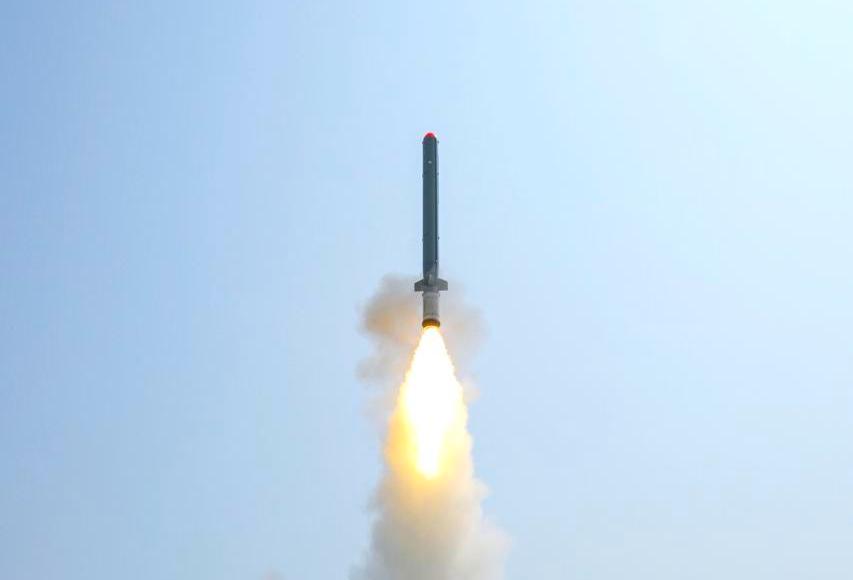
New Delhi: The Defence Research and Development Organisation (DRDO) conducted the second flight-test of its indigenously developed long range land-attack cruise missile (LRLACM) from Dr APJ Abdul Kalam Island off the coast of Odisha on Monday. A Ministry of Defence release said all test objectives were fully met, according to data captured by tracking instruments deployed by the Integrated Test Range at Chandipur.
The launch was observed by senior officials from DRDO and representatives of the Indian Navy and the Indian Air Force. The test, coming after a gap of around 10 months from the missile’s maiden flight in November 2024, is widely seen within defence circles as the critical validation needed before the armed forces proceed with a procurement order that could be worth upwards of ₹14,000 crore.
The defence minister, Rajnath Singh, congratulated the DRDO team and industry partners on the outcome. The defence secretary, Rajesh Kumar Singh, who has held additional charge as DRDO chairman since May 31, following the retirement of Dr Samir V Kamat, monitored all activities during the test and congratulated all team members involved.
What is the LRLACM?
The LRLACM is a subsonic, terrain-hugging cruise missile designed for precision strikes on land targets at stand-off distances. It is an improved version of the Nirbhay missile, featuring advanced avionics and software, and demonstrated terrain-hugging capability alongside the ability to perform complex manoeuvres at varying altitudes and speeds using waypoint navigation. Components are almost entirely locally sourced, with Bharat Dynamics Limited (BDL) and Bharat Electronics Limited (BEL) serving as development-cum-production partners.
The Aeronautical Development Establishment (ADE), Bengaluru, is the nodal laboratory for the programme, with contributions from several other DRDO laboratories and Indian industry partners.
The maiden test had been conducted on November 12, 2024, using a mobile articulated launcher at the Integrated Test Range in Chandipur. During that test, all sub-systems performed as expected, meeting primary mission objectives, with the missile tracked by radar, electro-optical tracking systems, and telemetry deployed at multiple locations along the flight path. Saturday’s second test, conducted from the same island facility in the Bay of Bengal, appears to have validated performance parameters beyond what was demonstrated in November.
The LRLACM has a strike range of around 1,000km in its current configuration, drawing comparisons to the US Tomahawk and Russia’s Kalibr in its ability to deliver precise, long-range strikes on strategic targets. It is designed for deployment across three platforms: mobile ground launchers, frontline warships, and fighter aircraft. The naval variant is compatible with the universal vertical launch module (UVLM), a system already operational on 30 Navy vessels.
The Air Force and the Army have already received the acceptance of necessity (AoN) for procurement, with planned orders estimated at ₹10,000 crore from the Air Force and ₹4,000 crore from the Army. The Navy is expected to place an order for approximately 200 missiles worth around ₹5,000 crore once trials are completed.
Development of an air-launched variant is also under way. Integration work is focused on adapting the missile for launch from the Su-30MKI, which will serve as the primary test platform, with the air-launched version powered by the indigenous Manik small turbofan engine developed by the Gas Turbine Research Establishment (GTRE). A further stealth-optimized variant is being designed to fit the internal weapons bay of the advanced medium combat aircraft (AMCA), with a reduced radar cross-section achieved through advanced composite materials and redesigned airframe geometry.
Scientists are also pursuing a 2,500km-range derivative of the missile, which would significantly extend India’s deep-strike reach. In its current form, the LRLACM complements the supersonic BrahMos by offering a longer-range, lower-cost strike option suited to scenarios where speed is less critical than persistence and precision.
The missile’s development is classified as a “mission-mode project” under the Defence Acquisition Council, which shows the priority attached to closing a capability gap that India has long sought to address. Its successful second test removes a key procedural hurdle before formal induction, and the presence of Navy and Air Force observers at the launch suggests both services are watching the programme closely.