


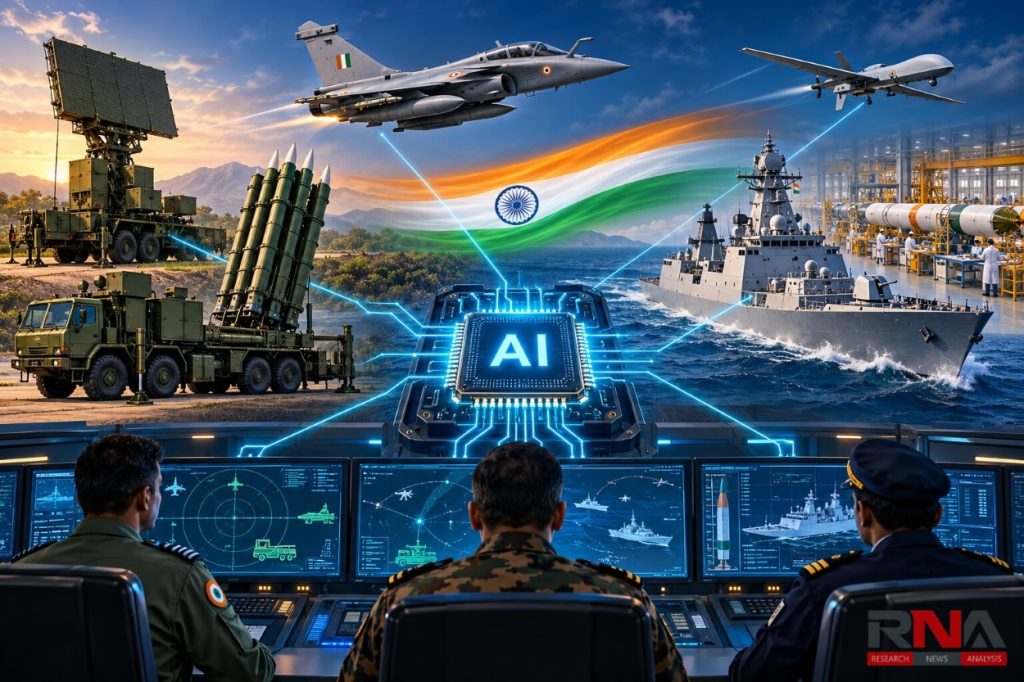
New Delhi: India is developing an indigenous artificial intelligence layer for its armed forces to retain control over sensitive operational data and reduce dependence on foreign technology, the defence secretary, Rajesh Kumar Singh, said on Friday. The initiative accompanies efforts to strengthen networked air defence and expand domestic missile production as inexpensive drones reshape the demands of warfare.
Speaking at the KPMG Agrasar Bharat Manch event, Singh said the government was working with the IndiaAI Mission and its selected private-sector partners, with the necessary computing resources already being procured. The proposed capabilities would support military decision-making, target acquisition and the integration of information from different sensors.
“We have to develop our own AI layer for our military,” Singh said, citing the sensitivity of the information involved. He linked the work to the “sensor-to-shooter loop” – the process of turning sensor inputs into information that supports targeting and military responses.
Singh argued that certain technologies were either unlikely to be shared or too important to entrust to foreign companies. However, developing domestic capabilities would not preclude cooperation with friendly countries.
The IndiaAI Mission, approved on March 7, 2024, with an outlay of ₹10,371.92 crore, provides the wider national framework for expanding access to AI computing and supporting indigenous models. Its original plan envisaged infrastructure comprising at least 10,000 graphics processing units through public-private partnerships, alongside programmes for applications, skills, start-up financing and safe AI development.
That framework offers resources beyond computing hardware, including support for models designed for specific sectors and applications addressing requirements identified by government institutions. Singh’s remarks indicate that defence planners intend to draw on this wider ecosystem to develop capabilities suited to military requirements.
On air defence, Singh said the Integrated Air Command and Control System (IACCS) already connected ground radars, aerial platforms and air-defence systems. The objective was to strengthen that network and modernize ageing equipment as part of a broader, multilayered protective shield.
The importance of such integration extends beyond the performance of any individual weapon: a shared operational picture helps different services coordinate their responses. In September last year, the defence ministry said the Air Force’s IACCS worked with the Army’s Akashteer and the Navy’s Trigun, supporting timely decisions and reducing the risk of friendly fire during Operation Sindoor.
Modernization does not necessarily mean discarding older weapons, Singh explained, pointing to air-defence guns upgraded with radars and network connections. Such guns could provide a cheaper response to drones than missiles costing ₹5 crore to ₹10 crore apiece.
Singh also called for larger-scale production of conventional ballistic missiles to lower unit costs, citing Iran’s experience. He said nearly 17 major private and public-sector companies had either obtained, or were pursuing, technology transfers covering conventional missiles of different ranges.
According to Singh, future conflicts would require drones and conventional ballistic missiles in substantially greater quantities than previously anticipated. Building the industrial capacity to increase production rapidly was therefore also necessary to strengthen deterrence.