


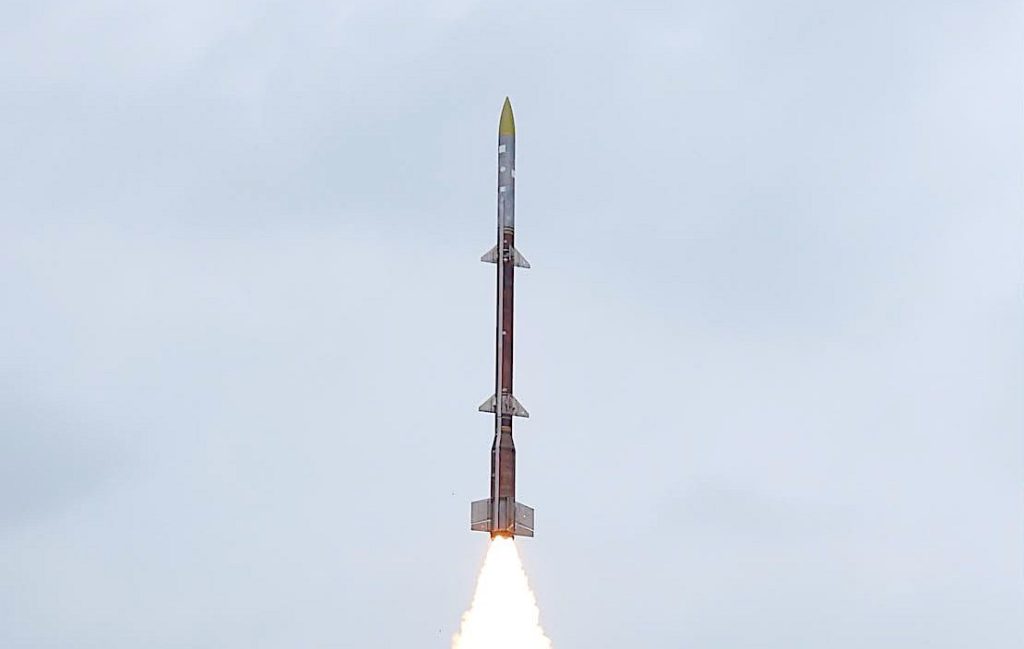
New Delhi: The Defence Research and Development Organisation carried out the maiden flight-test of its long-range surface-to-air missile system, Kusha, from the APJ Abdul Kalam Island off the coast of Odisha, on Thursday. The trial engaged an electronic target simulating a high-speed, high-altitude aerial threat.
The missile intercepted the target successfully, according to a statement issued by the Ministry of Defence.
The defence minister, Rajnath Singh, said the test marked an important milestone in Indian defence research and development, and reflected a capability held by only a handful of nations. He added that the system would end India’s dependence on imports for such systems and represented a significant advance in the country’s air-defence capability.
The defence secretary, who also holds charge as secretary of the department of defence research and development and chairman of DRDO, Rajesh Kumar Singh, monitored the launch and congratulated the team involved in the trial.
What Kusha is designed for?
Kusha is intended to neutralize a range of aerial threats, including fighter jets, missiles, unmanned aerial vehicles and large aircraft, across a wide envelope of range and altitude. All elements of the system – missiles, radars, and the command and control centre – have been developed by DRDO laboratories working with industry partners.
The programme, also referred to in defence circles as the ERADS (extended range air-defence system) has been under development since 2023 and was cleared by the Cabinet Committee on Security in May 2022. It is designed to close the gap between India’s medium-range surface-to-air missile, which has a range of around 80 kilometres, and the Russian-supplied S-400, which extends to 400 kilometres.
The complete system is expected to field three interceptor variants – the M1, with a range of roughly 150 kilometres; the M2, at around 250 kilometres; and the M3, extending to 350–400 kilometres – allowing a layered defence against threats approaching at different speeds and distances. Reports on the programme have put its overall cost at approximately ₹21,700 crore, with induction into service expected between 2028 and 2030.
Bharat Electronics Limited and Bharat Dynamics Limited are the principal industry partners on the programme, alongside DRDO’s missile laboratories.
The test comes as India continues to expand its layered air defence architecture, which currently rests on the Akash missile system, the Barak-8 and the imported S-400. Kusha, once operational, is intended to be integrated with the country’s wider air-defence network, drawing target data from long-range tracking radars and airborne early-warning platforms. Thursday’s trial is the first in a series of flight tests expected before the system moves towards user trials, which reports suggest could begin around 2027.