


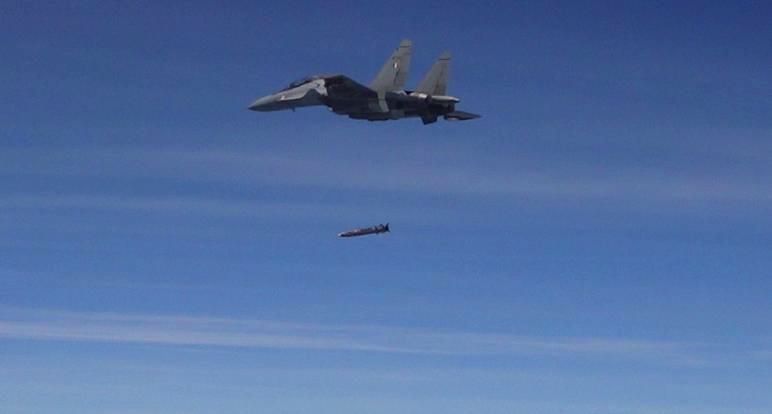
New Delhi: The Defence Research and Development Organisation (DRDO) and the Indian Air Force (IAF) successfully conducted fresh test-firing of the indigenous Rudram II air-to-surface missile from a Sukhoi-30MKI fighter aircraft off the coast of Odisha, the Ministry of Defence said in a news release on Tuesday. This marks another milestone in India’s effort to strengthen its long-range precision-strike capabilities.
According to the ministry, the missile was launched under extreme release conditions and successfully achieved all mission objectives. The test validated the missile’s guidance, navigation and control systems, as well as the performance of its critical onboard subsystems throughout the flight.
The ministry said the missile demonstrated pinpoint accuracy against its designated target, confirming the effectiveness of the weapon system and its suitability for operational deployment.
Data collected from various tracking assets deployed by the Integrated Test Range, Chandipur, including radars, electro-optical sensors and telemetry systems, confirmed the missile’s performance across all phases of the flight. The test was carried out jointly by DRDO scientists, IAF personnel and industry partners associated with the programme.
The defence minister, Rajnath Singh, congratulated DRDO, the Air Force, and industry partners on the successful trial. He described the achievement as a major boost to India’s indigenous defence capabilities and said the missile would substantially enhance the operational effectiveness of the armed forces.
The Department of Defence (R&D) secretary and DRDO chairman, Dr Samir V Kamat, also congratulated the teams involved in the programme and praised their efforts in achieving another important milestone in the development of advanced indigenous missile systems.
The latest trial follows the successful developmental test of Rudram II conducted on May 29, 2024, when the missile was launched from a Sukhoi-30MKI aircraft and validated its propulsion system as well as its control and guidance algorithms.
Rudram II: India’s next-gen standoff missile
Rudram II is an indigenously developed air-launched, solid-propelled supersonic missile designed primarily for the air-to-surface role. Developed by DRDO, the weapon is part of the broader Rudram family of missiles that are intended to provide the Indian Air Force with advanced suppression and destruction capabilities against enemy air-defence networks and high-value ground targets.
The missile has been developed by Hyderabad-based DRDO laboratories, particularly the Defence Research and Development Laboratory (DRDL), with contributions from several other DRDO establishments and Indian industry partners. It represents a major step in India’s effort to reduce dependence on imported precision-guided munitions and standoff weapons.
Unlike traditional strike weapons that require aircraft to fly close to hostile territory, Rudram II is designed as a standoff weapon. This allows a fighter aircraft to engage targets from long distances while remaining outside the engagement envelope of many enemy air-defence systems. Such capabilities are increasingly important in modern warfare, where integrated air-defence networks pose significant threats to attacking aircraft.
Official DRDO descriptions characterize Rudram II as an air-to-surface missile capable of neutralizing a wide range of enemy assets. The missile incorporates several advanced indigenous technologies, including modern guidance systems, navigation equipment and mission computers developed within the DRDO ecosystem.
The missile is launched from the Su-30MKI, the Air Force’s principal air-dominance fighter. Integration with the heavy twin-engine fighter provides the missile with substantial operational flexibility, enabling it to be carried deep into operational areas before launch. The combination gives the Air Force a powerful capability to strike strategic targets while minimizing risk to aircrew and aircraft.
One of the principal missions associated with the Rudram family is the suppression of enemy air defences (SEAD) and destruction of enemy air defences (DEAD). In such operations, missiles are used to locate and destroy radar stations, surveillance systems, command-and-control nodes and surface-to-air missile batteries. Eliminating or degrading these systems creates safer corridors for follow-on air operations.
Rudram II is understood to build upon technologies demonstrated in earlier Rudram variants while offering enhanced range, improved guidance and a larger engagement envelope. According to some media reports, the Rudram II missile has a range of 300 to 350 kilometres. Defence analysts have often described it as a weapon capable of engaging both emitting and pre-designated targets, making it useful against a variety of fixed and semi-fixed installations.
The missile’s development is also significant because it reflects the growing maturity of India’s indigenous missile ecosystem. Over the past decade, DRDO has successfully developed a broad portfolio of precision-guided weapons, including air-to-air missiles, cruise missiles, anti-radiation missiles and long-range glide weapons. Rudram II fits into this expanding family of indigenous strike systems intended to provide the armed forces with a comprehensive range of options across different operational scenarios.
The successful 2024 developmental trial validated the missile’s propulsion system and control and guidance algorithms, while the latest test focused on validating performance under operationally demanding release conditions and confirming the effectiveness of critical onboard systems. Together, these trials move the programme closer to induction and operational deployment.
For the Indian Air Force, the missile is expected to become an important force multiplier by providing a long-range precision-strike capability against high-value targets while allowing launch platforms to remain at safer distances from hostile defences. As regional militaries continue to invest in sophisticated air-defence systems, standoff weapons, such as Rudram II, are increasingly viewed as essential components of modern air power.
With another successful flight-test completed, the Rudram II programme has reinforced India’s progress toward self-reliance in advanced missile technologies and strengthened the country’s ability to develop complex precision-guided weapons for future operational requirements.