


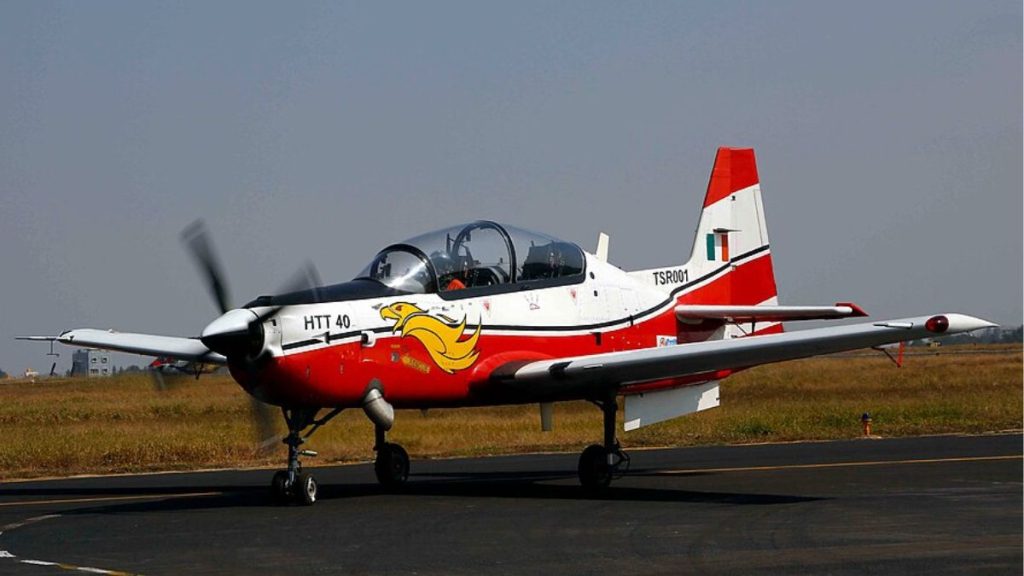
American engine-maker Honeywell has delivered three aero engines to India’s state-run Hindustan Aeronautics (HAL) for the delayed indigenous HTT-40 basic trainer aircraft.
The three PTE331-12B aero engines were part of the first batch that reached the Bengaluru-based HAL, overcoming the supply chain bottlenecks, according to officials with knowledge of the matter.
The HTT-40 (Hindustan Turbo Trainer – 40) is a critical platform for training Indian Air Force (IAF) flight cadets at the Air Force Academy (AFA) in basic flying.
HTT-40 is a HAL-built aircraft developed by the state-run company with its own resources and has been accepted into the AFA for basic training of cadets after much debate.
Honeywell’s TPE331-12B was selected to power the HTT-40 and HAL had ordered 88 aero engines at a cost of $100 million in 2022. Honeywell was supposed to deliver the first engine in September 2025.
The US firm will supply 16 units off-the-shelf and HAL will build the rest 72 units on technology transfer. The American company has now assured HAL of timely supplies after it initially faced supply chain disruptions, officials said.
HAL has received a 70-aircraft contract from the IAF for HTT-40 at a cost of Rs 6,838 crore. The contract mandated that HAL supply IAF 12 aircraft in the 2025-26 fiscal in the first batch.
Due to supply delays for the aero engines, HAL has already overshot the mandated timelines for delivery of the 12 first HTT-40. Now, Honeywell is expected to supply two aero engines a month, and the IAF would meet its contract commitments within the next six months, the officials said.
Two series production HTT-40s are already flying with ‘Category B’ (second-hand use) TPE331-12B engines that powered the prototype aircraft. HAL’s new manufacturing facility for the Honeywell aeroengine would help accelerate the HTT-40s delivery, the officials said.
In October 2025, Defence Minister Rajnath Singh had opened the LCA Mk1A and HTT-40 production lines at HAL’s Nasik facility to meet the air force’s fleet requirements. HAL facility can produce 20 HTT-40 a year in both Nasik and Bengaluru facilities.
The HTT-40 is a modern basic trainer aircraft with an air-conditioned cockpit, modern avionics, capability to refuel while the engines are still running (hot refuelling), and zero-zero ejection seats for safe ejection at low speeds and low heights for both the trainee and the trainer pilots.
The HAL-produced HTT-40 currently depends on 56% indigenous content and the state-run company targets to increase indigenisation by 60% gradually for major components and subsystems.
The IAF currently uses the Swiss-origin Pilatus PC-7 MkII basic trainers for ab-initio or Stage I flight training for all pilots, be they from the fighter, transport, or helicopter streams.
For Stage-II training, the IAF fighter pilots go on to train on the Kiran Mk1A and for Stage-III, they train on British-origin Hawk Advanced Jet Trainers, before they graduate to fly supersonic fighters. The helicopter and transport pilots fly their respective platforms after their Stage-I training.
India originally planned to buy more PC-7 MkII trainers, but it was shelved in July 2019 after the Swiss firm Pilatus Aircraft Limited was suspended for doing business with the Ministry of Defence for a year over violating the integrity pact as part of the Rs 2,900-crore contract for supplying 75 basic trainers.
India began an investigation into Pilatus for alleged irregularities in its operations in India, and the plans for buying an additional 38 basic trainers as part of the original contract was scrapped.