


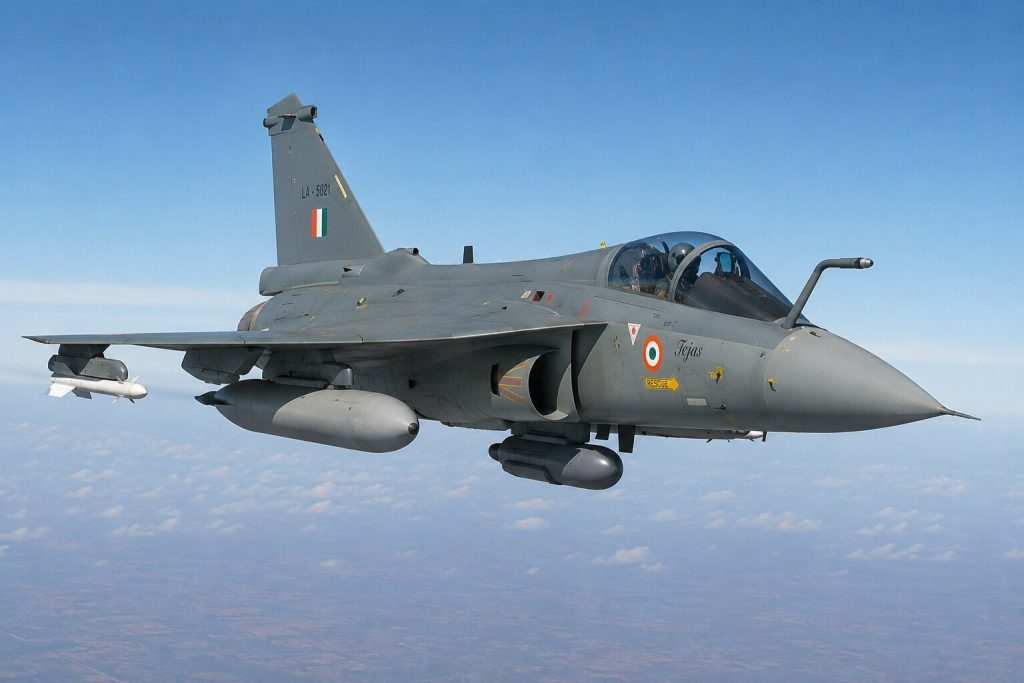
New Delhi: The long-delayed Tejas-Mk1A fighter jets could start entering the Indian Air Force in meaningful numbers sometime after September, the defence secretary, Rajesh Kumar Singh, has said. He added that the Air Force has eased some of the conditions it had originally laid down for induction.
Singh was speaking in a wide-ranging interview with Moneycontrol [YouTube video], published on Monday, that also touched on defence indigenization, startups, missile production, exports and the fifth-generation fighter programme.
Seven Tejas-Mk1A prototypes ready
Singh said seven Tejas-Mk1A prototypes are now ready, following the arrival of engines from GE Aerospace. Hindustan Aeronautics Limited (HAL), he said, is close to meeting the minimum requirements the Air Force had set out.
“My understanding is that on some of the critical areas, they are almost there,” Singh said. Going by the latest data from HAL, he added, September is the month by which those benchmarks could be met.
On the remaining conditions, Singh said the Air Force is “giving them some concessions” – a sign that the service is willing to accept the platform without insisting on every original requirement being met immediately.
Engine supply from GE will set pace
The timeline, Singh made clear, still hinges on engine deliveries. “If the engine delivery programme keeps up, August onwards they are supposed to give two engines every month,” he said, referring to the F404-IN20 engine that powers the single-engine Tejas-Mk1A.
“With that available, I hope by sometime after September we can start inducting these aircraft in good numbers,” he said.
The original 2021 contract for 83 jets had scheduled engine supply to begin from March 2024, a timeline GE Aerospace missed, citing supply-chain constraints. HAL has since imposed contractual penalties on GE Aerospace for the delay, even as the American company has more recently assured HAL that it would supply up to 20 F404-IN20 engines in the second half of 2026.
Beyond the original 83 jets, the government cleared a follow-on order for 97 more Tejas-Mk1A aircraft in 2025, taking the eventual fleet size to 180, a number that will matter as the Air Force contends with a dwindling squadron strength.
Private sector’s share climbing
In the interview, Singh said the government’s broader push has been to build a level playing field for the private sector and startups, give demand-side visibility on orders and ease supply-side compliance. Roughly 75 per cent of the procurement budget is now earmarked for domestic orders, he said, with the IDDM (indigenous design, development and manufacturing) category getting top priority within that.
Industrial licences issued to defence companies numbered about 250 until 2015, Singh said, and have crossed 800 in the past decade or so. He said his ministry has comfortably exceeded the 75 per cent domestic-sourcing target during his roughly one-and-a-half years in office.
On the public-private split, Singh said the private sector’s share of production has grown from about 20 per cent two years ago to 24 per cent now, against public-sector undertakings (PSUs). Steps such as removing product reservations for certain PSUs and opening the AMCA fighter programme to private bidders are meant to push that split towards 50-50 over time, he said.
Singh drew a comparison with the mobile phone sector, where iPhones assembled in India under the Production-Linked Incentive scheme – he referred to it during the conversation as the “PLI model” – are only partly indigenous in content. He said defence manufacturing would follow a similar phased path: starting with assembly or maintenance, repair and overhaul (MRO) work where technology readiness is low, and moving to full IDDM production as it improves, citing the Tejas and the Pinaka rocket system as areas where India is already close to full design sovereignty.
DRDO widening role
On startups, Singh said the Defence Research and Development Organisation (DRDO) now earmarks 25 per cent of its research budget for industry, startups and academia, and runs 11 centres of excellence with academic institutions. The Innovations for Defence Excellence (iDEX) scheme, he said, remains the only government mechanism that funds startups through to the prototype stage before they must compete in formal bidding.
Under the revised Defence Acquisition Procedure, Singh said, companies that develop a product in consultation with the services could be given repeat orders for about five years before the market is opened up fully. He said the aim is to give young companies enough revenue visibility to survive between one contract and the next.
Singh also credited DRDO’s technology transfers with underpinning much of India’s private defence sector. He said around 145 companies have taken more than 2,000 technology transfers from DRDO, cumulatively enabling close to ₹7 lakh crore worth of production over the decades – citing the Advanced Towed Artillery Gun System (ATAGS), a ₹7,000 crore contract, and a roughly ₹4,500 crore order for close-quarter carbines, among the largest small-arms orders in the world, as recent examples.
Missile production opens up
Missile manufacturing, Singh said, had long been concentrated with one public-sector company, Bharat Dynamics Limited (BDL). With warfare demanding much larger production volumes, he said the government now intends to transfer DRDO missile technologies to private companies as well, allowing them to produce conventional missiles at scale.
On the fifth-generation AMCA, Singh said requests for proposals have gone out to three consortia – Tata Advanced Systems Limited on its own, Larsen & Toubro with Bharat Electronics, and Bharat Forge with Data Patterns and BEML. He said bids are due, with five prototypes planned and a first flight test targeted for 2028.
He ruled out a fresh purchase of Sukhoi jets, saying the ministry is instead upgrading India’s existing Su-30MKI fleet, including integrating it further with the BrahMos missile.
Exports nearing ₹50,000 crore
Singh said defence exports touched almost ₹39,000 crore last year and could reach ₹50,000 crore by the early 2030s. He cited a finalized BrahMos order from the Philippines, with Indonesia and Vietnam close to signing, and Akash missile and artillery exports to Armenia as examples of growing overseas demand.
He said 145 Indian companies now export defence equipment, and 1,800 export authorizations were issued to more than 100 countries in 2025-26 alone.
Lessons from Operation Sindoor
Asked about lessons from last year’s Operation Sindoor against Pakistan, Singh said the experience had reinforced the need for unmanned systems, precision long-range weaponry and autonomous platforms on land, in the air and underwater. He said the government had already moved to fast-track procurement for drones and counter-drone systems, given how quickly the technology is evolving.
He said close to ₹31,000 crore worth of equipment was ordered through emergency procurement immediately after the conflict, with the bulk of it going towards drones, counter-drone systems and lightweight radars.
On the debate over whether India is building a “military-industrial complex”, Singh pushed back on the term, calling it pejorative and rooted in the American context. He said he preferred “defence industrial complex”, arguing that India needs the hard power to protect itself as it moves up the ranks of the global economy.