


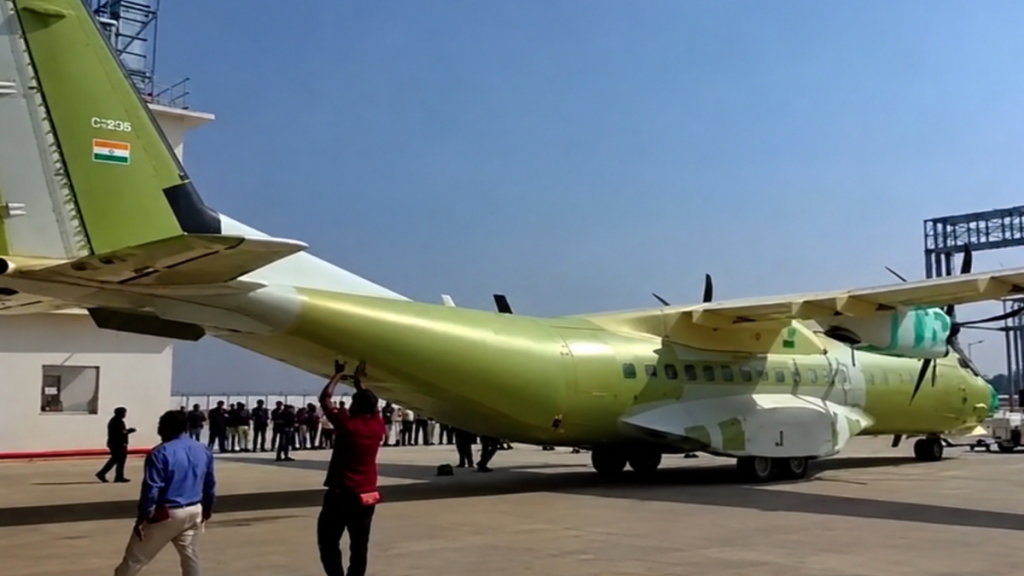
Private sector Tata Group has rolled out the first assembled-in-India C-295 military cargo aircraft from its facility in Gujarat’s Vadodara, marking a significant push towards self-reliance in aerospace and defence manufacturing.
The historic milestone was revealed in a video emerging from the Tata Advanced Systems Limited’s final assembly line, from where the first domestically manufactured Airbus C-295 was rolled out.
The TASL had set up the final assembly line for the C-295 with help from European aerospace and defence major Airbus, and the roll-out of the aircraft suggested the first unit was ready for the final stages of production.
Soon, the TASL and Airbus would deliver the aircraft to the Indian Air Force (IAF), which had ordered 56 C-295 aircraft to meet its transportation needs.
While no official word on the roll-out came from either the Indian government, the IAF, Airbus, or TASL, the video shows a breakthrough for the Indian aerospace and defence manufacturing ecosystem and ambitions.
When the contract was signed in 2021 for the 56 aircraft, the first 16 were to be delivered to IAF directly from Airbus’s Spanish facility, while the remaining 40 were to be assembled in India, gradually increasing the indigenous content on the aircraft.
Earlier, India’s External Affairs Minister Dr S. Jaishankar had said that the first C-295 aircraft from the Vadodara facility would be delivered in September 2026. Prime Minister Narendra Modi had inaugurated the Vadodara facility in 2024 in the presence of his Spanish counterpart.
The Airbus C-295 is a medium tactical military transport aircraft designed for troop movement, cargo transport, medical evacuation, and special operations.
Equipped with short take-off and landing capabilities, the aircraft can operate from rugged, semi-prepared, and short airstrips, making it ideal for Indian operational requirements, especially in mountainous regions and remote forward bases.
The aircraft can carry more than 9,000 kilograms of payload and transport up to 71 troops. It is expected to replace the Indian Air Force’s ageing Avro fleet and may eventually support the phased replacement of sections of the An-32 transport fleet as well.