


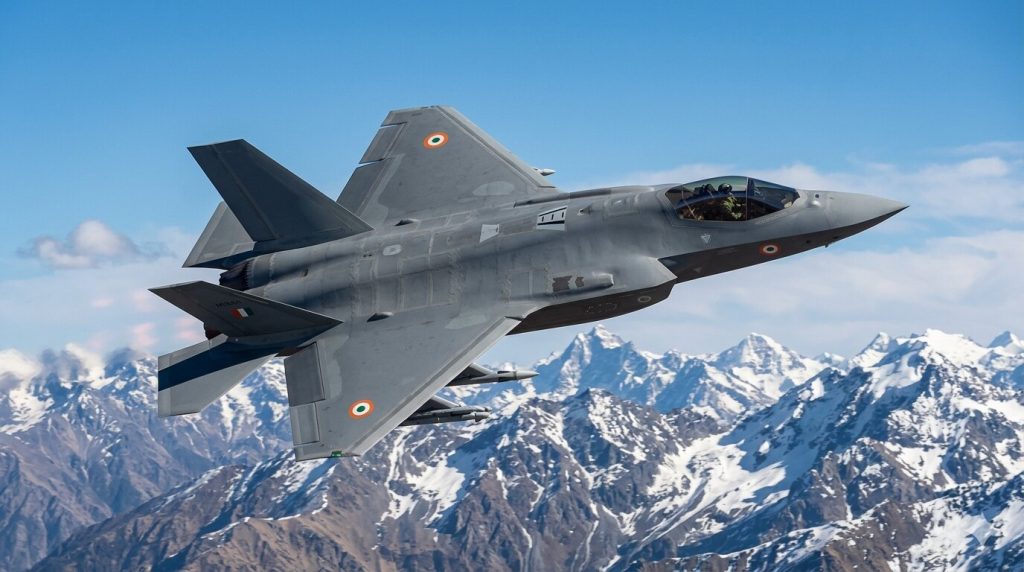
New Delhi: Reliance Industries and Rolls-Royce have announced plans to jointly pursue the development of an indigenous combat-aircraft engine for India’s AMCA (advanced medium combat aircraft) programme. The proposed collaboration would cover design, development, manufacturing, testing, production and long-term support, placing the companies in contention for one of India’s most strategically important defence-technology projects.
The companies said on Friday that they would also examine the establishment of a dedicated aerospace gas-turbine complex in India. The facility is envisaged as a centre for advanced propulsion technologies, with capabilities spanning the entire life cycle of military aero-engines.
The announcement is, however, a declaration of strategic intent rather than a government-awarded development contract or a finalized joint venture. The companies have not disclosed the proposed investment, ownership structure, technology-sharing terms or timetable for the complex, according to their joint statement.
If the proposal advances, Rolls-Royce would contribute its combat-engine design and propulsion expertise, while Reliance would bring its manufacturing scale, engineering capabilities and experience in executing large industrial projects. The companies said the facility could eventually support work beyond the AMCA, including civil aerospace and emerging power and propulsion systems.
The executive director of Reliance Industries, Anant Ambani, said sovereign control over critical technologies was central to India’s strategic autonomy. He said the proposed partnership was intended to combine Rolls-Royce’s propulsion expertise with Reliance’s manufacturing and execution capabilities to establish an enduring aero-engine ecosystem in India.
The chief executive of Rolls-Royce, Tufan Erginbilgiç, said the alliance would bring together the British company’s engineering heritage and Reliance’s position in Indian industry. He described the proposal as a step towards creating a more robust and self-reliant domestic aerospace base.
The initiative comes as India seeks to move beyond licensed production and local assembly towards ownership of the intellectual property, design knowledge and materials technologies needed to develop high-performance fighter engines. Modern combat powerplants require mastery of complex areas such as high-temperature turbine materials, single-crystal blades, advanced cooling systems, digital engine controls and precision manufacturing.
India has yet to field a fully indigenous engine for a frontline fighter, despite the technological experience accumulated through the Kaveri programme. The country consequently remains dependent on imported powerplants for aircraft including the Tejas LCA and the initial versions of the AMCA.
The first AMCA prototypes are expected to use General Electric’s F414 engine, while a more powerful engine developed with foreign collaboration is intended for later variants of the twin-engine stealth fighter. A prototype of the aircraft is expected to be rolled out in 2028, although complex combat-aircraft programmes frequently face changes in development schedules, Reuters reported.
The Reliance–Rolls-Royce proposal may place the British manufacturer in competition with France’s Safran, which has separately discussed collaboration with the Gas Turbine Research Establishment for a high-thrust engine. Any eventual selection would be expected to turn on the extent of technology transfer, Indian ownership of intellectual property, development costs, performance guarantees and the ability to establish a sustainable domestic supply chain.
The aircraft programme itself was opened to wider industrial participation after the defence ministry approved a new AMCA execution model in 2025. The framework allows Indian companies to compete independently or through consortia and joint ventures, marking a departure from the longstanding reliance on a single state-owned manufacturer for major fighter-aircraft projects.
Rolls-Royce already has a substantial military-aerospace history in India, including more than six decades of engine production and support with Hindustan Aeronautics Limited. HAL has manufactured and maintained Rolls-Royce Adour engines for the Indian Air Force’s Jaguar strike aircraft and Hawk advanced jet trainers, while the relationship began with licensed production of Orpheus engines in 1956, according to the British company.
Reliance, by comparison, would be a relatively new entrant into the highly specialized field of fighter-engine development. Its involvement nevertheless reflects the government’s effort to draw large private companies into capital-intensive defence programmes that were historically dominated by state-owned organizations.
For India, the strategic value of the project would depend less on assembling an engine domestically than on acquiring the capacity to design, modify, certify and upgrade it without external restrictions. Until commercial terms are agreed and the government identifies its development partner, the Reliance–Rolls-Royce announcement remains a significant industrial proposition rather than the final resolution of India’s long-running search for a sovereign fighter engine.