


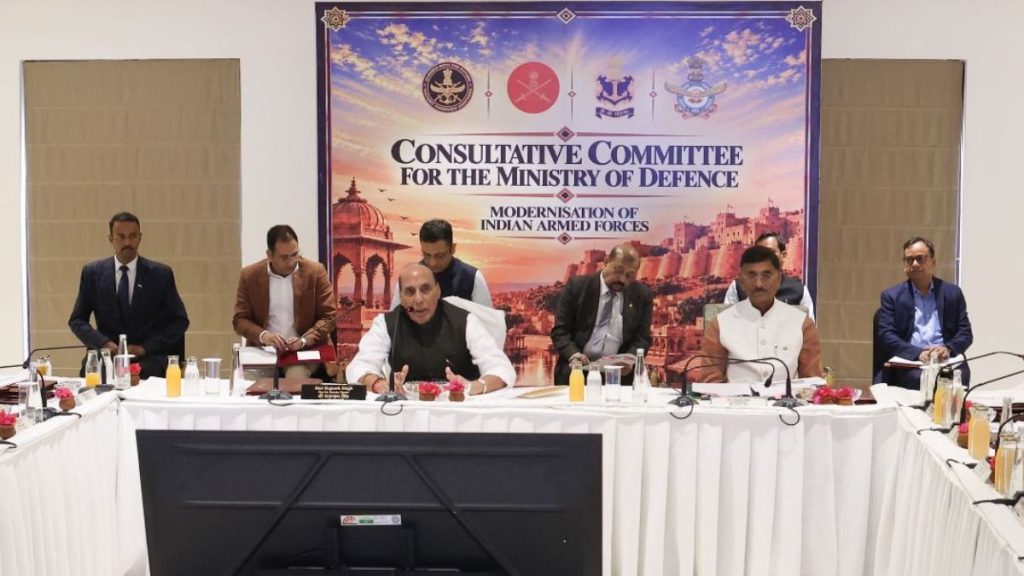
New Delhi: The defence minister, Rajnath Singh, on Tuesday reviewed plans to modernize the armed forces through advanced weapons, emerging technologies and closer coordination among the three services at a meeting in Jaisalmer, Rajasthan. He also set out targets of ₹3 lakh crore in annual defence production and ₹50,000 crore in defence exports by 2029.
The November 3 meeting of the Ministry of Defence’s consultative committee examined emerging security challenges, changing warfare requirements and the need for a technologically empowered military. In a post on X, Singh said the government, under the prime minister, Narendra Modi, had prioritized budgetary support and capital acquisition for modernization. He stressed that adequate financial resources, effective utilization and prioritization of the services’ critical requirements were essential to strengthening military capabilities. The members of parliament from both houses attended alongside senior civilian and military officials.
Six priorities for future warfare
The meeting highlighted six priorities, beginning with faster induction of next-generation platforms, weapon systems and technologies. It also stressed stronger joint operational planning among the Army, Navy and Air Force, including the coordinated use of capabilities across land, sea, air and other domains.
Artificial intelligence, autonomous systems, drones, cyber and space capabilities, electronic warfare and advanced communications featured among the technologies highlighted for future conflicts. The discussions focused on capability development and readiness rather than announcing any new weapon purchases or procurement approvals.
Other priorities included expanding domestic research, design and manufacturing, and improving collaboration among the services, the Defence Research and Development Organisation (DRDO), defence public sector undertakings, private manufacturers and universities.
The discussions also emphasized clearer priorities, institutional mechanisms and measurable milestones to ensure modernization programmes deliver operational improvements. The proposed approach included streamlining acquisition and development processes, coordinating stakeholders and regularly reviewing progress.
Defence budget and production ambitions
Singh cited a record defence budget of ₹7.85 lakh crore for financial year 2026-27, of which ₹2.19 lakh crore has been earmarked under the capital head for modernization and capital procurement. The overall allocation also covers other requirements, including personnel, pensions and operational expenditure.
The February budget backgrounder specified ₹1.85 lakh crore for capital acquisition, including ₹1.39 lakh crore for procurement from domestic defence industries. The latter represents roughly 75 per cent of the proposed capital acquisition expenditure. DRDO was allocated ₹29,100.25 crore, compared with a ₹26,816.82 crore budget estimate for 2025-26.
Defence production rose from ₹46,429 crore in 2014-15 to ₹1.78 lakh crore in 2025-26, while exports increased from less than ₹2,000 crore in 2014 to approximately ₹40,000 crore, Singh said. The 2029 figures remain targets, not current achievements.
New formations and personnel
The minister also referred to the Indian Army’s Asani, Bhairav and Shaktiban platoons, saying the newer formations were proving effective in responding to contemporary operational requirements. The release did not specify their strength, equipment, deployment locations or roles.
Singh said modernization involved more than acquiring equipment, emphasizing personnel preparedness and the ability to adapt military structures as warfare changes. He pointed to DRDO’s work on advanced weapons, missiles and other systems and sought greater participation by startups, small businesses and larger private companies.
The government’s stated objective is to reduce dependence on foreign defence suppliers while building domestic technological capabilities and strategic autonomy. Singh described this as a sustained effort linking military requirements to research, industry and longer-term operational preparedness.
The minister of state for defence, Sanjay Seth; the defence secretary, Rajesh Kumar Singh; and other senior officials attended. The ministry outlined a structured, phased approach, but announced no fresh contracts or specific procurement decisions.