


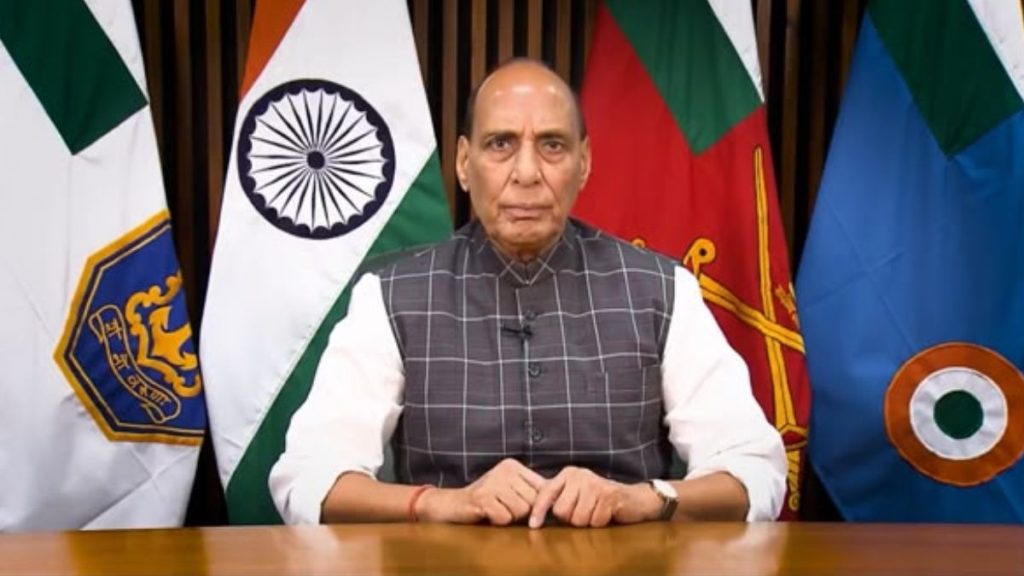
New Delhi: India’s defence modernization is entering a phase in which self-reliance is being linked directly with battlefield capability, faster procurement and preparation for technology-intensive warfare, the defence minister, Rajnath Singh, said in his Independence Day-eve address to the armed forces. His message placed the soldier at the centre of this transformation, arguing that modern weapons, indigenous capability and institutional reform must ultimately strengthen those operating on the battlefield.
The scale of the change is reflected in the numbers. India’s annual defence production reached a record ₹1.78 lakh crore in FY 2025-26, up from ₹46,000 crore in 2014, while defence exports rose from ₹686 crore in 2013-14 to ₹38,424 crore. India now has 145 defence exporters supplying products to more than 80 countries.
The government has set its sights higher, targeting defence production of ₹3 lakh crore and exports of ₹50,000 crore by 2029.
From self-reliance to military capability
Singh’s latest address builds on a theme that has become increasingly prominent in his Independence Day messages.
In 2023, the emphasis was on equipping the armed forces with modern weapons and training to meet future challenges. By 2025, following Operation Sindoor, the discussion had expanded to drones, layered air defence, electronic warfare, network-centric operations and the growing role of indigenous technology in combat.
The 2026 message goes a step further by linking these capabilities with the industrial and acquisition system required to sustain them.
The defence budget for 2026-27 stands at ₹7.85 lakh crore, with more than ₹2.19 lakh crore under the capital head. Of this, about ₹1.85 lakh crore is for capital acquisition, with approximately 75% earmarked for procurement from domestic defence industries.
The allocation for research and development through the Defence Research and Development Organisation (DRDO) has also risen to about ₹29,100 crore.
Self-reliance, therefore, increasingly means more than manufacturing a platform within India. The larger objective is to create the ability to design, test, manufacture, maintain and upgrade critical systems domestically through their operational life.
Private industry is becoming a larger part of that ecosystem. Public-sector entities accounted for about 76% of defence production in 2025-26, while the private sector contributed about 24%, up from 22% a year earlier.
Big approvals, but delivery is the real test
The acquisition pipeline illustrates the scale of ambition.
Singh said the Defence Acquisition Council had accorded Acceptance of Necessity for proposals worth more than ₹8.75 lakh crore over the previous year. Financial powers available to field commanders have also been enhanced, while revised delegated powers are expected to facilitate procurement worth more than ₹1.25 lakh crore through the revenue route.
But an Acceptance of Necessity is not the same as a signed contract or inducted equipment. It represents an important approval in the procurement process, after which proposals must progress through subsequent stages before equipment reaches military units.
That distinction will become increasingly important as India moves from announcing large acquisition programmes to measuring how quickly they translate into battlefield capability.
A major part of the next phase will be the new Defence Acquisition Procedure expected in 2026. Singh has said the revised procedure is intended to give fresh momentum to indigenous production and improve the acquisition system.
The challenge will be to shorten procurement timelines without weakening technical evaluation, transparency or operational testing.
Future warfare takes shape
Recent indigenous trials indicate the technologies being prioritized.
India has tested the Tactical Advanced Range Augmentation weapon, an indigenous glide weapon designed to extend the range and precision of conventional air-delivered weapons. DRDO has also successfully tested an actively cooled full-scale scramjet combustor for more than 1,200 seconds, an important step in the development of hypersonic technologies.
The maiden flight-test of the indigenous Kusha long-range surface-to-air missile in July added another element to the effort to build layered air-defence capability against advanced aerial threats.
Development of long-range strike systems, precision weapons, missiles, electronic warfare capability and unmanned systems reflects a broader recognition that future conflicts will increasingly be shaped by sensors, networks, drones, stand-off weapons and the speed at which information can be converted into action.
Successful trials are only the first step. The systems must still pass user evaluation, enter serial production and reach operational formations in meaningful numbers.
Beyond weapons and platforms
Singh’s Independence Day message also placed military preparedness in a wider context.
Border infrastructure, connectivity, veterans’ welfare and the expanding role of women in the armed forces remain part of the transformation. He highlighted the commissioning of the first women cadets trained at the National Defence Academy and the role played by military personnel as first responders during natural disasters.
Welfare has also received greater financial attention. The allocation for the Ex-Servicemen Contributory Health Scheme has increased sharply over the past five years, alongside higher grants under the Armed Forces Flag Day Fund.
Taken together, the developments point to a defence establishment seeking to combine indigenous industrial capacity, technology, infrastructure, personnel welfare and faster decision-making.
India has committed substantial resources to this transition. The test now is how quickly those investments translate into equipment available to commanders and troops.