


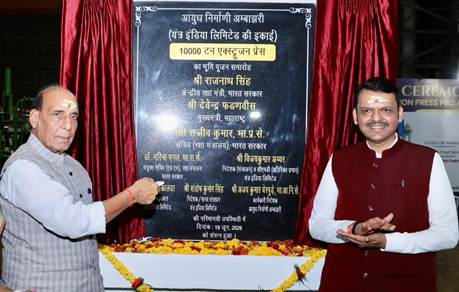
Nagpur: India took another step towards strengthening its defence-industrial base on Thursday with the launch of a major aluminium manufacturing project that is expected to support the production of advanced military and aerospace systems while reducing dependence on imports of critical materials. The defence minister, Rajnath Singh, performed the groundbreaking ceremony for a 10,000-tonne aluminium extrusion press at Ordnance Factory Ambajhari in Nagpur, a unit of Yantra India Limited (YIL).
The event took place in the presence of the chief minister of Maharashtra, Devendra Fadnavis.
The facility, described by officials as one of the most advanced of its kind in India, will manufacture large and complex aluminium alloy profiles used in fighter aircraft, missile systems, aerospace structures, rail transport and other strategic sectors. The project is expected to strengthen domestic supply chains for critical defence manufacturing and reduce reliance on imported aluminium extrusions.
Addressing the gathering, Singh said India must retain control over security-related industrial capabilities in an increasingly uncertain geopolitical environment. He stressed that self-reliance in critical technologies and materials was essential for long-term national security and strategic autonomy.
The project assumes significance as India seeks to expand indigenous production of military platforms and components under its broader self-reliance programme. High-strength aluminium alloys are widely used in modern combat aircraft, missile systems and space applications because of their combination of low weight, durability and resistance to extreme operating conditions.
Singh said the new facility would help meet a critical requirement for advanced metallurgy in defence manufacturing. He noted that sophisticated military systems depend on thousands of specialized components and materials, making domestic industrial capability as important as the final platform itself.
Referring to Operation Sindoor, Singh said indigenous equipment had demonstrated its value during recent military operations and highlighted the need to expand domestic production of defence hardware and supporting technologies.
The minister also argued that despite rapid technological changes in warfare, conventional military capabilities and the industrial infrastructure supporting them would remain relevant for decades. According to him, a strong military-industrial ecosystem will continue to be a key determinant of national power.
Singh used the occasion to highlight the growth of India’s defence manufacturing sector. He said domestic defence production had risen from about ₹46,000 crore in 2014 to a record ₹1.78 lakh crore in financial year 2025–26, while defence exports had increased to ₹38,424 crore from less than ₹1,000 crore over the same period. He expressed confidence that the government’s targets of ₹3 lakh crore in defence production and ₹50,000 crore in defence exports could be achieved ahead of schedule.
The minister also pointed to the transformation of the former Ordnance Factory Board following its corporatization in 2021. According to government figures, the combined production of the former OFB entities increased from ₹12,755 crore in 2019–20 to ₹26,282 crore in 2025–26, while exports rose from ₹81 crore to ₹4,561 crore. YIL alone contributed ₹397 crore in exports during the last financial year.
Industry analysts note that advanced materials and metallurgical capabilities are increasingly becoming strategic assets as countries seek resilient supply chains for defence and aerospace programmes. India’s efforts to develop domestic capacity in areas such as special alloys, propulsion systems, electronics and precision manufacturing are seen as crucial for reducing external dependence and supporting future military modernization.
Speaking at the event, Fadnavis said the project would help position Nagpur as an important hub in India’s defence manufacturing ecosystem and contribute to the country’s broader goal of self-reliance in strategic industries.
The ceremony was attended by senior officials from the Department of Defence Production, Yantra India Limited, the armed forces and industry representatives.