


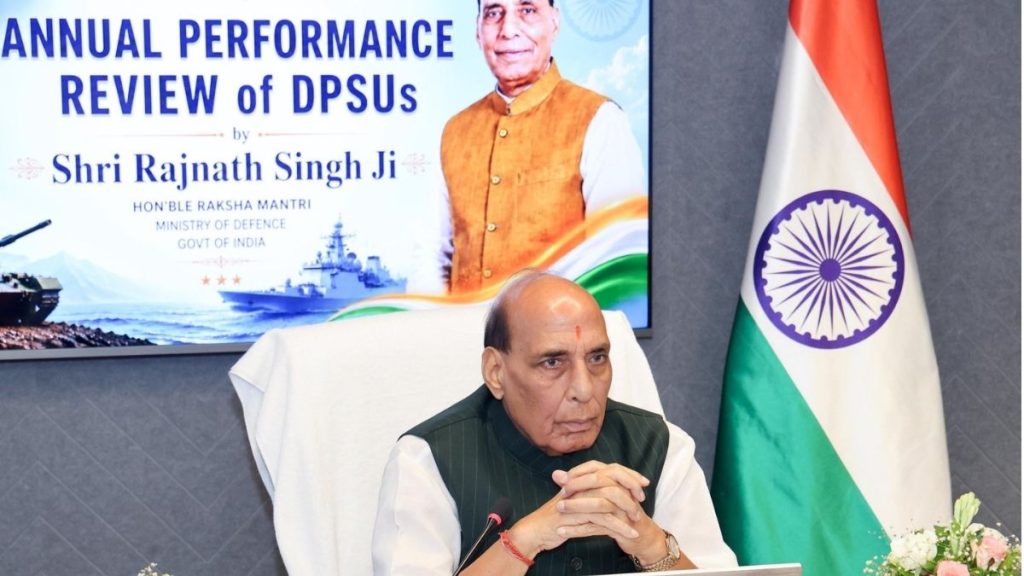
New Delhi: The defence minister, Rajnath Singh, has asked all 16 defence public sector undertakings (DPSUs) to prepare a five-year roadmap to strengthen India’s defence preparedness in line with changing security challenges. The direction came after Singh reviewed their performance and progress at DPSU Bhawan in New Delhi on Tuesday.
Singh said in a post on X that he had reviewed all 16 DPSUs, lauded their contribution to record defence production and asked them to draw up a roadmap for the next five years to enhance defence preparedness in step with changing times.
According to the ministry of defence, the review covered indigenous production, manufacturing capabilities, advanced defence technologies, exports, major projects and supply chain strengthening. Singh also identified timely delivery, lower import dependence, research and development, productivity, capital expenditure and product quality as key priorities.
DPSUs post higher turnover, profits
The direction comes after the DPSUs recorded strong growth in financial year 2025-26. Their combined turnover rose 15.4 per cent to ₹1.29 lakh crore, while cumulative profit after tax increased 15.6 per cent to ₹23,136 crore, according to the defence ministry. Exports by the DPSUs rose 151.2 per cent over the previous financial year.
An earlier ministry release put DPSU exports at ₹21,071 crore, accounting for 54.84 per cent of India’s record defence exports of ₹38,424 crore during the year. India’s overall defence production reached approximately ₹1.8 lakh crore in financial year 2025-26, with the DPSUs contributing ₹1.29 lakh crore.
The figures underline the growing role of public-sector defence companies in India’s domestic manufacturing base as the government seeks to increase indigenous production and reduce dependence on imported equipment, systems and components.
Technology and indigenization in focus
Singh asked the DPSUs to reduce import dependence and transform research and development into technology leadership. The ministry said research outcomes should be assessed through the development of new technologies, intellectual property, prototypes and operational products. Singh also asked the companies to identify niche areas where India could move beyond self-reliance and build technological leadership.
Other priorities identified during the review included higher productivity through capital expenditure, greater support for startups and micro, small and medium enterprises (MSMEs), timely delivery of equipment and raising product quality to international standards.
Singh said recent global conflicts had demonstrated the importance of assured supply chains, surge capacity, critical spares, rapid repair capabilities and the ability to sustain production during prolonged conflicts.
“The progress of DPSUs is not merely an economic or industrial necessity; it is a national security imperative,” he said.
The 16 DPSUs form a major part of India’s public-sector defence manufacturing base and operate across aerospace, electronics, missiles, shipbuilding, armoured systems, ammunition and specialised materials.
They include HAL, BEL, BDL, Mazagon Dock Shipbuilders Limited, GRSE, BEML and Midhani.
During the review, the chairmen and managing directors of seven DPSUs presented dividend cheques worth a combined ₹3,951 crore for the government’s equity holdings for financial year 2025-26.
Singh also released four publications covering indigenization, new products and processes, student engagement with defence technologies and separate modernization and indigenization roadmaps for HAL.
As RNA Media had reported on Monday, Singh was scheduled to review the 16 DPSUs amid the government’s push for indigenous technologies and higher defence exports. The latest meeting has now set out the next step, with the companies being asked to align their plans for the coming five years with future defence requirements, technology development, higher domestic production and changing security challenges.