


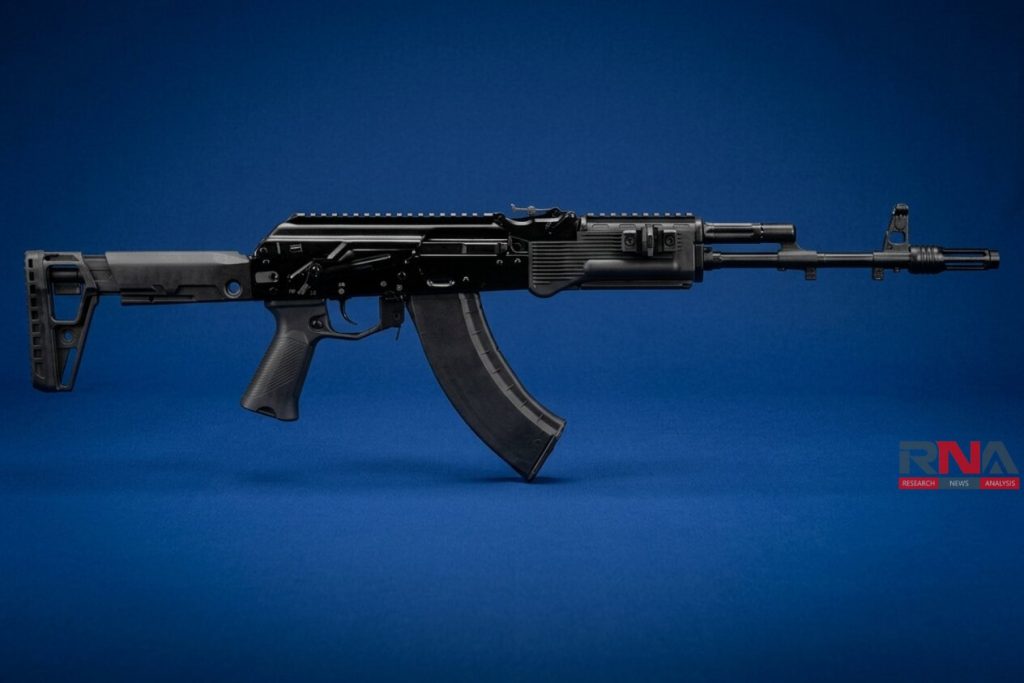
New Delhi: An India-Russia defence joint venture has manufactured and test-fired the first AK-203 “Sher” assault rifle built entirely from Indian components and input materials at its Korwa plant in Uttar Pradesh’s Amethi district. The milestone completes a phased indigenization effort aimed at establishing a domestic supply chain for one of the Indian Army’s principal infantry weapons.
The prototype successfully completed initial firing checks, including burst fire, and the results were encouraging, according to Indo-Russian Rifles Private Limited (IRRPL). The company is preparing additional fully indigenized prototypes for handover to the Army in September 2026, with formal user trials expected to begin the following month.
Major General SK Sharma, IRRPL’s chief executive and managing director, said every component and material used in the rifle had been sourced from Indian industry. He described the achievement as end-to-end indigenization rather than the localization of a limited number of parts.
The distinction is significant because the weapon has yet to clear the Army’s prescribed user trials, which will test its reliability, accuracy, durability and performance under different operational conditions. Successful factory firing confirms that the prototype functions, but it does not by itself constitute acceptance for series production in its fully indigenized configuration.
IRRPL received the complete transfer of technology from Russia during 2023–24 and subsequently worked on replacing imported parts, materials and manufacturing processes with Indian alternatives. The rifle incorporates about 50 major components, nearly 180 subcomponents and approximately 120 manufacturing processes, making the localization exercise substantially more complex than assembling imported kits.
Nearly 100 Indian micro, small and medium enterprises have participated in developing components, tooling, gauges, specialized materials and processes such as heat and surface treatment. IRRPL has also sought alternative Indian suppliers for critical parts to reduce the risk of production being disrupted by a single-source dependency.
Some Russian GOST-standard materials were replaced with equivalents conforming to Indian standards, while testing and quality-validation capabilities were established at Korwa. Components and processes that previously required Russian approval can now be evaluated at the Indian facility, strengthening domestic control over the manufacturing cycle.
The claim of 100 per cent indigenization applies to the rifle’s components, raw materials and production processes, rather than to its original design. The AK-203 remains a Russian-designed Kalashnikov weapon manufactured in India under technology transfer, but the domestic supply chain is intended to remove dependence on imported parts for future production and maintenance.
The Ministry of Defence signed a contract with IRRPL on December 6, 2021, for 6,01,427 rifles, all of which are to be produced at Korwa. The company is owned 50.5 per cent by the Indian side, represented by Advanced Weapons and Equipment India Limited and Munitions India Limited, while Russia’s Rosoboronexport and Concern Kalashnikov together hold 49.5 per cent.
Licensed production began with a limited proportion of Indian content before localization was progressively increased across successive batches. By July 2024, the joint venture had delivered 35,000 AK-203 rifles to the Army, while the indigenous content of that initial tranche stood at about 25 per cent.
IRRPL now plans to raise its output to one rifle every 100 seconds as production stabilizes in the fully indigenized configuration. Sharma said improvements in capacity, localization and manufacturing efficiency would allow the company to complete deliveries of nearly six lakh rifles to the Army almost a year ahead of the earlier schedule.
Chambered for the 7.62×39mm cartridge, the gas-operated AK-203 has a 30-round magazine, a folding and adjustable stock, and accessory rails for sights and other equipment. It has a cyclic firing rate of about 700 rounds a minute and a sighting range of up to 800 metres, although practical engagement distances depend on ammunition, terrain and battlefield conditions.
The Army is acquiring the rifle to progressively replace its older 5.56×45mm Insas weapons, particularly in frontline infantry, counterterrorism and high-altitude deployments. The change restores the larger 7.62mm cartridge to a central role in the Army’s small-arms inventory while offering improved ergonomics and compatibility with modern accessories.
For India, the importance of the Sher programme extends beyond the rifle itself because it creates domestic capacity for precision small-arms manufacturing, testing and lifecycle support. IRRPL has also reported export enquiries from countries in Africa, Southeast Asia and West Asia, although completing the Army’s order remains its immediate priority.