


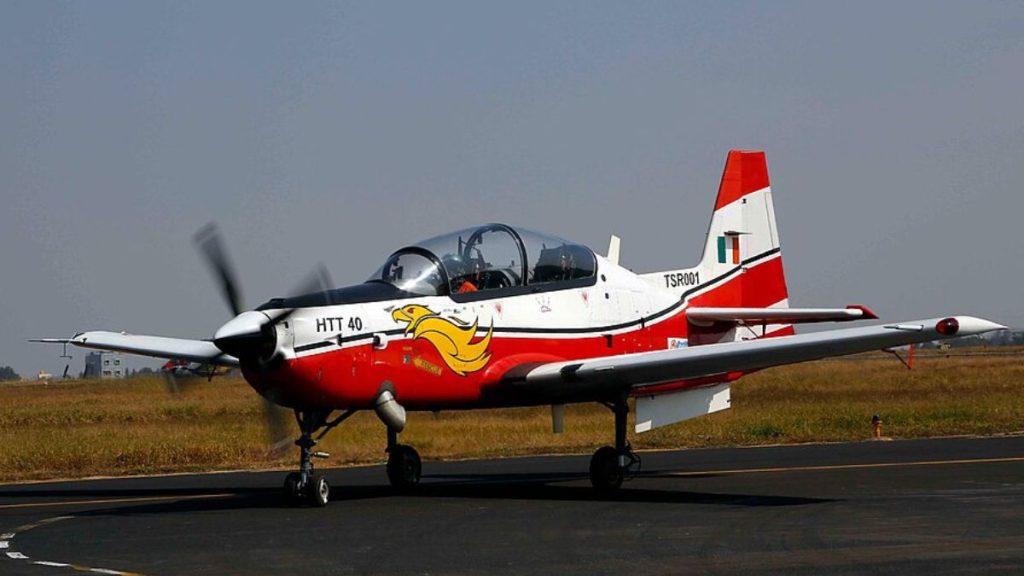
New Delhi: Hindustan Aeronautics Limited (HAL) handed over the first three indigenously developed Hindustan Turbo Trainer-40 (HTT-40) basic trainers to the Indian Air Force (IAF) in Bengaluru on September 18, at an event attended by the defence minister, Rajnath Singh. But full-scale training of rookie pilots on the aircraft could take up to two years.
Full-scale training cannot begin until the IAF receives more trainers and qualifies enough instructors, the Hindustan Times reported.
Why full-scale training will take time
The initial aircraft are expected to be stationed at the Flying Instructors’ School in Tambaram near Chennai, where instructors will familiarize themselves with the type. They will also develop standard operating procedures, training syllabuses and proficiency benchmarks, according to the report.
Officials quoted in the report said the IAF needs a fleet of about 25 to 30 HTT-40s and enough qualified instructors before the aircraft can be used for training at the Air Force Academy near Hyderabad. The IAF currently uses Swiss-origin Pilatus PC-7 MkII aircraft for Stage-I training of all rookie pilots before they branch into fighter, transport and helicopter streams. Fighter pilots later undergo Stage-II training on PC-7 MkII and Kiran Mk-1A aircraft, followed by Stage-III training on Hawk advanced jet trainers before progressing to frontline fighters. Transport and helicopter pilots follow separate training programmes.
The IAF signed a contract for 70 HTT-40s in March 2023, following government approval for procurement worth ₹6,828.36 crore, including simulators and other training aids. The two-seat turboprop is designed for basic handling, aerobatics, navigation, instrument flying and night flying.
The aircraft also has an air-conditioned cockpit, modern avionics, hot refuelling capability and zero-zero ejection seats, which allow pilots to escape even when the aircraft is stationary on the ground. These features are designed to support basic flying instruction and improve training efficiency and safety.
Engine supplies still constrain deliveries
Production has been held back by delays in deliveries of Honeywell’s US-made TPE331-12B engines. HAL was scheduled to deliver 12 HTT-40s during the 2025–26 financial year but delivered none, according to earlier defence-industry reporting.
Under an agreement exceeding $100 million, Honeywell will supply 16 complete engines directly, while HAL will manufacture the remaining units from an 88-engine order under a technology-transfer arrangement. Honeywell said earlier this month that it had delivered four engines and expected to raise the total to eight by the end of 2026.
The company attributed part of its supply chain difficulties to a fire at a supplier’s facility, which affected the availability of two engine components. It has since taken steps to diversify suppliers and accelerate deliveries.
HAL has the capacity to produce about 20 trainers annually across Bengaluru and Nashik if engine supplies stabilize. The aircraft has about 56 per cent indigenous content, which the defence ministry expects to exceed 60 per cent as additional components are localized.