


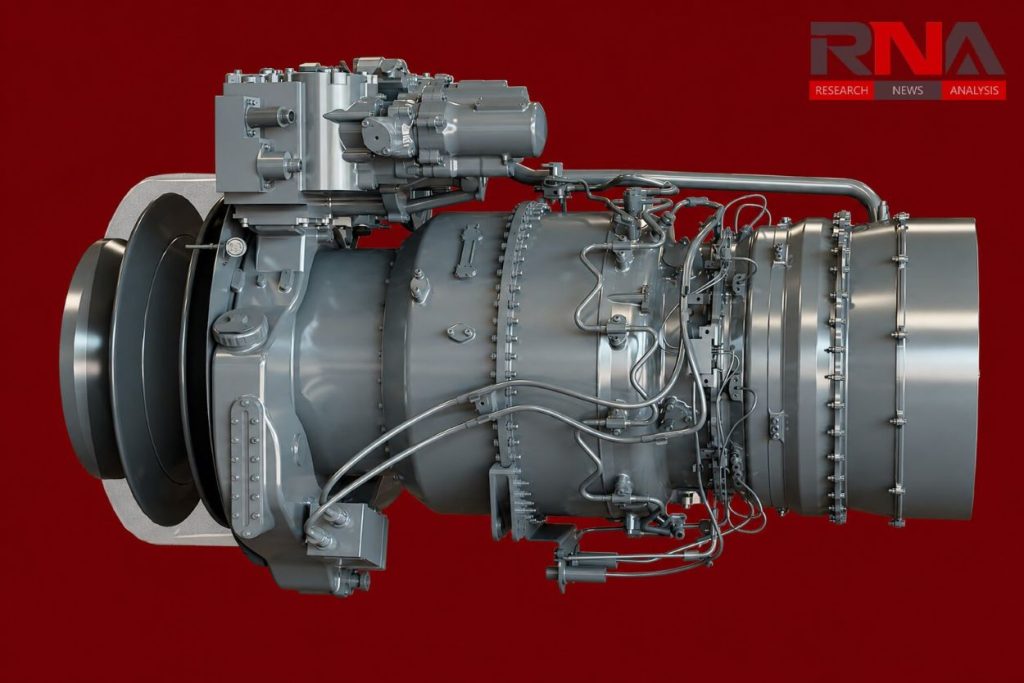
New Delhi: Hindustan Aeronautics Limited and France’s Safran Helicopter Engines have signed the final contract for the joint development and production of the Aravalli turboshaft engine, moving a critical component of India’s next-generation military helicopter programme into formal execution. The 3,500–4,000-shaft horsepower powerplant will equip HAL’s 13-tonne Indian multi-role helicopter (IMRH) and its naval derivative, the deck-based multi-role helicopter (DBMRH).
The agreement with SAFHAL Helicopter Engines Private Limited – a joint venture between HAL and Safran Helicopter Engines – covers the engine’s design, development, manufacture, supply and support throughout its operational life. HAL disclosed the contract in a regulatory filing to the BSE and National Stock Exchange on Wednesday.
The contract was signed by HAL’s director for engineering, research and development, Ajay Kumar Shrivastava, and SAFHAL director Olivier Savin, who is also Safran Helicopter Engines’ executive vice-president for sales and marketing. The ceremony was overseen by the chairman and managing director of HAL, Ravi K, and the chief executive officer of Safran Helicopter Engines, Cedric Goubet.
HAL said the programme would combine advanced design methods, modern manufacturing processes, extensive testing and long-term product support to produce an engine with the required performance, reliability and maintainability. Goubet described it as the first time Safran Helicopter Engines had undertaken the co-development of an engine in this power class.
The power rating is significant because it places Aravalli above the engines used by HAL’s existing family of light helicopters and gives the company access to propulsion technology for substantially heavier rotorcraft. Safran had indicated in March 2025 that the engine would produce closer to 4,000shp than 3,000shp and was being developed to support entry into service early in the next decade.
The Aravalli has been selected for the twin-engine IMRH, which HAL is developing for the Indian Air Force and Indian Army as an indigenous platform in a category now dominated by Russian-origin Mi-17 helicopters. The aircraft is expected to perform troop transport, logistics, casualty evacuation, special operations and other medium-lift missions in conditions ranging from high-altitude deployments to hot-and-dusty environments.
Its naval counterpart, the DBMRH, is being designed for the Indian Navy, with modifications needed for operations from warships and prolonged exposure to corrosive maritime conditions. HAL has described the DBMRH as the naval version of the IMRH, although its final mission configurations and procurement numbers will depend on requirements approved by the Navy and the defence ministry.
The latest agreement follows a sequence of arrangements that began with a memorandum of understanding in July 2022 and a workshare agreement in February 2023. HAL and SAFHAL then signed an “airframer contract” in August 2024 to begin the joint design, development, manufacture, supply and support of the engine; the new agreement is the final contract committing HAL, Safran and their joint venture to the development-and-production programme.
The 2023 workshare agreement provided for an equivalent division of activities between the two partners and gave HAL a role in designing, developing and producing some core engine components. It also provided HAL with manufacturing rights for seven critical forged and cast raw parts used in the Shakti engine family, strengthening the industrial foundation on which the Aravalli programme will be built.
Safran and HAL have worked together on helicopter propulsion for decades, beginning with the Artouste engines used by the Chetak and Cheetah. Their subsequent Shakti engine family powers HAL’s Advanced Light Helicopter Dhruv, the Rudra armed helicopter, the Prachand light combat helicopter and the light utility helicopter.
What Aravalli means for India’s helicopter ambitions
India has acquired substantial experience in designing and manufacturing helicopter airframes, rotor systems, transmissions, avionics and mission equipment through the Dhruv, Rudra, Prachand and LUH (light utility helicopter) programmes. High-performance aeroengines, however, remain one of the most technically demanding parts of the aerospace value chain and an area in which the country continues to rely heavily on foreign technology or collaborative programmes.
The Aravalli project could narrow that gap by involving Indian engineers in the engine from its design stage instead of restricting domestic activity to licensed assembly, component manufacture or maintenance. Its real industrial value will depend on the precise intellectual-property arrangements, the technologies made available to HAL and the proportion of high-value components eventually manufactured in India – details that the companies have not publicly disclosed.
Developing a 3,500–4,000shp turboshaft requires expertise in high-temperature materials, precision castings and forgings, compressor and turbine design, digital engine controls, testing and certification. Even where some sensitive technologies remain with Safran, sustained Indian participation across design, production and testing could create skills and infrastructure applicable to future military and civilian rotorcraft engines.
The programme should also create opportunities for Indian suppliers producing precision-machined components, bearings, seals, fuel systems, control equipment, electronics and specialized materials. The scale of HAL’s existing helicopter ecosystem is evident from the defence ministry’s ₹62,700 crore order for 156 Prachand helicopters, under which more than 250 domestic companies – most of them MSMEs (micro, small and medium enterprises) – are expected to participate.
In March 2025, the Ministry of Defence had said the order would generate more than 8,500 direct and indirect jobs.
Engine manufacture would add a particularly valuable layer to that supply chain because propulsion generates business well beyond the original aircraft order. Spare engines, scheduled overhauls, replacement modules, repairable components and technical upgrades can sustain industrial activity for several decades after a helicopter enters service.
HAL and Safran have consequently included lifecycle support in the final contract, with the programme expected to promote indigenous maintenance, repair and overhaul capabilities. A domestic support base could improve fleet availability and reduce dependence on overseas overhaul facilities, although this will require adequate stocks of critical components and Indian access to repair data, tooling and approved processes.
India is also building the physical capacity needed to support a larger helicopter market. HAL’s helicopter factory at Tumakuru was established with an initial capacity of about 30 helicopters annually, scalable to 60 and eventually 90, although a separate production plan would be required for the much larger IMRH and DBMRH.
HAL and Safran see possible civil applications for the engine and the associated helicopter family in offshore transport, utility work and VVIP travel, besides potential sales in international markets. Those opportunities remain longer-term prospects because civil certification, operating economics, after-sales support and a sufficiently large order book will determine whether the programme becomes commercially viable beyond Indian military requirements.
The Aravalli should therefore be viewed as a major capability-building programme rather than an immediately indigenous engine in every respect. If the agreed workshare produces genuine design authority, manufacturing depth and an Indian lifecycle-support network, it could help move the country’s helicopter industry from platform integration towards ownership of one of the most complex and valuable technologies in the aircraft.