


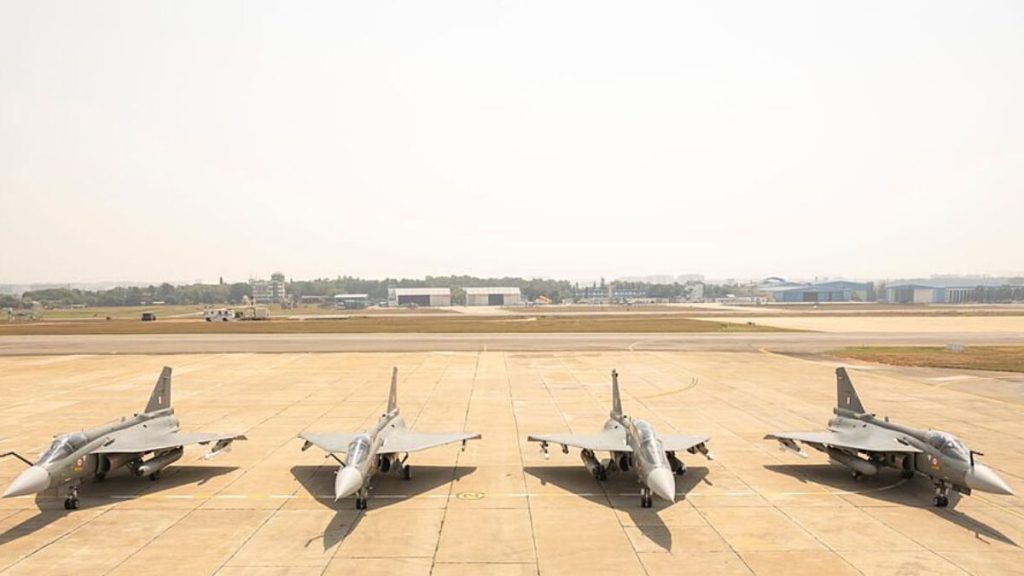
New Delhi: Hindustan Aeronautics Limited expects to begin deliveries of the LCA (light combat aircraft) Tejas-Mk1A to the Indian Air Force by the end of this year, as remaining radar and weapons integration issues move towards resolution. The company has built 27 Mk1A airframes and received 10 F404-IN20 engines from GE Aerospace.
The completed airframes are not yet equivalent to aircraft cleared for induction. Radar related corrections, final weapons integration testing and associated trials remain before the first fighters can be handed over, with HAL expecting the outstanding work to be completed in roughly a month.
HAL chairman and managing director, Ravi K told Hindustan Times that “last-mile corrections” were underway and the company aimed to deliver around 10 Mk1As during financial year 2026-27. The timeline remains dependent on completion of the remaining tests and continued engine supplies.
The F404-IN20 powers the single engine Mk1A. Engine supply constraints have been one factor in the programme’s delayed delivery schedule, alongside certification and aircraft-integration work. GE Aerospace delivered the first engine from HAL’s 99-engine order in March 2025.
As RNA Media reported earlier, GE Aerospace delivered three F404-IN20 engines to HAL in August, taking supplies under the current order to 10 as the company worked to convert completed Tejas Mk1A airframes into aircraft ready for delivery.
The IAF’s first major Mk1A linked order, contracted in 2021, covers 73 Tejas Mk1A fighters and 10 Tejas Mk1 trainers. The government had approved ₹45,696 crore for procurement of the 83 aircraft, along with ₹1,202 crore for design and infrastructure development.
A second contract signed in September 2025 covers 97 Mk1As, comprising 68 single-seat fighters and 29 twin-seat aircraft, at more than ₹62,370 crore excluding taxes. Deliveries under that order are scheduled to begin during 2027-28 and be completed over six years, making HAL’s current year-end target applicable to the earlier order.
The Mk1A incorporates capabilities including an Active Electronically Scanned Array (AESA) radar, electronic warfare systems, beyond-visual-range weapons and air-to-air refuelling. HAL has not suggested that all 27 completed airframes are in an identical configuration or ready for immediate induction.
The programme is significant for an IAF operating 29 fighter squadrons against an authorized strength of 42.5 following the retirement of the MiG-21 fleet. Tejas Mk1A forms part of the service’s plans to replenish fighter numbers as older aircraft are progressively withdrawn.
Production capacity reaches 24 a year
HAL’s combined LCA production capacity has risen to 24 aircraft annually across two Bengaluru lines and a third production line at Nashik, inaugurated in October 2025. Ravi said HAL was continuing to build airframes irrespective of engine availability so aircraft could move towards completion as powerplants arrived.
The production ramp-up is also drawing more of the Tejas airframe into the private-sector supply chain. HAL has engaged companies including Larsen & Toubro, Alpha Tocol Engineering Services, Tata Advanced Systems, VEM Technologies and Lakshmi Machine Works to manufacture major structures and sub-assemblies. During 2025, private suppliers handed over the first rear fuselage, centre fuselage and wing assemblies for the Mk1A, expanding industry participation into major structural sections of the fighter.
The 97 aircraft follow-on contract is expected to have more than 64 per cent indigenous content and incorporate additional Indian systems, including the Uttam AESA radar and Swayam Raksha Kavach electronic warfare suite, according to the defence ministry.
HAL’s immediate target remains the first Mk1A handovers by year end, subject to completion of the remaining radar, weapons integration and testing requirements.