


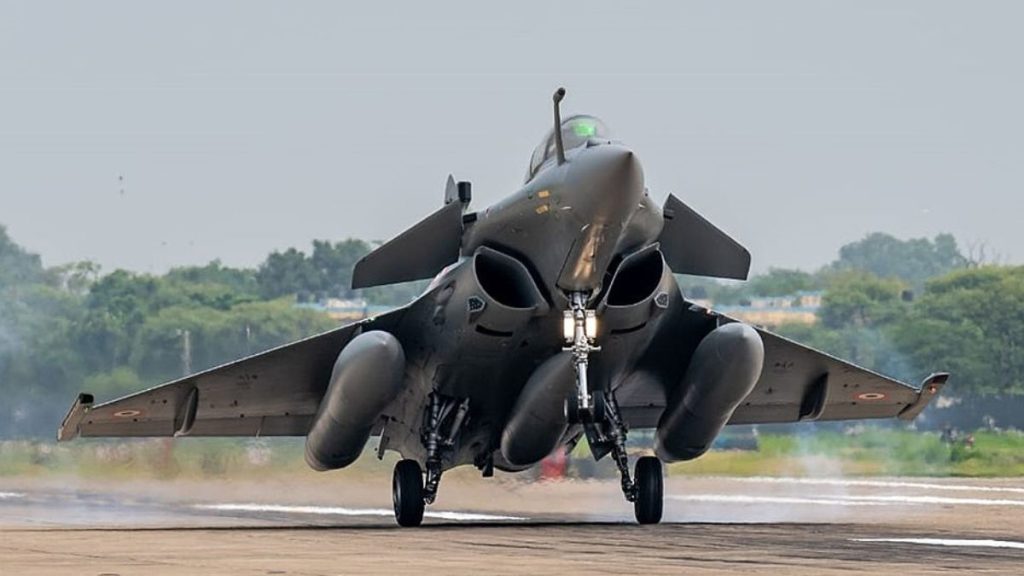
New Delhi: India may soon benefit from advanced fighter aircraft technologies and new nuclear plants, as France has expressed its willingness to share scientific knowledge on combat aviation and to integrate India-made defence systems on Dassault Aviation’s Rafale jets, 114 of which the Indian Air Force (IAF) will buy soon. In another development, the French state-run nuclear company, EDF, is ready to engage with Indian private players to explore setting up nuclear power plants, taking advantage of the changes in the domestic nuclear laws.
The two unrelated pieces of information were given out by people with knowledge of the matters, after India’s external affairs ministry announced prime minister Narendra Modi’s visit to France next week at the invitation of French president Emmanuel Macron, when he would also be attending the G7 summit.
The Tribune quoted unnamed French diplomatic sources to report that France would be comfortable with sharing advanced military aviation technologies with India as part of the Rafale deal, and also be ready to integrate India-made military systems on the fighter aircraft, 36 of which are already in the IAF fleet. “Yes, we are comfortable sharing technology, and ‘Make in India’ will be part of the deal (for 114 Rafales) … Integration of local weapons is also a part of the deal,” the newspaper quoted the sources as saying.
The diplomatic sources also said France did not see its military ties with India as a “customer-provider” relationship, but as “very substantive discussions are on at the moment.” India issued a formal request letter to France to buy 114 Rafale aircraft, after selecting it from among offers from major global aircraft makers, including American Boeing and Lockheed Martin, Swedish Saab, and Russian Sukhoi and MiG about a year ago, as part of a procurement plan to shore up the IAF’s dwindling combat fleet numbers. The letter of request is a formal government-to-government communication to initiate a foreign sale through a sovereign agreement between two nations.
India’s Rafale procurement
India, under Modi, had first bought 36 Rafale jets from France in an inter-governmental agreement in 2016 to meet “emergency” requirements of the IAF, after cancelling a 2007 tender that had intended to buy 126 jets. Rafale had been chosen as the winner of that multi-billion-dollar contract in 2013.
However, after he stormed to power in 2014, Modi cancelled the tender in 2015, citing technical difficulties in pursuing the contract with French Dassault Aviation, during a Paris visit, and later initiated the sovereign agreement route to buy the 36 Rafales as an interim measure. A fresh process to buy 114 jets, under a “Make in India” programme, was initiated in April 2019, just a year ahead of France delivering the first lot of Rafales in 2020. The 36-jet order was completed in 2022, enabling the IAF to raise two fighter squadrons.
Under the 114-jet procurement plan, India has set strict clauses that include manufacturing 96 Rafale aircraft in India in partnership with a domestic company, apart from at least 50% indigenous content in the made-in-India planes and integrating domestically made data links for communication with Indian radars and sensors. France would transfer aeroengine technology, airframe, and avionics for the Rafale jets that would be produced in India. The India-made Rafales would also have locally developed weapon systems integrated on them.
India has sought the integration of the F-4 and F-5 variants of the Rafale aircraft from France, as it currently operates the F3R variants, as part of the 114-jet deal. French engine-maker Safran would supply the aeroengine technology, while Thales would provide the avionics, as part of the technology transfers under the new contract. The upgraded Rafales would include a modern, next-generation active electronically scanned array radar.
French-Indian partners for nuclear plants
Meanwhile, taking advantage of the changed Indian nuclear laws, French multinational EDF would talk to Indian private sector companies to collaborate on setting up nuclear plants in India, Hindustan Times reported on Thursday. India and France have already cooperated in the civil nuclear energy sector for several years now, but the challenges have included funding and the cost of nuclear power.
The passage of the Sustainable Harnessing and Advancement of Nuclear Energy for Transforming India (SHANTI) Act by the Indian parliament recently paved the way for participation of the Indian private players in the nuclear sector.
Citing unnamed people with knowledge of the matter, the report said the state-run EDF was in “active discussions with all big Indian players wanting to enter the (nuclear) sector”. “We are beginning a new phase of discussions and hope to have a clear picture by the end of the year,” one of the people said. The report said India targeted an increase in nuclear power generation capacity to 100GW by 2047 from the current 8.78GW levels.
At a special media briefing by the external affairs ministry on Thursday, additional secretary (Europe West) Piyush Srivastava said civil nuclear energy was an area of strategic cooperation with France, and with the passing of the SHANTI Act, both nations were discussing greater opportunities for the private sector, including small modular reactors (SMRs) and advanced modular reactors (AMRs).
Modi will be in France for a week, when he will attend the G7 summit at Evian and meet with Macron at Nice for a summit, before travelling to Slovakia for his first official visit to that country. In Evian, Modi will hold several bilateral meetings with the leaders of other G7 nations, including US president Donald Trump, which is being explored.
Modi and Macron will unveil 12 new bilateral initiatives during the summit meeting, apart from joining a three-day Bharat Innovates event as part of the India-France year of innovation to showcase Indian technologies from higher technical education institutions. Modi will be in Slovakia on June 14 and 16, before travelling to Evian in France for the G7 summit on June 16 and 17. In the last leg of his tour, Modi will be in Paris on June 18 for his bilateral engagements and to attend the VivaTech summit, Europe’s largest startup event.