


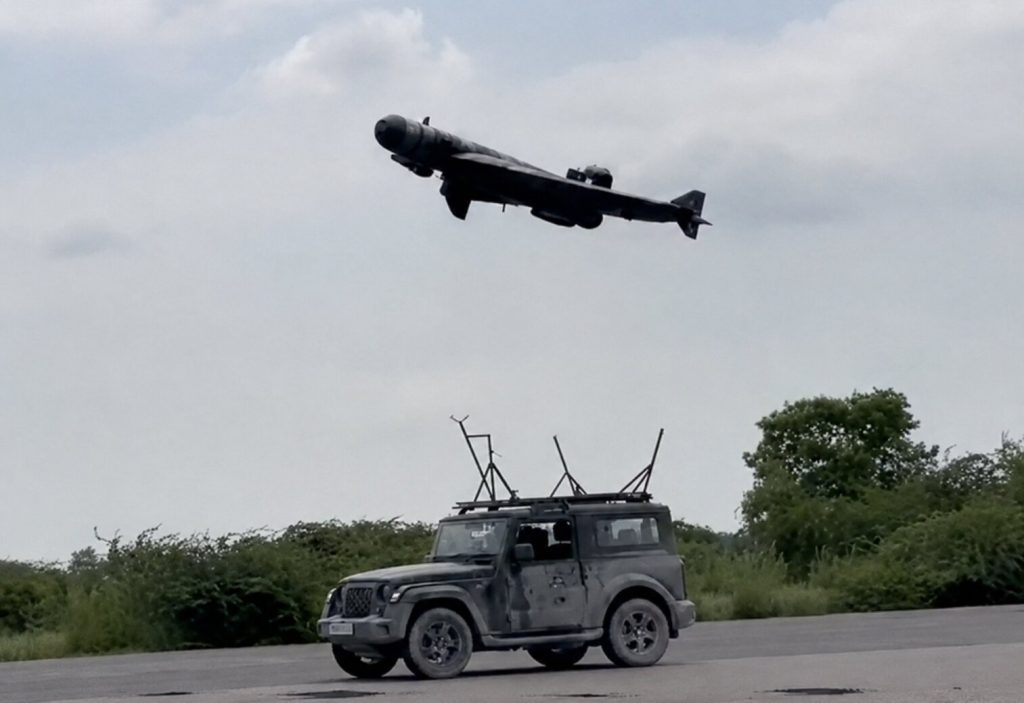
New Delhi: Lucknow-based Kawa UAV has completed the maiden flight of its Divyastra Mk3, which the company describes as India’s first indigenously developed jet-powered loitering munition. The unmanned weapon, powered by a jet engine built by Indian start-up DG Propulsion, flew for the first time on August 11, 2026.
Kawa UAV, which operates under the HoverIt brand, announced the test on August 16, saying the programme had progressed from inception to its first flight within a year. The company claimed that neither the engine nor any critical subsystem used in the prototype had been imported, although detailed information about its indigenous content has not been released publicly.
The maiden flight establishes that the aircraft’s basic configuration, propulsion system and flight controls can function together in the air. It does not, by itself, demonstrate the full operational performance of the weapon, which would require further trials covering navigation, target acquisition, communications, warhead integration and terminal accuracy.
Kawa UAV has not disclosed the Divyastra Mk3’s range, endurance, maximum speed, payload or guidance architecture. It has also not said whether the flight involved an unarmed technology demonstrator, how long the aircraft remained airborne or whether a military customer observed the test..
Unlike a conventional reconnaissance drone, a loitering munition carries an explosive payload and is designed to remain airborne while searching for, identifying or awaiting authorization to attack a target. Once committed, the aircraft dives into the target and is destroyed along with its warhead, earning such systems the informal descriptions “one-way attack drone” and “kamikaze drone”.
Jet propulsion could allow the Divyastra Mk3 to reach distant or time-sensitive targets faster and reduce the warning available to an adversary. The trade-off is that small jet engines generally consume fuel more rapidly than electric motors or piston engines, making the balance between speed, endurance, payload and production cost central to the weapon’s eventual battlefield value.
DG Propulsion says it specializes in developing and manufacturing indigenous jet engines and gas turbines for aerospace applications. Its participation is significant because propulsion remains one of the most difficult parts of India’s defence-technology supply chain, although the engine used in the Divyastra Mk3 and its performance parameters have not been identified by either company. DG Propulsion describes its focus as designing and producing jet-engine technology in India.
The test comes as the Indian military accelerates the acquisition of loitering weapons after their extensive employment in recent conflicts demonstrated their value against armour, artillery, air-defence systems and other mobile targets. Their attraction lies in combining surveillance and strike functions in one expendable platform, but their operational effectiveness depends heavily on resilient communications, navigation in GPS-denied conditions and the ability to distinguish genuine targets from decoys.
On August 14, the defence ministry signed contracts worth about ₹1,577 crore with Tata Advanced Systems Limited and NIBE Limited for loitering munition systems, ammunition and associated equipment for the Indian Army. The systems are being procured under the Buy (Indian) category through the fast-track procedure and are intended to strengthen the Army’s artillery regiments, according to an official defence ministry statement.
The Divyastra Mk3 is not part of those announced contracts, and Kawa UAV has made no public claim of a procurement order for the system. Its immediate importance, therefore, lies in demonstrating an emerging private-sector capability; whether the aircraft becomes an operational weapon will depend on successive flight and weapon trials, military evaluation, production readiness and cost.