


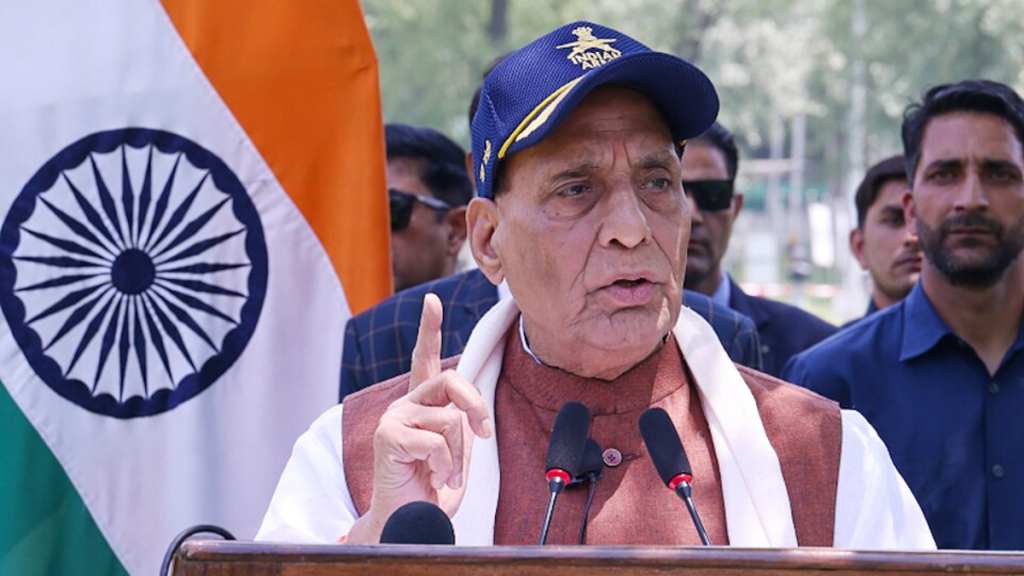
New Delhi: The country’s highest decision-making body for defence procurement, DAC, chaired by the defence minister, Rajnath Singh, is set to review defence procurement proposals on Friday. The proposals to be discussed are aimed at strengthening India’s military capabilities across land, air, and sea, with a strong focus on indigenous defence manufacturing.
Among the key proposals, the council is looking to add to India’s layered air defence with the purchase of the very short-range air-defence system (VShoRADS), which is a portable missile system designed to defeat low-altitude aircraft, helicopters, cruise missiles, and drones. The importance of these systems has gained prominence in the Russia-Ukraine conflict, and India’s Operation Sindoor last May, both of which have demonstrated the centrality of the low-altitude and drone threats in modern warfare.
The Indian Air Force will acquire Hammer precision guided weapons for its Rafale and LCA Tejas aircraft, high-altitudepseudo satellites (HAPS) fixed/wind-based for long endurance surveillance missions and ship-based aerial vehicle systems for maritime reconnaissance.
A key indigenous procurement programme currently under consideration by the government is the introduction of the man-portable anti-tank guided missile(MP-ATGM) developed by the Defence Research and Development Organization (NIWDR). The government is looking to purchase 100 launchers, 2,300 missiles, and five simulators manufactured by Bharat Dynamics Limited (BDL) as part of India’s self-reliance in defence manufacturing objective.
The Army is also likely to seek approval to procure more K-9 Vajra 155mm self-propelled howitzers since they are effective at both high altitude along the northern boundary and for desert operations. The DAC is expected to consider requests to acquire Kamikaze or “loitering” munitions/drones, indicating the importance the military is placing on precision strike capabilities in modern warfare.
For the Navy, the council is expected to evaluate several acquisitions that will enhance its undersea and maritime strike capabilities. These acquisitions include next-generation heavyweight torpedoes, unmanned surface vessels (USVs), autonomous underwater vehicles (AUVs), advanced sonar systems, and electronic warfare suites, all of which will improve the Navy’s ability to conduct surveillance, anti-submarine warfare operations, and maintain maritime situational awareness.
Some reports have suggested that the agenda will also have proposals to acquire active protection systems (APS) for tanks and additional air-defence munitions, showing the military’s current focus on improving force protection and counter-drone capability based on emerging threat patterns of the battlefield.
Friday’sagenda runs the lessons learned from the Russia-Ukraine war as well as the earlier operational experience of the Indian army. The agenda also reinforces the government’s self-reliance push in defence production, as significant share of the proposal falls under the Buy (Indian-IDDM) category, including the MP-ATGM, domestically built K-9 Vajra units, and indigenous drones. This “self-reliance”matters beyond the balance sheet as it is meant to insulate India’s military readiness from foreign supply shocks, sanctions, or diplomatic pressure during a crisis.
All taken together, the scale and scope of the proposal spanning land, air, sea, electronic warfare, unmanned systems, precision-guided weapons, and persistent surveillance, mark a shift toward integrated, technology-driven military capability rather than piecemeal, single-domain upgrades.