


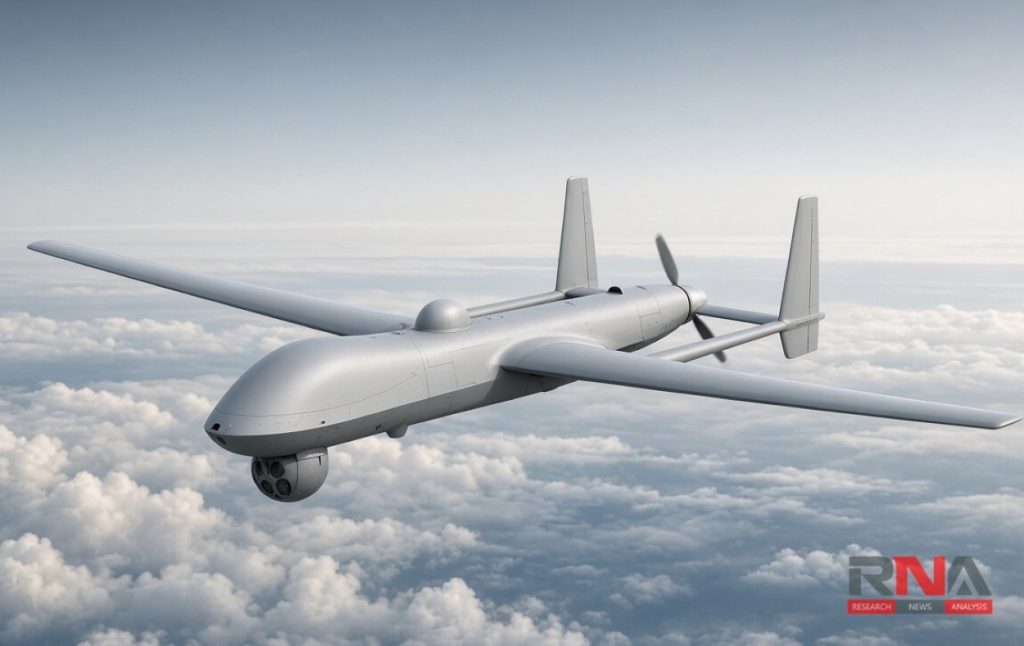
New Delhi: Bharat Forge Ltd has entered a collaboration with Pratt & Whitney Canada to evaluate the integration of advanced turboprop engines into India’s indigenous high-altitude, long-endurance (HALE) unmanned aerial vehicle programme. The tie-up, announced on Tuesday, pairs a global propulsion specialist with an Indian engineering major on a platform designed and developed by the Defence Research and Development Organisation.
Under the arrangement, Pratt & Whitney Canada will evaluate how well its turboprop engines suit the airframe, assessing compatibility, performance and installation requirements. Bharat Forge will lead the engine-airframe integration work, covering installation design and systems interfaces for the unmanned aircraft.
The Pune-headquartered Bharat Forge will draw on engineering, manufacturing and aerospace systems capabilities built up over more than a decade, including earlier work with global engine-makers such as Rolls-Royce. The initiative also feeds into the government’s Atmanirbhar Bharat (self-reliant India) programme, which seeks to deepen domestic content in critical defence platforms.
The vice-chairman and joint managing director of Bharat Forge, Amit Kalyani, said the partnership aimed to combine Pratt & Whitney’s propulsion technology with the company’s systems-integration expertise to produce a world-class HALE platform. Kalyani added that the effort was intended to strengthen India’s strategic self-reliance and defence preparedness.
The vice-president and country head of Pratt & Whitney, Ashish Saraf, echoed that view, describing the collaboration as consistent with the company’s ongoing commitment to India’s aerospace and defence ambitions. Saraf said the firm’s turboprop engines carried a proven record of reliability in demanding operational conditions, precisely what the HALE programme needed.
The move matters for a fairly simple reason that India still does not operate a HALE drone of its own.
The country currently fills that gap with leased and imported American UAVs, having ordered 31 MQ-9B drones from General Atomics in the SkyGuardian and SeaGuardian variants. The Navy is due to get fifteen of these aircraft, with the Air Force and the Army receiving eight apiece, though the total still falls short of the forces’ full operational demand.
DRDO’s Aeronautical Development Establishment has already prepared conceptual HALE designs for all three services and issued an expression of interest seeking a development-cum-production partner from Indian industry. The aircraft under consideration is expected to be a six-tonne-class platform with a single pusher turboprop engine, a wingspan of roughly 25 metres and a payload capacity of about 2,000 kilogrammes spread across six hardpoints, allowing it to operate at altitudes of around 40,000 feet.
The broader programme has already completed its system analysis and feasibility studies, giving it a reasonably firm technical and operational foundation to build on. Two configurations – one built around a turbofan engine and the other around a turboprop – have been examined, and the project proposal is currently before the Cabinet Committee on Security for clearance.
Bharat Forge’s aerospace arm has steadily expanded its footprint in this space, supplying forged and machined aero-engine components to Rolls-Royce and building dedicated manufacturing capacity for the sector. It has also signed separate agreements covering unmanned platforms with Turgis Gaillard and Windracers, alongside its role in India’s AMCA (advanced medium combat aircraft) programme.
For now, the arrangement between Bharat Forge and Pratt & Whitney remains at the evaluation stage, with no production contract or firm order attached to it. Even so, it signals a maturing partnership model in which foreign propulsion technology and Indian systems-integration capability are brought together early, well before a platform’s design is frozen.