


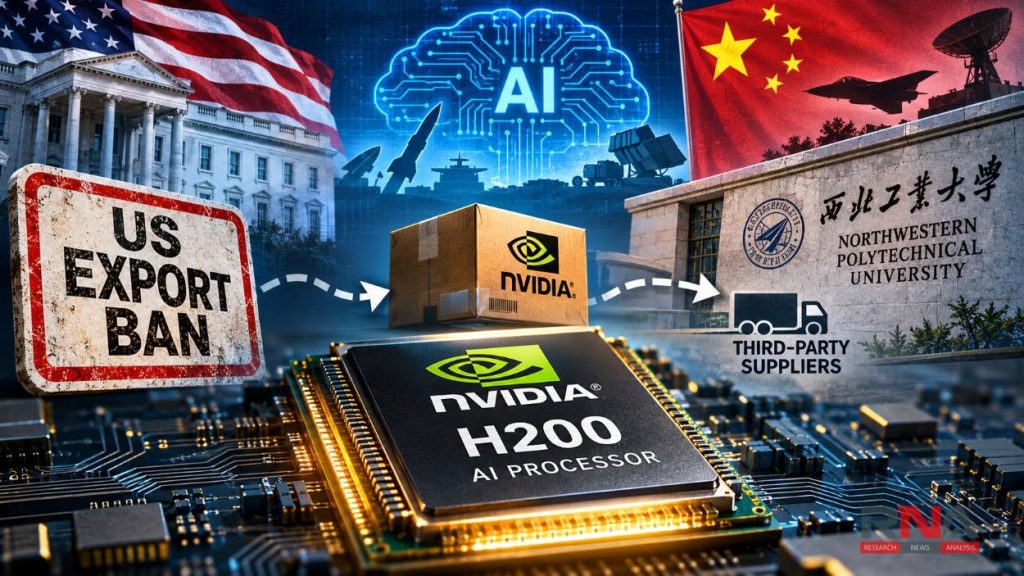
New Delhi: A Chinese university with close links to the People’s Liberation Army has acquired advanced artificial intelligence processors manufactured by Nvidia despite being on a US trade blacklist, exposing potential weaknesses in Washington’s efforts to restrict China’s access to sensitive American technology. The discovery, based on procurement records examined by Reuters, comes as the US government faces growing pressure to tighten semiconductor export controls and investigate possible national security risks surrounding Nvidia’s operations in China.
Northwestern Polytechnical University, based in Xi’an, purchased two Nvidia H200 processors for 874,700 yuan (approximately $123,000) in October, according to a procurement document dated October 21, 2026. The chips were supplied by a Chinese technology company, Shaanxi Bosuan Network Technology, rather than Nvidia directly, raising questions about how restricted American computing hardware reaches institutions barred from acquiring it.
The university belongs to China’s so-called Seven Sons of National Defence – a group of institutions closely associated with the country’s military-industrial establishment. Its research spans military aviation, missile technologies and satellite systems, making its access to powerful AI processors particularly sensitive from Washington’s perspective.
The US commerce department placed Northwestern Polytechnical University on its Entity List in 2001 over alleged involvement in missile proliferation and defence-related research. Restrictions were strengthened in 2019, establishing a policy under which applications to supply controlled American technology to the institution are generally denied.
How restricted American chips reach China
The latest findings extend beyond the purchase of two processors, suggesting that Chinese research institutions can obtain substantial computing capabilities without necessarily importing the hardware themselves. Reuters examined 26 procurement and corporate records from 2026 showing that universities and research organizations had either purchased restricted Nvidia chips through domestic suppliers or contracted computing services using those processors.
Northwestern Polytechnical University’s cybersecurity school awarded two seven-month contracts in January for access to servers containing eight H200 processors each, worth 441,700 yuan and 441,000 yuan respectively. The arrangements covered activities including AI model fine-tuning and reinforcement-learning training, while separate contracts provided access to Nvidia A100 and A800 processors.
Another university institute contracted computing resources containing at least 24 A100 chips for structural and fluid-dynamics simulations in April. Such applications can have civilian and military uses, particularly in aerospace engineering, although the procurement records do not establish that the specific computing resources were employed for weapons development.
The practice appears to extend across China’s higher-education sector, including institutions associated with defence research. Shenzhen University purchased three H100 processors in September, Wuhan University of Technology acquired restricted Nvidia hardware earlier this year, and Beihang University – another member of the Seven Sons – bought four A800 chips in April.
The central difficulty for American regulators is that sophisticated processors can be supplied through intermediaries or accessed remotely from servers whose locations and ownership are not always transparent. The records do not establish where the chips originated, whether they were diverted from legitimate inventories or whether particular transactions violated US export laws.
Washington’s semiconductor dilemma
The administration of the US president, Donald Trump, relaxed certain restrictions on advanced semiconductor exports in January this year, which allowed applications for H200 shipments to approved Chinese customers to be considered individually. However, the revised policy did not remove the separate restrictions governing blacklisted organizations or military end-users.
The H200 is a high-performance processor designed for demanding AI workloads, including training and operating sophisticated machine-learning systems. Its computing capabilities are relevant to civilian research but also have potential applications in military intelligence, autonomous systems, surveillance and advanced weapons development.
American policymakers face competing strategic considerations: restricting China’s technological progress while preserving the international competitiveness of US semiconductor companies. Nvidia’s chief executive, Jensen Huang, has argued that continued commercial engagement would sustain American leadership and discourage Chinese customers from abandoning US technology altogether.
Critics in Congress contend that allowing advanced processors into China could strengthen Beijing’s military modernization efforts, regardless of their declared commercial applications. Lawmakers from both major American political parties have advocated tighter supply-chain monitoring, stronger safeguards against unauthorized transfers and greater congressional scrutiny of export licences.
Nvidia controversy adds political pressure
The procurement revelations coincide with a separate controversy involving Huang, whose reported relationship with a Chinese businesswoman suspected by US intelligence authorities of having links to Beijing has triggered political criticism. The company’s board has initiated an independent investigation, although Nvidia maintains that it has no reason to believe national security information or confidential corporate material was compromised.
The Republican senator, Kevin Cramer, has called for Huang’s resignation over the potential security implications, while three Republican congressional committee chairmen have requested a briefing from the executive on November 18. China has rejected the espionage allegations as groundless, and the allegations have not been established as fact.
For Washington, the broader issue extends beyond Nvidia or individual Chinese universities to the effectiveness of technology restrictions in an increasingly interconnected global semiconductor market. The procurement records suggest that controlling direct exports alone may be insufficient when restricted institutions can acquire advanced computing capabilities through domestic resellers, third-country supply chains and rented processing infrastructure.