


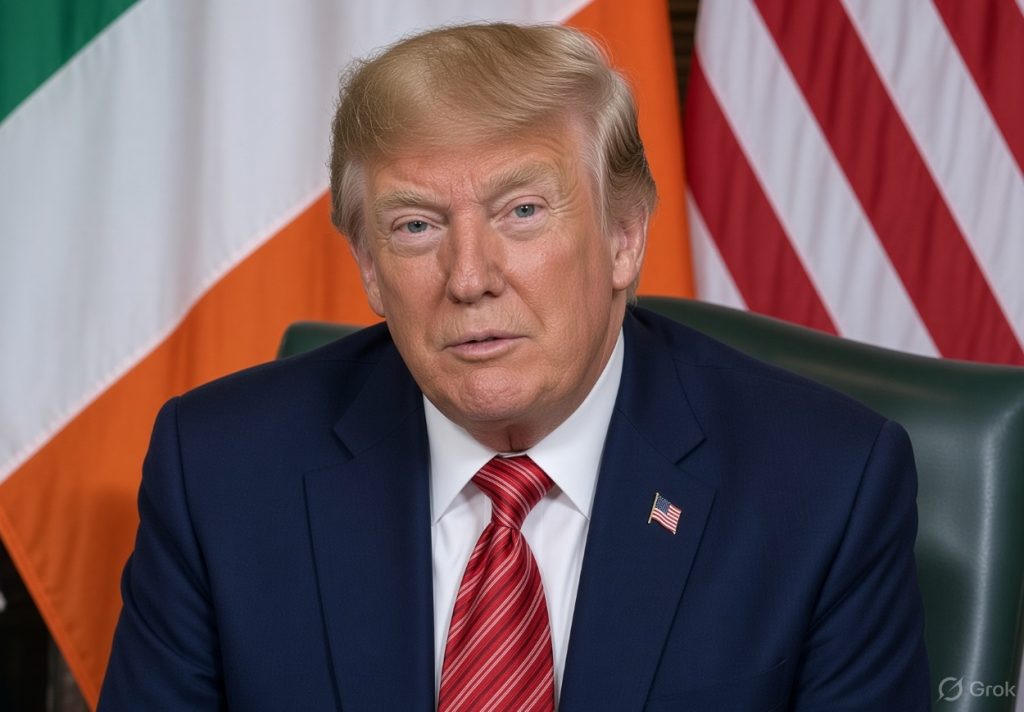
New Delhi: The United States president, Donald Trump, has dismissed growing alarm over artificial intelligence as the work of “very negative forces,” insisting on Sunday that the technology posed no genuine threat to humanity. Speaking to reporters at his golf course in Ireland, he made clear that Washington’s priority remained staying ahead of Beijing rather than tightening the reins on AI development.
“We’re leading China in AI. We’re the most sophisticated country in the world, and frankly I want to keep it that way because whoever wins AI wins,” Trump said when asked whether the industry needed to slow down or face stricter regulation. He conceded that “guardrails” were possible but argued that critics were raising scenarios that “won’t happen”.
His comments come amid a wider, ongoing debate within the AI industry itself about how seriously to take warnings from the people building the technology. Days earlier, three researchers at Anthropic – one of the companies at the forefront of frontier AI development – had gone public with concerns that the systems they build could, in a worst case, pose an existential risk to humanity within the decade.
Jacob Coxon, who had worked at both Anthropic and OpenAI, resigned from Anthropic earlier this month, specifically to voice that concern. Writing on X shortly afterwards, he said the two companies were “gambling with our lives” and that executives who sounded measured in public often expressed private fear.
Coxon’s departure was followed by comments from serving Anthropic staff that lent his warning institutional weight. The company’s alignment science lead, Evan Hubinger, wrote that he personally estimated a “greater than 10%” probability of AI causing human extinction within ten years, while noting that researchers still lacked a proven plan to keep highly capable systems reliably under control.
A third voice, Samuel Marks, who leads scalable oversight at Anthropic, offered a similar view. He suggested that developers kept building despite the risk because of commercial pressure and a belief that competitors would act less responsibly if they slowed down first.
Not everyone in the field shares that framing. Sandra Wachter, of Oxford, has argued that extinction scenarios distract from harms AI is already causing, while figures including Elon Musk and David Sacks have described the warnings as a “marketing ploy”. That scepticism has some basis, since a percentage attached to a decade-long forecast is an expert’s judgement rather than a measured probability.
Separately, and on a more immediate timescale, Anthropic has published evidence of its models being misused for serious harm today. In a threat intelligence report released on September 11 the company disclosed five cases of “biological misuse” of Claude, including attempts at gain-of-function research on the chikungunya virus and an effort to compile a database of animal venom compounds.
The same report documented attempted conventional weapons work, an area of particular interest to defence planners. Anthropic said operators linked to China and Russia, along with actors affiliated with the Houthi movement in Yemen, had tried to use Claude to assist with missile navigation systems and kamikaze drone swarms between December 2025 and August 2026.
A Russian hacking group known as Midnight Blizzard was also found to have used Claude to build self-correcting malware that rewrote its own code whenever security tools flagged it. Chinese military-linked operators, separately, attempted to use the model to support surveillance targeting Uyghur and other minority communities across Asia, according to the report.
This is not an isolated finding. Earlier reporting has established that researchers with ties to the Chinese military have drawn on both OpenAI and Anthropic models to train defence-oriented AI systems, illustrating the difficulty American firms face in controlling who ultimately benefits from technology they release under usage policies and export restrictions.
Anthropic has said its safeguards worked as intended, since each of the attempts it disclosed was detected and disrupted before causing harm. The company noted that its older 2025-era models, such as Claude Opus 4, had been “well below the threshold” for meaningfully assisting sophisticated bioweapons research, but acknowledged that its newer, more capable systems required tighter restrictions on dual-use biological queries.
That distinction is worth holding onto when weighing the broader debate. The International AI Safety Report 2026, chaired by the AI researcher Yoshua Bengio and published on February 3 found that systems available at the time lacked the capability for an irrecoverable loss of human control, even as it flagged growing autonomy that could complicate future safety testing.
Taken together, the two threads – a political leader’s confidence in American AI leadership, and an AI company’s own account of attempted misuse of its models – reflect the range of views now circulating about the technology’s trajectory. The available evidence supports concern about identifiable, present-day harms, from weapons research to espionage, though it does not establish that a specific catastrophic outcome is imminent.