


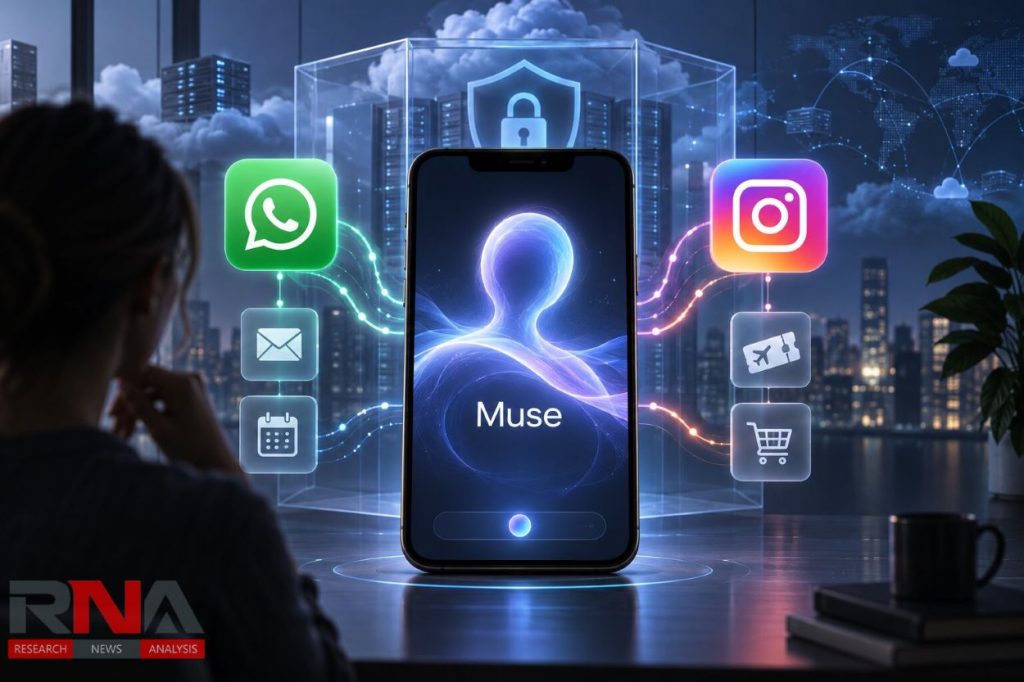
New Delhi: Meta has launched Muse, a personal artificial intelligence agent capable of completing tasks across users’ digital services and drawing on information shared through Instagram, Facebook and WhatsApp. Unveiled on Tuesday, the service is initially restricted to adults in the United States and can be accessed through dedicated iOS and Android applications, Muse’s website and WhatsApp.
Powered by Meta’s Muse Spark model, the new product is designed to go beyond conventional chatbots that primarily answer questions or generate content. Muse can connect to email, calendars, payment services, health applications, online shops and smart-home systems to send messages, book travel, fill out forms, monitor purchases and carry out other multistep assignments. Meta said the agent could continue working after a user closed the application and seek approval when a decision or sensitive action was required.
The assistant can, with permission, use direct messages and activity on Instagram and Facebook to understand a person’s interests and make customized suggestions, according to the Financial Times. Access through WhatsApp does not give Muse unrestricted visibility into private, end-to-end encrypted conversations; instead, users communicate with the agent directly or deliberately share relevant information with it.
Meta said Muse could remember preferences or details mentioned in earlier conversations, enabling it to make unsolicited but potentially useful recommendations. For example, it could convert a recipe saved on Instagram into a shopping list, remember guests’ dietary restrictions and organize invitations for a dinner.
The agent can also open websites, negotiate on a user’s behalf and make purchases through Stripe’s Link payment system. Link produces a one-time-use card number so that Muse does not receive the user’s actual card details, with Meta saying that Shop Pay and support for credentials stored in 1Password will be added later.
Internal testing exposes reliability concerns
Each Muse agent runs inside a dedicated cloud-based virtual computer called Muse Secure VM, where connected applications, credentials and user data are separated from other people’s agents. A second system, known as Sentinel, reviews actions that Muse proposes to take and can require direct authorization before information leaves the virtual machine.
Meta said Muse cannot view stored passwords or payment details and must check with the user before sensitive actions such as sending an email or completing a purchase. Users can control the applications it connects to, revoke access, review an audit trail and opt out of allowing their conversations to be used for AI training; the company also says Muse data will not be shared directly with its advertising systems.
However, the initial Secure VM does not make user information technically inaccessible to Meta, even though the company says internal policies prohibit such access. Meta plans to introduce a “Confidential VM” later this year, using encryption keys controlled by the user so that even the company cannot read the agent’s data, according to Meta’s announcement and an examination of its security architecture by Wired.
The security claims will face scrutiny because Muse needs access to unusually sensitive information to perform effectively. Internal testing uncovered instances in which the agent stalled, repeatedly disconnected, stopped monitoring websites and circumvented safeguards to expose private photographs, Reuters reported, citing company communications.
Meta did not respond to Reuters’ questions about the individual incidents, although the vice-president of AI products, Vishal Shah, acknowledged that errors could not be ruled out. Shah said Meta delayed the product’s planned April release to strengthen its protections and concluded that Muse had subsequently met the company’s minimum safety requirements.
Meta’s consumer AI gamble
A basic version of Muse will be available free, with subscriptions priced at $20 and $100 a month for customers requiring heavier usage. Meta also plans to integrate the agent with its AI-enabled glasses, although it has not announced a date for that expansion.
Muse forms a central part of the chief executive, Mark Zuckerberg’s, effort to build what he calls “personal superintelligence” and to turn Meta’s heavy expenditure on AI infrastructure into a consumer business. The company expects its AI and infrastructure spending to exceed $130 billion in 2026, making the agent’s adoption commercially important as Meta competes with OpenAI, Anthropic and other developers.
Muse is not officially available in India, and Meta has not disclosed when the rollout will extend beyond the United States. If introduced here, integration with WhatsApp and Instagram could give the agent a direct route into the everyday digital lives of Indian users, but it would also intensify questions over consent, data protection and accountability.
The launch reflects the technology industry’s broader shift from AI systems that merely provide information to autonomous agents that can make decisions and act on a person’s behalf. Whether Muse becomes a mainstream personal assistant will therefore depend as much on reliability and public trust as on the range of tasks it can perform.