


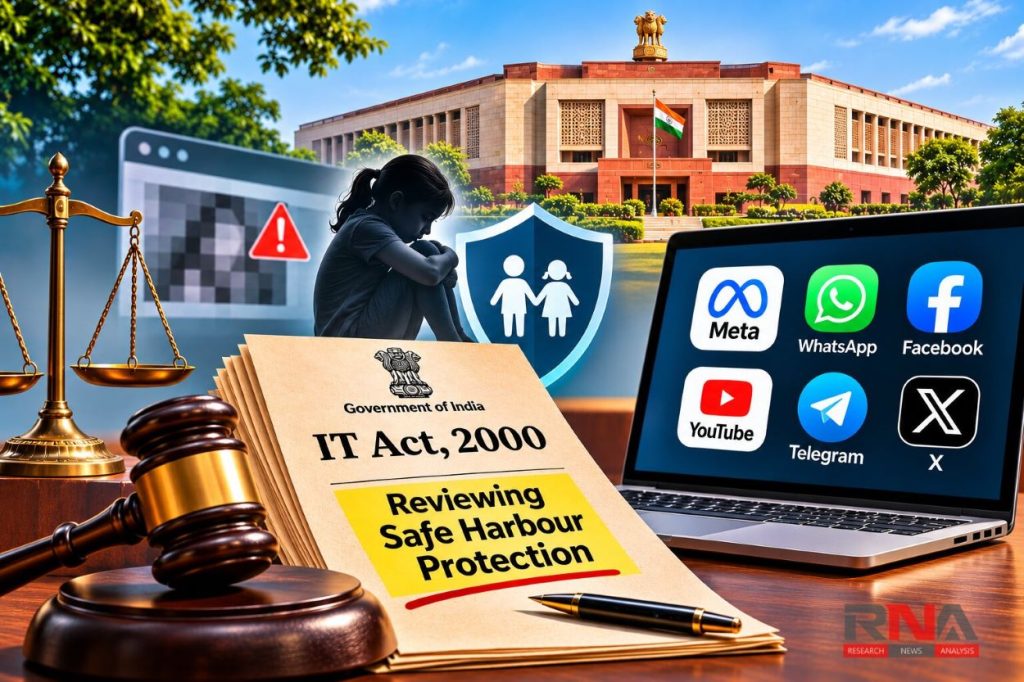
New Delhi: The government is considering a fundamental change to the country’s internet laws that could make social media companies legally accountable for unlawful content posted and circulated by their users. The proposed overhaul comes as the Delhi Police investigates allegations involving child sexual abuse material on Meta-owned platforms, bringing renewed scrutiny to how technology companies detect, moderate and amplify harmful content.
The Ministry of Electronics and Information Technology (MeitY) has begun examining whether platforms such as Facebook, Instagram, YouTube and X should continue enjoying legal protection from prosecution over third-party content when their algorithms actively influence what millions of users see. The discussions could eventually lead to amendments to the Information Technology Act, 2000, potentially transforming the relationship between the government, technology companies and internet users in India.
According to separate reports in the Indian Express and Business Standard, senior government officials believe the existing distinction between companies that merely transmit information and those that influence its distribution has become increasingly difficult to justify. However, the deliberations remain preliminary, with neither a final policy decision nor a formal legislative proposal announced.
At the centre of the proposed changes is the principle of safe harbour, which protects internet intermediaries from legal liability for material generated by users, provided they fulfil statutory conditions. Officials are considering restricting this protection to services that primarily transmit communications, including internet service providers, telecommunications operators and certain private messaging platforms, rather than companies whose recommendation systems determine the visibility of user-generated content.
Delhi Police probe brings Meta under scrutiny
The debate has acquired immediate significance following revelations that the Delhi Police’s Special Cell registered a first information report (FIR) on October 8, concerning the alleged circulation of child sexual exploitation and abuse material through Meta-operated platforms. The case was registered under Sections 67 and 67B of the Information Technology Act after a complaint identified approximately 10 internet links suspected of facilitating access to or circulation of such content.
The police are examining the flagged links and associated digital evidence to establish whether unlawful material was distributed, how it circulated and who may have been responsible. Section 67 deals with the publication or transmission of obscene material electronically, while Section 67B specifically addresses electronic material involving the sexual exploitation of children.
The development was publicly confirmed on Wednesday by a member of the National Human Rights Commission (NHRC), Priyank Kanoongo, who said the police had acted on the commission’s directions. The registration of the FIR represents the beginning of a criminal investigation, and the allegations remain subject to verification rather than constituting an established finding of wrongdoing by Meta.
The case follows growing concern over the circulation of links and advertisements allegedly directing users towards child sexual abuse material hosted on other websites or messaging services. Such arrangements present a particular challenge for enforcement because harmful material may not be stored directly on the platform where the promotional links are encountered.
Meta has maintained that protecting children is a priority and that it is cooperating with Indian authorities to combat online exploitation. The company has also announced that it will report child-safety matters directly through the national cybercrime reporting system managed by the Indian Cyber Crime Coordination Centre (I4C), strengthening its engagement with domestic law enforcement agencies.
The company has separately introduced artificial intelligence-based systems intended to identify suspicious advertisements and other material potentially connected to child exploitation. However, the effectiveness of these measures, particularly in detecting indirect links, disguised advertisements and coordinated distribution networks, remains an important question for investigators and regulators.
Why government wants to reconsider safe harbour
Section 79 of the Information Technology Act, 2000, establishes the legal foundation for intermediary protection in India, recognizing that an online service cannot automatically be held responsible for every message, photograph, video or comment uploaded by its users. The exemption is conditional, requiring intermediaries to observe due diligence and fulfil prescribed legal obligations.
The protection generally applies where an intermediary does not initiate a transmission, select its recipient or select or modify the information contained in it. It can also become unavailable when an intermediary participates in specified unlawful conduct or fails to comply with legally valid requirements concerning prohibited material.
The government’s concern is that major social media platforms no longer function exclusively as neutral channels for transmitting information. Their algorithms continuously rank posts, recommend videos, prioritize advertisements and promote material likely to generate engagement, giving the companies considerable influence over the information reaching individual users.
A video uploaded by one person, for example, may reach thousands or millions of users because a recommendation system identifies it as likely to attract attention, rather than because those users specifically sought it. Officials examining the proposed changes argue that such algorithmic intervention raises questions about whether platforms are exercising a degree of editorial control without accepting corresponding legal responsibility.
The distinction could have substantial consequences for technology companies whose business models depend on personalized feeds, targeted advertising and automated recommendation systems. It could also require lawmakers to define when ordinary technological functions become sufficiently interventionist to justify a different standard of legal accountability.
The government’s reported position is that platforms which determine the ranking, placement or promotion of content should not necessarily receive the same protection as infrastructure providers that simply deliver communications. Nevertheless, algorithmic recommendation alone has not been established under existing Indian law as an automatic ground for withdrawing safe harbour.
Supreme Court calls for tougher penalties
The government’s deliberations also follow a significant Supreme Court order issued on October 15, in the Just Rights for Children Alliance versus S Harish case, which examined persistent shortcomings in the detection and removal of child sexual exploitation and abuse material. The court expressed serious concern over the circulation of such content through social media platforms, including cases where indirect links were used to direct users to websites hosting illegal material.
The court identified weaknesses in the existing regulatory framework, observing that the possible withdrawal of safe harbour protection was an inadequate mechanism for addressing repeated violations of intermediary obligations. It reasoned that losing legal immunity could be excessively severe for some regulatory failures but too uncertain or remote a consequence to discourage routine non-compliance.
The judges consequently called for a more proportionate enforcement framework, including substantial financial penalties calibrated to the seriousness, duration and recurrence of violations. They also suggested considering the size and turnover of the intermediary when determining penalties, reflecting regulatory approaches adopted in other major jurisdictions.
Importantly, the court’s observations did not amount to an instruction to abolish safe harbour protection for all social media companies. Instead, it advocated additional enforcement mechanisms capable of penalizing regulatory failures directly, without necessarily relying on the withdrawal of intermediary immunity in every case.
The court further emphasized that intermediaries have obligations under the Protection of Children from Sexual Offences (Pocso) Act that cannot automatically be discharged merely by satisfying the conditions of Section 79. It directed the government to develop appropriate guidelines, standard operating procedures and legislative or regulatory amendments wherever necessary to strengthen the protection of children online.
Growing friction between government and tech companies
The latest proposals emerge against a background of increasingly strained relations between Indian authorities and major international technology platforms over content moderation, compliance with domestic laws and the distribution of politically sensitive material. The disagreements have extended beyond the circulation of unlawful content to questions about who ultimately determines what Indian users can publish, access or share.
In July, MeitY summoned senior Meta executives, including the company’s president of global affairs, Joel Kaplan, following an incident in which Facebook briefly withheld a video uploaded by the prime minister, Narendra Modi, during student protests. Officials reportedly raised broader concerns about the company’s content-moderation practices, the proliferation of deepfakes and compliance with Indian regulations.
The government has also faced legal resistance from X, owned by Elon Musk, over the mechanisms through which authorities direct social media companies to remove or restrict access to content. In September 2025, the Karnataka high court dismissed X’s challenge concerning the government’s Sahyog portal and associated content-removal procedures, following which the company pursued an appeal.
Parliamentary scrutiny has intensified as well, with the parliamentary standing committee on communications and information technology, chaired by the Bharatiya Janata Party MP, Nishikant Dubey, pressing for stronger accountability. In August 2026, Dubey warned that Meta could face the withdrawal of safe harbour protection if it failed to meet its legal obligations, particularly following the controversy surrounding Modi’s video.
Tighter controls and faster removal of harmful material
Beyond reconsidering legal immunity, MeitY is examining additional requirements that could fundamentally change how global technology companies introduce services and handle complaints in India. One proposal would require social media and messaging platforms to notify the government before rolling out significant technological changes that may affect user safety or create new opportunities for online fraud.
The proposal follows a disagreement with WhatsApp over its planned introduction of usernames, a feature designed to allow users to communicate without necessarily revealing their telephone numbers. In July, the government asked the company to suspend the rollout pending consultations, citing possible risks involving impersonation, phishing and financial fraud.
Officials are considering whether such incidents justify establishing a formal mechanism for advance notification of product changes with significant implications for security and consumer protection. Although the precise scope remains undecided, the proposal could give Indian regulators greater visibility into major platform developments before they are made available to users.
A separate reform under discussion concerns the handling of complaints involving manipulated photographs, sexually explicit deepfakes and intimate imagery circulated without consent. The government wants affected individuals to have more effective means of approaching platforms directly and securing the rapid removal of harmful material without unnecessarily prolonged legal proceedings.
The proposed changes would seek to make grievance mechanisms more responsive to victims rather than leaving decisions almost entirely to the platforms’ internal moderation systems. Such measures could be particularly significant in cases involving the misuse of artificial intelligence to create convincing but fabricated images or videos capable of causing immediate reputational, psychological or personal harm.
Challenge of protecting free speech
Any comprehensive withdrawal of intermediary immunity would represent a major departure from the legal framework governing India’s digital economy. Unlike amendments to subordinate rules, a fundamental rewriting of the statutory protection provided by Section 79 would ordinarily require changes to the Information Technology Act itself and parliamentary approval.
The legal implications would extend well beyond the largest international technology companies, potentially affecting domestic social networking services, video-sharing platforms, discussion forums and smaller technology businesses. Without carefully defined exemptions and liability thresholds, such companies could face significantly greater compliance costs and exposure to litigation involving material uploaded by third parties.
The proposals also raise important constitutional questions because content moderation intersects directly with the freedom of speech and expression guaranteed under Article 19(1)(a) of the Constitution. Although that freedom is subject to reasonable restrictions under Article 19(2), a regulatory framework imposing excessive liability could encourage platforms to remove lawful material merely to avoid prosecution or expensive legal disputes.
The Supreme Court addressed some of these concerns in its landmark Shreya Singhal versus Union of India judgment of March 24, 2015, which struck down Section 66A of the Information Technology Act. The court also interpreted Section 79 to ensure that certain takedown obligations were triggered through court orders or legally valid government notifications concerning restrictions permitted under Article 19(2), rather than leaving intermediaries to determine the legality of innumerable complaints independently.
Any revised liability regime would consequently need to reconcile the government’s objective of preventing unlawful content with existing constitutional safeguards. It would also have to distinguish between material whose circulation is itself a criminal offence and content that may be controversial, politically sensitive or offensive without necessarily being illegal.
A particularly difficult question concerns the treatment of recommendation algorithms, which are used not only to promote entertainment and advertisements but also to organize news, educational material, public-interest information and ordinary social interactions. Establishing liability simply because a platform employs automated ranking systems could create considerable uncertainty unless lawmakers define the conduct, knowledge and degree of involvement that would attract legal consequences.
The stakes are substantial for India’s digital ecosystem, where social media services have become important channels for journalism, political communication, public information, commerce and civic participation. A regulatory framework designed to strengthen online safety would therefore need sufficient safeguards to prevent disproportionate restrictions on legitimate expression.
For now, the government has not published a finalized proposal to withdraw safe harbour protection, nor has it announced a timetable for introducing the necessary legislation. The reported discussions nevertheless indicate a potentially significant shift in Indian internet regulation – from treating platforms primarily as conduits for user-generated content towards examining the responsibility they bear for determining how that content spreads.
The eventual outcome will depend on how the government defines platform accountability, whether Parliament accepts changes to the existing statutory framework and how the resulting provisions withstand constitutional scrutiny. The challenge will be to make technology companies answerable for unlawful material without creating a system in which the fear of legal liability becomes an incentive to suppress legitimate speech.