


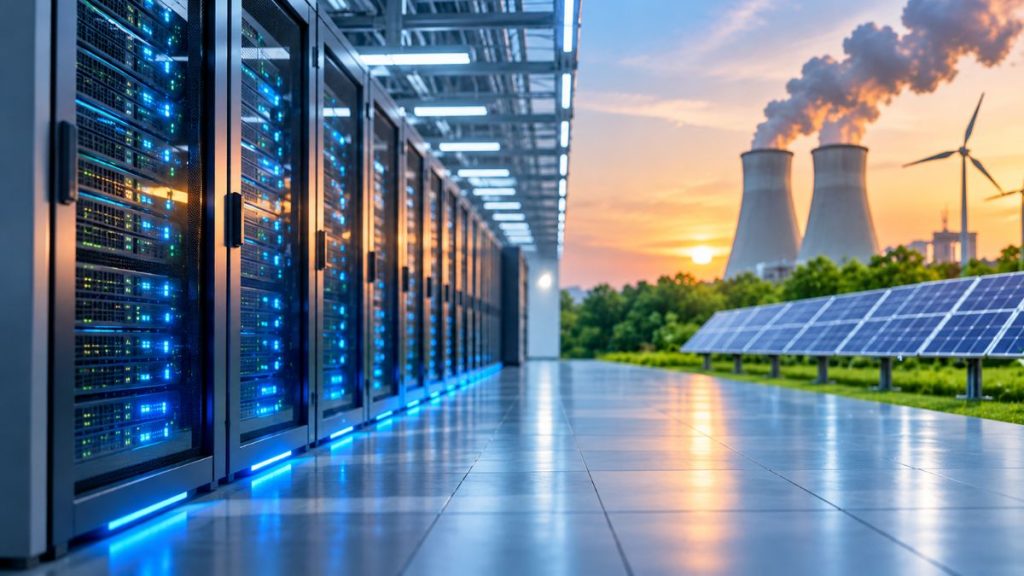
New Delhi: An estimated 403 large US data centres consumed 82 terawatt hours of electricity and were associated with 25.7 million tonnes of carbon dioxide emissions between May 2024 and April 2025. The findings have sharpened concerns about computing’s environmental costs as the COP31 climate summit in Antalya, Turkey, launched a voluntary initiative for more sustainable artificial intelligence (AI).
The Harvard-led research, published on Monday in Nature Sustainability, estimated that fossil fuels supplied around 54 per cent of the electricity attributed to these facilities. Their combined power use was enough to supply nearly seven million American homes for a year.
Researchers combined satellite imagery with facility information and regional electricity generation data to model energy use and emissions. Their estimates cover 403 hyperscale facilities, not every US data centre, and do not separate AI workloads from other computing tasks.
What are data centres?
Data centres are buildings filled with servers, storage devices and networking equipment that process, store and transmit information. They underpin services ranging from online banking and video streaming to cloud storage and AI chatbots.
Hyperscale facilities operate at a much greater scale. Modern AI systems often use specialized processors, including graphics processing units, to train models and generate responses, images and videos.
Why do they need so much electricity?
Servers run continuously, while cooling equipment prevents powerful processors from overheating. Both require electricity, which creates emissions when supplied by coal, natural gas or other fossil fuels.
The International Energy Agency (IEA) estimated that data centres worldwide used 415 terawatt-hours in 2024, roughly 1.5 per cent of global electricity consumption. Its central projection puts demand at approximately 945 terawatt-hours by 2030.
The impact varies widely. Facilities supplied by cleaner electricity have lower operational emissions, while new centres in already strained grid regions can increase pressure on generation capacity and infrastructure.
Why is water use a concern?
Some cooling systems evaporate water to remove heat. Power generation and semiconductor manufacturing can also consume water, extending the industry’s footprint beyond the data centre site.
A study of 9,347 facilities, published in environmental science & technology, found that about one-quarter were in locations modelled to experience at least one month of water scarcity annually. That indicates exposure to local water stress, not proof that data centres caused it.
Cooling needs and water consumption differ with climate, technology and location. Competition for supplies becomes especially sensitive where communities and agriculture already face shortages.
Regulatory pressure is growing, too. Lawmakers in Pennsylvania have introduced a bill that would require large data centres to explain how they plan to meet their electricity and water needs before construction, as RNA Media previously reported.
What about other environmental costs?
Constructing facilities requires land, cables, metals and advanced chips. Replacing equipment generates electronic waste, while backup diesel generators can contribute to local air pollution.
Waste heat need not always be discarded. The IEA has identified substantial potential for recovering it through district-heating networks, although doing so requires suitable nearby infrastructure.
What is the Antalya AI Pledge?
Launched on Monday by the COP31 Presidency and the international telecommunication union, the voluntary pledge encourages low-emission power, more efficient energy and water use, responsible hardware management, transparent environmental reporting and support for climate-focused AI in developing countries.
Progress is to be reviewed annually at UN climate conferences until 2030. The pledge does not legally restrict data-centre construction.
Meanwhile, COP31 discussions have also drawn attention to carbon dioxide removal technologies, which aim to remove CO₂ from the atmosphere but have raised concerns about their cost, effectiveness and potential to delay fossil fuel emissions reductions.
Why does this matter for India?
India’s data centre capacity reached 1.57 gigawatts in August 2026 and is projected to approach eight gigawatts by 2030, according to government figures.
India’s expansion is also fuelling competition among states. Governments are offering power subsidies, land incentives and dedicated policies to attract AI data centres, with combined investment targets exceeding ₹9 lakh crore, as RNA Media reported.
Expanding digital services and AI could make decisions about power sources, cooling systems and locations increasingly consequential. AI may improve climate forecasting and energy efficiency, but those benefits do not remove the need to measure and limit the resources consumed by the infrastructure that enables it.