


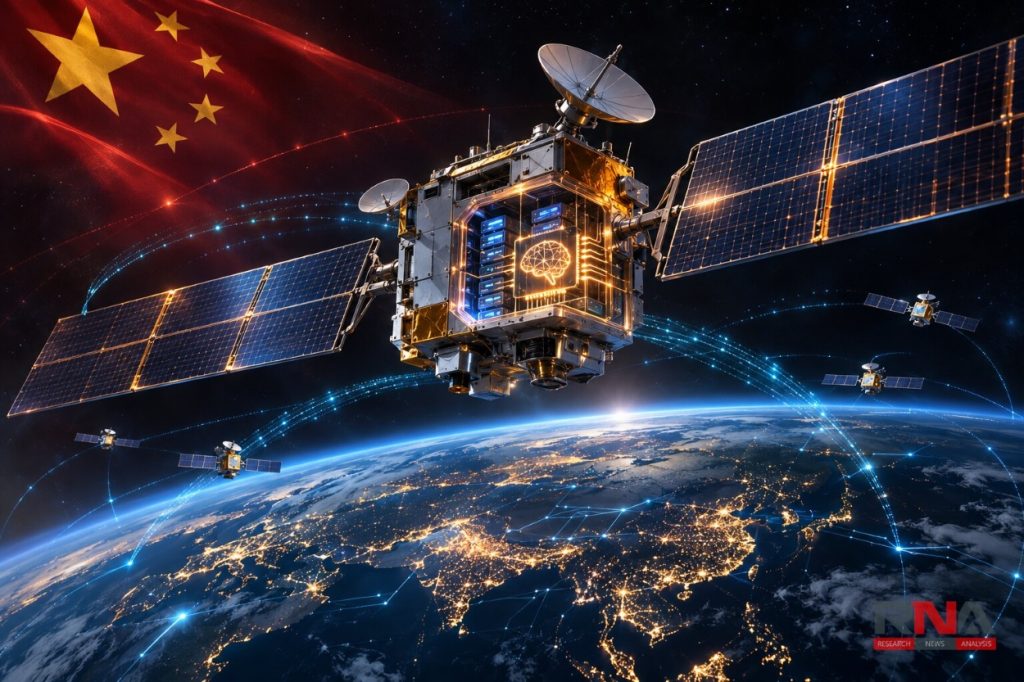
New Delhi: China has successfully tested the training of a large artificial intelligence model aboard a satellite, marking a significant advance in the emerging global race to build computing infrastructure in space. The development takes Beijing a step closer to establishing an orbital supercomputing network that could eventually transform everything from disaster monitoring and scientific research to strategic surveillance and intelligence gathering.
The China Academy of Information and Communications Technology (CAICT) has released the findings of third-party performance tests conducted on satellites belonging to the second batch of the country’s ambitious “Star Compute” programme. Developed by Chinese space technology company ADA Space, the project envisages a constellation of 2,800 satellites capable of performing sophisticated computing operations independently of terrestrial data centres.
The latest batch, comprising eight AI computing satellites, was launched from the Jiuquan Satellite Launch Centre on October 14. According to the developer, the combined processing capacity of the satellites deployed under the programme has reached nearly 50 quadrillion operations per second, making it what the company claims is the world’s largest operational space-based computing constellation.
Teaching AI in space
At the centre of the latest technological demonstration was a satellite named Libra, which successfully performed both training and inference operations using Alibaba’s Qwen3-32B large language model. The model contains approximately 32 billion parameters – numerical variables that determine how an AI system processes information, recognizes patterns and generates responses.
According to the test results reported by Chinese state media, Libra sustained an uninterrupted AI training session lasting 45 minutes and 33 seconds during a single orbital revolution. The satellite executed the complete computational cycle required to refine the model’s parameters, with a progressive decline in its training loss – a mathematical measure of the difference between its predictions and expected outputs.
The achievement is particularly noteworthy because most satellites equipped with AI processors have traditionally concentrated on inference – using previously trained models to analyse information or perform specific tasks. Training, by contrast, requires substantially greater computational resources, memory bandwidth and energy, making it considerably more challenging to undertake in space.
However, the experiment should not be confused with training an entire large language model from scratch in orbit. Rather, it demonstrates that an existing sophisticated AI model can undergo further training aboard a satellite without relying on ground-based computers for the core computational process.
Overcoming the heat barrier
Libra has a nominal computing capacity of 32 petaflops at eight-bit floating-point (FP8) precision, a numerical format increasingly used in AI computing to improve processing efficiency. However, operating powerful processors in space presents considerable engineering challenges, particularly in dissipating the heat generated during intensive computational operations.
Unlike terrestrial data centres, satellites cannot rely on surrounding air to carry away heat through convection. They must ultimately release excess thermal energy into space through radiation, requiring specialized cooling systems and sufficiently large radiators.
ADA Space’s 10-kilowatt-class liquid-cooling system and deployable thermal radiators reportedly performed successfully during the orbital trials. The results provide preliminary evidence that high-performance computing equipment can sustain extended operations in space without overheating.
China’s ambitious orbital supercomputer project
China began assembling its orbital computing infrastructure on May 14, 2025, with the launch of the first 12 satellites developed under the Star Compute programme. The eventual constellation is expected to comprise 2,400 satellites dedicated to AI inference and another 400 designed for training AI models.
The spacecraft are intended to operate at altitudes ranging from 500 to 1,000 kilometres, occupying different orbital configurations and exchanging information through high-speed laser communications. Once fully deployed, the network is envisaged as a distributed supercomputer capable of processing enormous volumes of information directly in orbit.
Unlike conventional Earth-observation satellites that transmit raw information to ground stations for analysis, an interconnected orbital computing network could process data at its source. This could significantly reduce the time required to detect forest fires, assess natural disasters, monitor maritime traffic and identify environmental changes.
Although China has emphasized the commercial and scientific applications of space-based computing, the technology has considerable strategic implications. AI-enabled satellite networks could accelerate the interpretation of reconnaissance imagery, improve maritime domain awareness and reduce dependence on terrestrial infrastructure for intelligence processing.
For India, such developments assume particular significance given China’s expanding space capabilities and the growing importance of satellite-based intelligence in modern warfare. Nevertheless, the latest Chinese trials do not establish that the constellation has been integrated into military command-and-control systems.
New frontier in US-China tech rivalry
China is not alone in pursuing orbital computing. Google’s Project Suncatcher envisages interconnected, solar-powered satellites equipped with the company’s tensor processing units (TPUs) to undertake AI computations in space.
On November 19, Reuters reported that Google had selected Jeff Bezos’s Blue Origin to launch experimental computing satellites in 2029. Meanwhile, as RNA Media reported, Elon Musk’s ambitious proposal for a constellation of up to one million orbital data centre satellites has also attracted regulatory attention and scrutiny over its feasibility.
India, too, has entered this emerging technological domain, albeit on a considerably smaller scale. Hyderabad-based space technology start-up TakeMe2Space launched its MOI-1A orbital computing satellite aboard a SpaceX mission in October, following an earlier technology demonstration aboard an Indian Space Research Organization (Isro) mission in December 2024.
Despite the growing enthusiasm, orbital data centres face formidable challenges involving launch costs, radiation exposure, equipment maintenance, heat dissipation and space debris. China’s latest experiment does not resolve all these questions, but it demonstrates that space is increasingly becoming a destination not merely for collecting and transmitting information but also for processing it.