


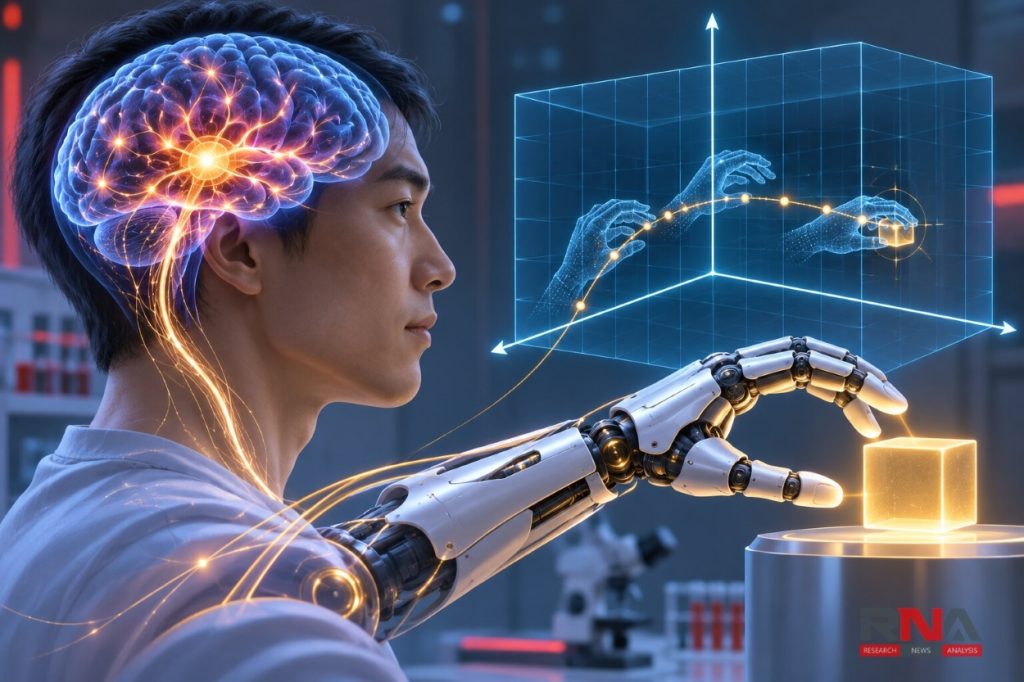
New Delhi: Chinese neuroscientists have identified a previously poorly understood mechanism through which the brain continuously tracks the position of the hand in three-dimensional space, a discovery that could significantly improve the next generation of brain-computer interfaces (BCIs). The findings suggest that future neural implants may be able to interpret where a person intends to move a limb rather than merely decode the electrical signals associated with the direction and speed of movement.
The research, conducted by scientists at the Institute of Automation under the Chinese Academy of Sciences (CAS), identifies specialized neurons that effectively maintain an internal spatial representation of hand positions. Published in the Journal of Neuroscience, the peer-reviewed study offers new evidence about how the brain coordinates voluntary movements and how those processes might eventually be translated into commands for assistive technologies.
Led by the neuroscientist, Yu Shan, the research team examined the neural activity of two rhesus macaques performing natural reaching and grasping movements. By implanting microscopic electrode arrays into specific regions of their brains, the scientists recorded electrical signals from individual neurons as the animals moved their hands through three-dimensional space.
The experiments focused on two regions – the primary motor cortex (M1), which plays a central role in executing voluntary movements, and the dorsal premotor cortex (PMd), which contributes to movement planning. Researchers discovered that approximately 36.2 per cent of neurons recorded in M1 and 21.3 per cent in PMd displayed significant sensitivity to the instantaneous spatial position of the hand.
Unlike neurons whose activity principally reflects movement speed or direction, these position-sensitive cells responded most strongly when the hand entered particular regions of space. Their activity weakened as the hand moved away, suggesting that the brain maintains a continuously updated representation of the limb’s location rather than relying exclusively on movement calculations.
Explaining the finding to the Chinese news outlet Global Times, the study’s first author, Cao Shenghao, compared the mechanism to an internal three-dimensional positioning system. He suggested that when someone reaches for an object, the brain can represent the destination without consciously calculating every intermediate movement needed to reach it.
Why the discovery matters for brain-computer interfaces
The implications extend beyond understanding ordinary hand movements, particularly for patients whose brains retain the ability to formulate movement intentions but whose nervous systems cannot transmit those instructions to their muscles. Such conditions include spinal cord injuries, paralysis following strokes and amyotrophic lateral sclerosis (ALS), a progressive disease affecting the nerve cells responsible for voluntary muscle movement.
Most existing motor BCIs interpret patterns of neural activity associated with the direction and velocity of intended movements, which are then translated into commands for computers, robotic arms or other external devices. The Chinese findings raise the possibility of a different approach in which a device identifies the intended position of a hand and uses computational systems to determine how to reach that destination.
One particularly significant finding concerns the efficiency with which the brain’s spatial information can be decoded. The researchers reported that position-sensitive neurons representing only 17.7 per cent of the recorded population in PMd achieved 94.1 per cent of the trajectory-decoding performance obtained from the entire recorded population.
In M1, a similarly selected group comprising 32.8 per cent of recorded neurons delivered 92.9 per cent of the decoding performance of the complete population. These results indicate that carefully chosen neural signals may contain sufficient information to reconstruct hand movements accurately, potentially reducing the computational burden of future interfaces.
The researchers also calculated that an average of 2.8 position-sensitive neurons in PMd, or 16.4 in M1, could account for 90 per cent of full-population decoding performance under their experimental conditions. However, Cao cautioned that these statistical estimates should not be interpreted as evidence that a practical brain implant would need to record signals from only a handful of neurons.
China accelerates development of neural technology
The discovery comes as China expands its investment in brain-computer interfaces, an emerging technological field with potential applications in rehabilitation, robotics and human-machine interaction. In March 2026, Chinese regulators approved a BCI medical device designed to help restore hand-movement abilities, marking an important step towards commercial clinical applications.
Beijing has also moved to strengthen its influence over international technical standards governing the technology. On October 19, China’s State Administration for Market Regulation announced the publication of an international BCI reference architecture developed through cooperation between Chinese specialists and experts from several countries, including India, the United States, Britain and Japan.
The framework, formally designated ISO/IEC 27572:2026, establishes common technical concepts for designing and implementing brain-computer interfaces. Although unrelated to the specific neurological discovery, the initiative demonstrates China’s broader effort to combine fundamental neuroscience research with commercial development and international standardization.
Significant scientific obstacles remain
Despite the encouraging findings, the research remains at an experimental stage and has not demonstrated that the same neural decoding technique can restore movement in human patients. Scientists must establish whether comparable spatial representations exist in human brains and whether their signals can be recorded reliably over prolonged periods.
Implanted electrodes also present complications involving biological compatibility, deterioration of recorded signals and changes in neuronal activity over time. Even successful decoding of intended hand positions would not automatically enable delicate finger movements, complex manipulation or natural multitasking.
An additional distinction concerns the difference between tracking a hand’s current position and identifying a movement a person intends to perform. Although the research provides evidence relevant to both movement control and target representation, reliable decoding of complex future actions requires further investigation.
Nevertheless, the findings offer an important foundation for developing assistive systems that combine neural signals with artificial intelligence and robotic control. If successfully translated into clinical technology, such systems could eventually allow people with severe movement disabilities to direct external devices towards intended targets with greater independence and less continuous mental effort.