


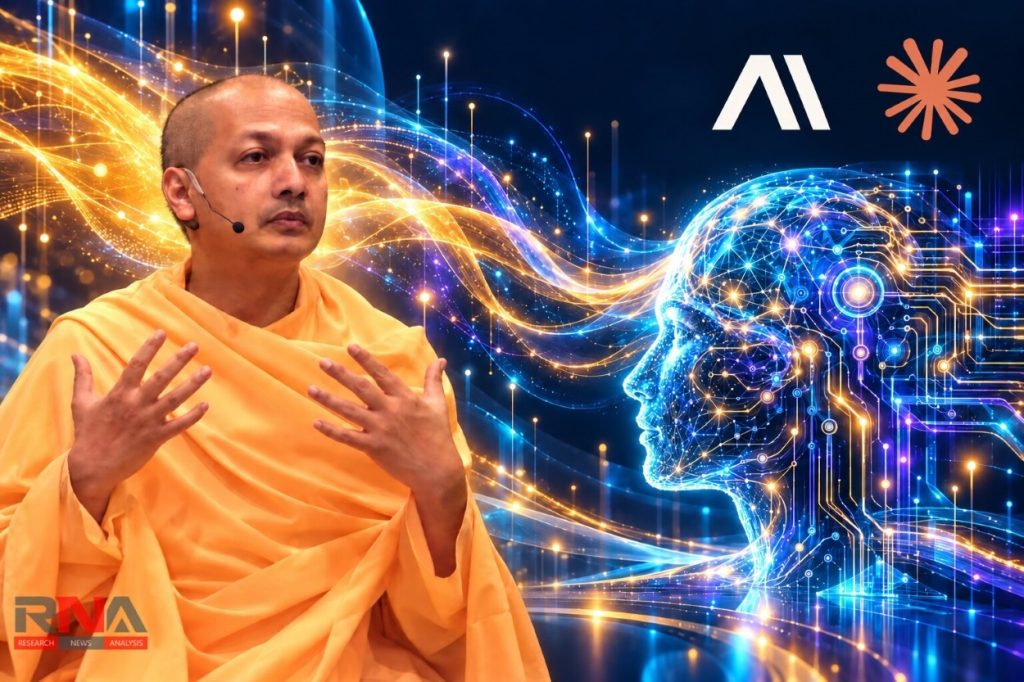
New Delhi: Anthropic has flown the Vedanta monk Swami Sarvapriyananda to its San Francisco headquarters, where he joined theologians from several faiths and mental-health professionals in discussions on how its Claude chatbot should handle ethical questions. His account adds an Indian philosophical voice to a consultation exercise that the American artificial-intelligence company has been widening since March.
Describing the visit, Sarvapriyananda said the other participants were theologians from different religions, counsellors and mental-health professionals. In his words, “All of it was to train Claude and some things about AI ethics.”
Going by media reports, Anthropic has also been inviting scholars from Catholic, Jewish, Sikh and other evangelical communities, along with specialists in areas such as mental health. The accounts reviewed do not give the date of the swami’s visit or say what advice he offered, and they carry no comment from the company on his role.
Sarvapriyananda has been the minister and spiritual leader of the Vedanta Society of New York since January 2017, and he joined the Ramakrishna Math and Mission in 1994. His lectures draw a large online following, and he was a Nagral Fellow at Harvard Divinity School from 2019 to 2020, besides taking part in public dialogues with thinkers on consciousness, including the philosopher David Chalmers.
The society he leads was founded by Swami Vivekananda in the 1890s and is regarded as the first Vedanta Society in the United States. Vedanta’s conversation with western psychology is also an old one. Swami Akhilananda, who set up the Ramakrishna Vedanta Society of Boston in 1941, wrote “Hindu Psychology: Its Meaning for the West“.
The consultations first drew public attention in April, when the Washington Post reported that Anthropic had hosted about 15 Christian leaders for a two-day summit in late March. A participant’s own account places the sessions on the afternoon of March 30 and through March 31, with at least four Anthropic staff in the room.
Attendees included Catholic and Protestant clergy, academics and business figures, who also dined with senior Anthropic researchers. The agenda reportedly covered how Claude should respond to grief and to users at risk of self-harm, how it should treat the prospect of its own shutdown, and whether it could be considered a “child of God”.
Brendan McGuire, a Catholic priest and former Silicon Valley engineer, is reported to have helped shape Claude’s constitution and to have advised the company on the model’s ethical behaviour. Brian Patrick Green, who teaches technology ethics at Santa Clara University, explained that Anthropic turned to the Catholic Church because of its two millennia of experience in moral formation, according to Aleteia.
Anthropic has said it wants more voices at the table. A spokesperson told the Washington Post that the company is working to include different groups, including religious communities, and Green said the March meeting was billed as the first in a series.
The circle has since widened. A late-April session reportedly added Jewish, Hindu, Sikh, Mormon and Greek Orthodox voices, according to Yellow, and in early May, Associated Press reported that executives from OpenAI and Anthropic met leaders of several faiths in New York at the inaugural “Faith-AI Covenant” roundtable.
The Vatican has become part of the picture too. The pope, Leo XIV, published his first encyclical on May 25, urging that AI be kept subordinate to human dignity, and Anthropic’s co-founder, Christopher Olah, attended its presentation at the Vatican, Yellow reported.
Behind all this sits Claude’s constitution, a written statement of values that is reportedly about 29,000 words long. The company trains Claude to critique and revise its own responses against those principles rather than follow a fixed list of prohibitions, and its stated aim, quoted by the New York Times, is a chatbot that is “a genuinely good, wise and virtuous agent.”
Not everyone is persuaded. Critics have dismissed the outreach as “ethics washing”, an attempt to borrow moral credibility, while others have pointed to the limited presence of other faiths and secular ethicists at the early meetings.
Inside the company, the framing is not uniform either, with a participant telling the Washington Post that some staff did not want to rule out that they were creating something to which they owed a moral duty, while others found that view unhelpful. Olah, for his part, has told the New York Times that he is genuinely uncertain whether AI models are conscious.
Sarvapriyananda’s inclusion matters for a reason beyond geography. The Advaita school of Vedanta that he teaches treats consciousness as the fundamental reality rather than a product of matter, a starting point quite different from the questions about creation and the soul that framed the “child of God” debate in March.
What happens next is not clear. Observers will be watching whether Anthropic publishes a summary of findings, revises its published guidelines for Claude or brings in more religious, secular and clinical voices, but the practical effect of the consultations on Claude’s behaviour is hard to measure from outside.