


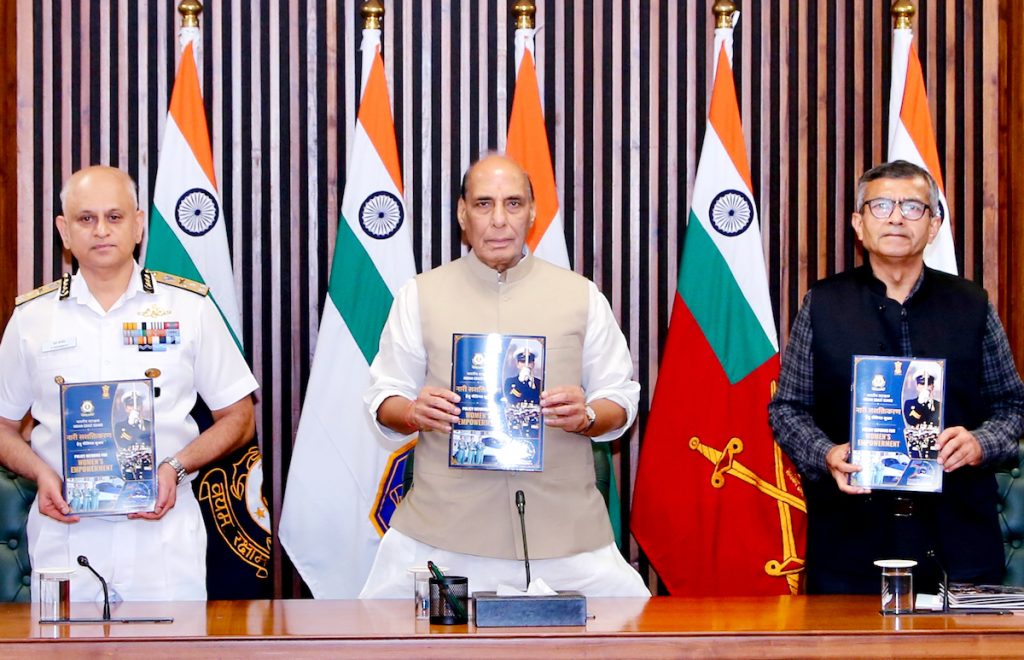
New Delhi: The defence minister, Rajnath Singh announced two policy reforms for the Indian Coast Guard (ICG) – one opening officer induction equally to men and women, the other speeding up compensation for families of personnel who go missing at sea. He unveiled the changes at an event at Kartavya Bhavan-2 in New Delhi, on Monday.
The defence secretary, Rajesh Kumar Singh, the director general of the ICG, Paramesh Sivamani, and other senior officials attended event held for the announcement.
Singh praised the force’s record over nearly five decades and said the reforms would strengthen morale and operational effectiveness as the ICG heads toward its Golden Jubilee. The Coast Guard was raised on February 1, 1977, with two frigates and five patrol boats transferred from the Navy, and formally instituted under the Coast Guard Act the following year, with a fleet of just seven ships at the outset – meaning 2027 will mark 50 years since its founding. Singh also reaffirmed the government’s stated intent to build the ICG into a modern, capable maritime force.
Under the first reform, women can now be inducted into both the short service appointment (SSA) and permanent appointment (PA) streams on the same terms as men. Conversely, the SSA route – until now largely the entry point for women officers – has been opened to male candidates as well, which was only for women officers previously.
Career progression will be equal from the from the starting training stage onward. Serving women officers on PA will be eligible for promotion to higher ranks, subject to meeting eligibility conditions, and women currently on SSA will have the option of converting to PA if they meet the stipulated criteria.
The move follows sustained pressure from the courts. In February 2024, the Supreme Court, hearing a plea by Commandant Priyanka Tyagi over the denial of a permanent commission after 14 years of service, noted that the Coast Guard had only 16 women officers out of a total strength of 1,586, none holding a permanent commission. A bench led by the then chief justice, DY Chandrachud, rejected the Centre’s argument that the ICG functioned differently from the Army, Navy and Air Force – all of which had already begun granting permanent commissions to women following earlier Supreme Court rulings – and observed: “Women cannot be left out.”
The court had also directed the ICG to frame a gender-neutral policy.
The second reform concerns next of kin (NoK) of personnel who go missing at sea while on duty. The ICG will now have the authority to declare such personnel “presumed dead” specifically for the purpose of ex gratia payments – a one-time compensation paid without admission of legal liability – and this is expected to speed up the release of compensation and terminal benefits considerably.
This addresses a longstanding bureaucratic bottleneck. Under ordinary Indian law, a missing person can be presumed dead only after seven years of being unheard of, a presumption that typically requires a court’s determination once that period has elapsed. The new provision lets the ICG make an internal determination for ex-gratia purposes without the family having to wait out the statutory period or petition a court, sparing them prolonged administrative delay at an already difficult time.