


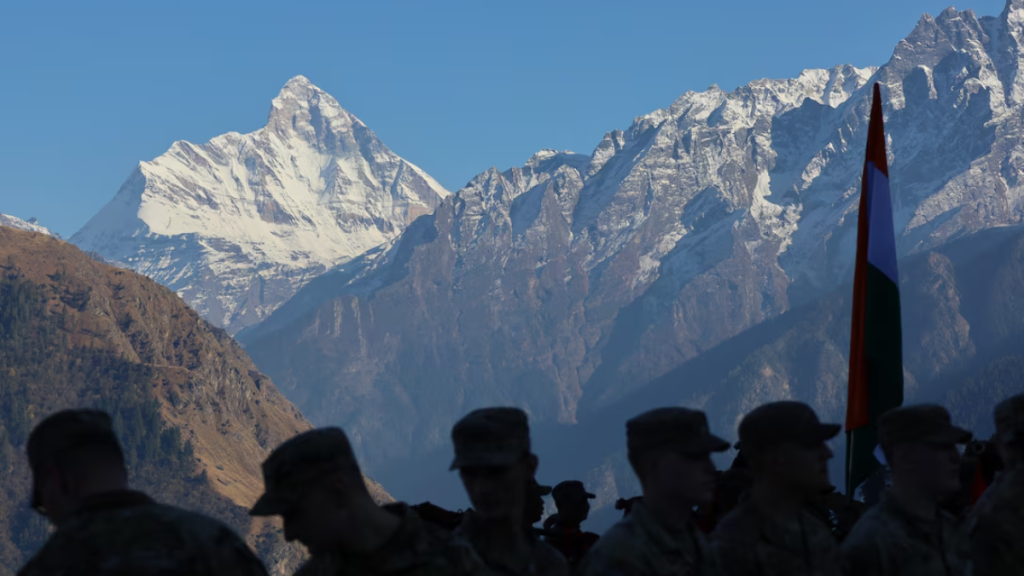
New Delhi: India and the United States have begun the 22nd edition of their annual Army exercise, Yudh Abhyas, with the latest edition running from September 9 to 28. The exercise is being held in India and comes with an expanded focus on precision fires, battlefield networking and counterdrone warfare as the two sides seek to sharpen their ability to operate together in modern combat scenarios.
The US Army has deployed Arctic-trained troops from the 11th Airborne Division, based at Fort Wainwright, Alaska, for the exercise. The 3rd Multi-Domain Task Force has also joined the drills, bringing long-range precision-fire capabilities and integrated command-and-control systems into the bilateral training.
This year’s exercise will combine a command post exercise with field training, before concluding with a joint live-fire demonstration. The drills will also test the integration of Indian and US long-range and precision-fire systems, while the deployment of the US Army’s mobile low, slow, small unmanned aircraft integrated defeat system, or MLIDS, introduces a new counterdrone capability to the exercise.
The inclusion of MLIDS is particularly significant as unmanned systems have become an increasingly important part of contemporary warfare. The two armies will use the training to examine ways of detecting and defeating small drones while improving coordination against emerging battlefield threats.
RNA Media had earlier reported, latest edition follows Yudh Abhyas 2025, which was hosted by the US Army at Fort Wainwright, Alaska, from September 1 to 14. During that exercise, the Indian contingent of around 450 personnel was led by a battalion of the Madras Regiment, while the US side fielded troops from the 1st Battalion, 5th Infantry Regiment, or the “Bobcats”, of the 11th Airborne Division.
The 2025 drills placed the two forces in sub-Arctic conditions and included training in mountain and high-altitude warfare, air mobility, heliborne operations, artillery-aviation coordination, electronic warfare and surveillance. Counterdrone operations, battlefield medical support and live-fire training were also part of the previous edition.
Yudh Abhyas has developed into a major army-to-army exercise since its early editions, with India and the US alternating hosting responsibilities. The exercise has moved across different operational settings over the years, including high-altitude terrain in Uttarakhand, desert areas in Rajasthan and cold-weather conditions in Alaska, giving the two forces opportunities to train for different battlefield environments.
The 2026 edition adds another layer to that cooperation by bringing long-range fires, digital command-and-control and counter-unmanned aircraft capabilities into the exercise. The US Army has described the training as part of Operation Pathways and said it is intended to strengthen the two countries’ readiness and their ability to respond to evolving security challenges in the Indo-Pacific.