


New Delhi: Operational preparedness remains the immediate focus for the Indian Army’s Western Command as it monitors the security environment along the western front, even as the formation marks its 80th raising day at Chandimandir. The command, which carried out assigned operational tasks along the western front during Operation Sindoor, has in recent weeks reviewed joint planning, technological integration and readiness for coordinated operations with the Indian Air Force.
That focus was underlined on September 4 when the Indian Air Force chief, Air Chief Marshal Amar Preet Singh, visited Headquarters Western Command and met the Army commander, Lieutenant General Pushpendra Singh. Their interaction centred on operational preparedness, joint planning and deeper integration between the Army and Air Force for synergized operations.
Western Command’s role along the Pakistan facing theatre has retained particular operational relevance after Operation Sindoor. During a post-operation review at Chandimandir in May 2025, the chief of defence staff was briefed on the command’s kinetic and non-kinetic response, the prevailing security situation along the western borders, technological infusion and measures to improve real time situational awareness.
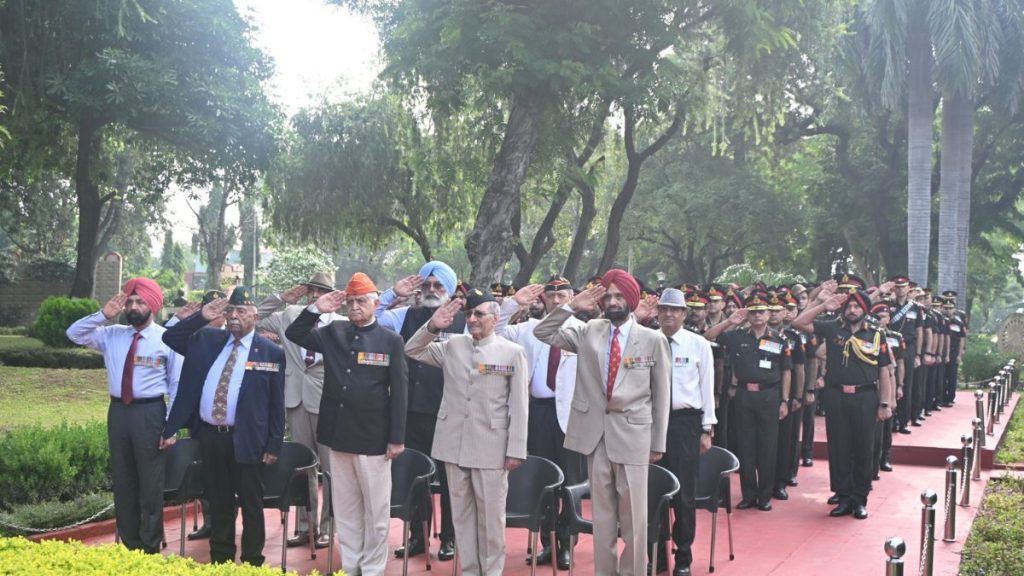
Against that operational backdrop, Western Command commemorated its 80th Raising Day at Chandimandir on Tuesday. Lieutenant General Pushpendra Singh, general officer commanding in chief, Western Command, laid a wreath at the Veer Smriti War Memorial in tribute to personnel who made the supreme sacrifice.
The former chief of the Army staff, General Ved Prakash Malik (retired), former Army commanders and senior veterans also paid floral tributes. A ceremonial guard reversed arms and buglers sounded the last post during the ceremony.
The command traces its post-Independence origins to the Delhi and East Punjab command formed in September 1947, which was redesignated Western Command in January 1948. It subsequently participated in the wars of 1947-48, 1962, 1965 and 1971 and has remained one of the Army’s principal formations responsible for the western theatre.
Technology and joint operations
According to a defence spokesperson quoted by the Tribune, the command says its current transformation is being driven by technological absorption, jointmanship, realistic training and sustained operational preparedness. Those priorities reflect wider lessons from Operation Sindoor, where the armed forces placed greater emphasis on integrated air defence, drones and counterdrone capabilities, electronic warfare and networked coordination.
For Western Command, the 80th raising day therefore comes less as a pause for commemoration than against a continuing cycle of readiness reviews and joint training. Its headquarters at Chandimandir remains central to Army planning for the western theatre, where surveillance, precision engagement, logistics and close Army-Air Force coordination have assumed greater importance in the post-Operation Sindoor security environment.