


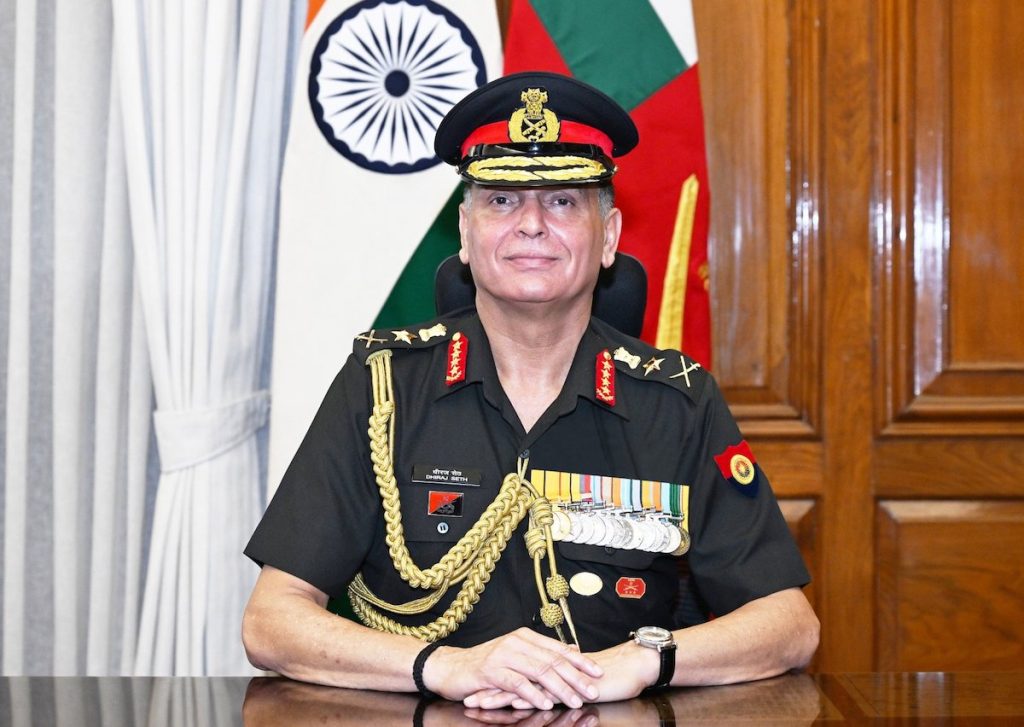
General Dhiraj Seth took over as India’s 31st chief of Army staff on Tuesday, succeeding General Upendra Dwivedi, who retired after more than four decades in uniform. Gen Seth is the seventh officer from the Armoured Corps to reach the Army’s highest post, and the first in almost three decades – a moment of real significance for India’s tank regiments, which have waited since the mid-1990s to see one of their own at the top.
The formal change of command took place this morning at South Block lawns in New Delhi, where Gen Dwivedi was presented a ceremonial guard of honour before relinquishing charge. The outgoing chief also laid a wreath at the National War Memorial in tribute to soldiers who had died in service, before formally handing over to Gen Seth, whose appointment takes effect from the afternoon of Tuesday.
Rise of an Armoured Corps officer
As RNA Media reported earlier, the government appointed Gen Seth to the post on June 13, and confirmed that he would assume the substantive rank of general on taking charge. He had been serving as vice-chief of Army staff since April 1 – succeeding Lieutenant General Pushpendra Pal Singh, who moved on to head Western Command – which gave him a ringside view of ongoing modernization, budgetary planning and personnel reforms in the service before stepping into the top job himself.
Early life and education
Gen Seth comes from a military family. His father, Lieutenant General Krishna Mohan Seth, served as adjutant general and commanded a strike corps before retiring in 1997, which have the son early exposure to the Army’s institutional culture. Educated at Sainik School, Rewa; and later at the National Defence Academy, Khadakwasla; and the Indian Military Academy, Dehradun; he was commissioned into the 2nd Lancers (Gardner’s Horse) on December 20, 1986.
He joined the Armoured Corps at a time when mechanized warfare sat at the heart of India’s deterrence posture on the western front. That makes him only the third Army chief to emerge from the storied 2nd Lancers, after General Maharaj Shri Rajendrasinhji Jadeja and General Bipin Chandra Joshi.
Gen Seth distinguished himself early, winning the Silver Centurion in the Young Officers’ Course and topping both the Radio Instructor Course and the Junior Command Course, before being adjudged the best all-round student at the Defence Services Staff College, Wellington. His academic record matches his field one: an MPhil in defence and management studies, two master’s degrees in strategic studies and military science, and advanced command and acquisition courses in France and the United States.
Command and operational experience
Operationally, Gen Seth’s career spans armoured manoeuvre, counterinsurgency and large-formation command. He has led Skinner’s Horse, the 98 Armoured Brigade, the Rashtriya Rifles counterinsurgency force in Jammu & Kashmir, XXI Corps (the Sudarshan Chakra Corps) and Delhi Area – experience spread across desert, plains and urban theatres alike.
He served with the United Nations Angola Verification Mission (UNAVEM III) in 1995–96 as an operations officer, an early exposure to multinational peacekeeping and complex post-conflict environments. More recently, he earned the rare distinction of commanding two Army commands back to back: South Western Command from November 1, 2023, to June 30, 2024, and Southern Command, headquartered in Pune, from July 1, 2024.
He relinquished the latter on March 31 this year, before moving to Army Headquarters as vice-chief. It is this reputation for studying modernization closely and tracking global military trends that earned him the moniker “the tankman” from defence commentators.
Staff, instructional and modernization roles
Beyond field command, Gen Seth has held key instructional appointments as instructor and assistant adjutant at the NDA, and as chief instructor at the School of Armoured Warfare, Armoured Corps Centre and School in Ahmednagar, thus shaping successive generations of mechanized officers. On the staff side, he has served as brigade major of an independent armoured brigade, assistant military secretary, brigadier general staff (operations) at South Western Command, deputy director general (plans) in the perspective planning directorate, and additional director general (weapons and equipment), which placed him at the heart of doctrinal revision and capital procurement for years.
These appointments, together with courses at the Military College in Paris, the Naval Postgraduate School in Monterey, the Higher Command Course at Mhow, and the National Defence College in New Delhi, have given Gen Seth a firm grip on strategy, capability development and joint planning. His decorations – the Param Vishisht Seva Medal (PVSM), Uttam Yudh Seva Medal (UYSM) and Ati Vishisht Seva Medal (AVSM) – reflect sustained excellence across both operational and staff environments.
On the personal side, Gen Seth is married to Komal Seth and the couple have two daughters. He is also a keen sportsman who plays tennis and golf.
Why this matters for Armoured Corps
Gen Seth’s elevation closes a 30-year gap since an Armoured Corps officer last headed the Army, restoring the corps’ place in the leadership mix after a long stretch dominated by infantry chiefs. By open-source count, he is the seventh chief of Army staff with Armoured Corps roots, following Rajendrasinhji Jadeja, Jayanto Nath Chaudhuri, Arun Shridhar Vaidya, Vishwa Nath Sharma, Bipin Chandra Joshi and Shankar Roychowdhury.
The Armoured Corps’ six chiefs before him
General Maharaj Shri Rajendrasinhji Jadeja, 1st COAS (April 1, 1955–May 14, 1955)
Gen Rajendrasinhji Jadeja, a prince of Nawanagar who chose a military career, was commissioned into the Indian Army in 1921 after training at the Royal Military College, Sandhurst, later joining the 2nd Royal Lancers. Following Independence, he was appointed commander in chief of the Indian Army on January 14, 1953, and on April 1, 1955, became the first officer formally designated chief of Army staff, holding the post until his retirement on May 14, 1955.
His tenure, though brief, was crucial in Indianizing the senior leadership, stabilizing the Army through the turbulence of Partition, and beginning the shift from colonial structures to a national military ethos.
General Jayanto Nath Chaudhuri, 5th COAS (November 20, 1962–June 7, 1966)
Gen Jayanto Nath Chaudhuri was commissioned from Sandhurst onto the Unattached List of the Indian Army on February 2, 1928, and soon joined the cavalry, eventually serving with the 16th Light Cavalry of the Armoured Corps. He took over as the fifth chief of Army staff on November 20, 1962, in the aftermath of the 1962 war with China, and served until June 7, 1966.
Gen Chaudhuri’s record spans World War II service in the Middle East, command of the 1 Armoured Division during Operation Polo – the integration of Hyderabad – his subsequent appointment as military governor of Hyderabad, and his stewardship of the Army’s reorganization and modernization, including armoured warfare reforms and leadership during the 1965 war against Pakistan.
General Arun Shridhar Vaidya, 12th COAS (August 1, 1983–January 31, 1986)
Gen Arun Shridhar Vaidya was commissioned into Deccan Horse (9 Horse), an Armoured Corps regiment, and built a formidable reputation as a tank commander in the 1965 and 1971 wars, earning the Maha Vir Chakra twice – an honour unique among Army chiefs. He became the 12th chief of Army staff on August 1, 1983, and served until January 31, 1986, a period of intense operational challenge and political sensitivity.
As COAS, Gen Vaidya oversaw the Army’s mechanized preparedness and planned and supervised Operation Blue Star in June 1984, the controversial operation to clear armed militants from the Golden Temple complex. He was assassinated in Pune on August 10, 1986, by Khalistani extremists, leaving one of the most searing legacies attached to any Indian Army chief.
General Vishwa Nath Sharma, 14th COAS (June 1, 1988–June 30, 1990)
Gen Vishwa Nath Sharma, of the 16th Light Cavalry, was commissioned on June 4, 1950, becoming the first president’s commissioned officer eventually to lead the Army. He took over as chief of Army staff in 1988, succeeding General Krishnaswamy Sundarji, and served until 1990, continuing many of his predecessor’s structural reforms.
Gen Sharma’s tenure was defined by the Indian Peace Keeping Force (IPKF) campaign in Sri Lanka and intensified counterinsurgency operations in Punjab and the northeast, alongside efforts to consolidate mechanized infantry concepts, raise training standards and manage the morale impact of prolonged out-of-area and internal security commitments.
General Bipin Chandra Joshi, 16th COAS (July 1, 1993–November 19, 1994)
Gen Bipin Chandra Joshi was commissioned into the 2nd Lancers (Gardner’s Horse) on December 4, 1954, later moving to 64 Cavalry, and rose through command and staff roles that mirrored the Army’s shift towards specialized counterinsurgency forces. He became the 16th chief of Army staff on July 1, 1993, and served until his death in harness on November 19, 1994 – the only Indian Army chief to die in office.
Gen Joshi’s signal contribution was conceiving and raising the Rashtriya Rifles as a dedicated counterinsurgency force. As COAS, he guided the Army’s early shift towards a sustained internal-security posture in Jammu & Kashmir while keeping conventional deterrence sharp, before his tenure was cut short by a heart attack.
General Shankar Roychowdhury, 17th COAS (November 22, 1994–September 30, 1997)
Gen Shankar Roychowdhury was commissioned into the 20 Lancers of the Armoured Corps on June 9, 1957, after graduating from the Indian Military Academy. He assumed charge as the 17th chief of Army staff on November 22, 1994, following Gen Joshi’s sudden death, and retired on September 30, 1997, after four decades of service. Before becoming chief, he commanded 16 Corps in Jammu & Kashmir during a critical phase of rising militancy.
As COAS, Gen Roychowdhury oversaw the Army’s deepening counterinsurgency campaign in Kashmir, expanded and institutionalized the Rashtriya Rifles, and helped steer the doctrinal and organizational adjustments needed for sustained low-intensity conflict alongside conventional readiness.
Gen Seth’s challenges ahead
Gen Seth’s tenure will unfold amid simultaneous pressure to modernize, restructure and maintain credible deterrence against both China and Pakistan along contested borders. He takes charge as the Army is expected to adapt to emerging theatre-command concepts and absorb disruptive technologies – from drones and precision munitions to artificial intelligence-enabled decision support – all under tight fiscal constraints. He inherits stewardship of what the Army has termed its “Decade of Transformation”, alongside the push for deeper integration with the other services.
Managing the human dimension of reform may prove as demanding as hardware modernization: questions around the Agnipath model, recruitment patterns, training cycles and veteran welfare will all need careful handling if morale and regimental identities are to stay robust. Gen Seth’s background in perspective planning and weapons and equipment, combined with his experience commanding strike formations and two Army commands, positions him to balance mechanized transformation with the needs of infantry-heavy formations that bear the brunt of counterinsurgency and high-altitude deployments.
The real test of his tenure will be whether he can convert that deep institutional and operational experience into clear priorities – modernizing the mechanized and artillery inventory, tightening jointness with the Indian Navy and the Indian Air Force, and ensuring the Army’s reaction time in any crisis keeps shrinking even as political and diplomatic processes remain the primary instruments of statecraft.